What happens when you swing the driver 10mph faster? Presumably, the answer is obvious: you hit it longer. But this is the question we get from readers more than almost any other in the equipment space – what really changes when a player picks up speed? – and the honest answer is that the launch-monitor numbers don’t move in a straight line.
RELATED: Latest Arccos distance study shows near-zero growth since 2018 for average golfers
For our latest round of robotic driver testing with Golf Laboratories, we ran the 13 driver heads from Ping, TaylorMade and Callaway through the standard nine-point face mapping protocol twice, once at 95mph club speed, then again at 105mph.
What we found was a set of patterns that rewrite a few common assumptions about how loft and speed work together.
Where every driver landed at both speeds
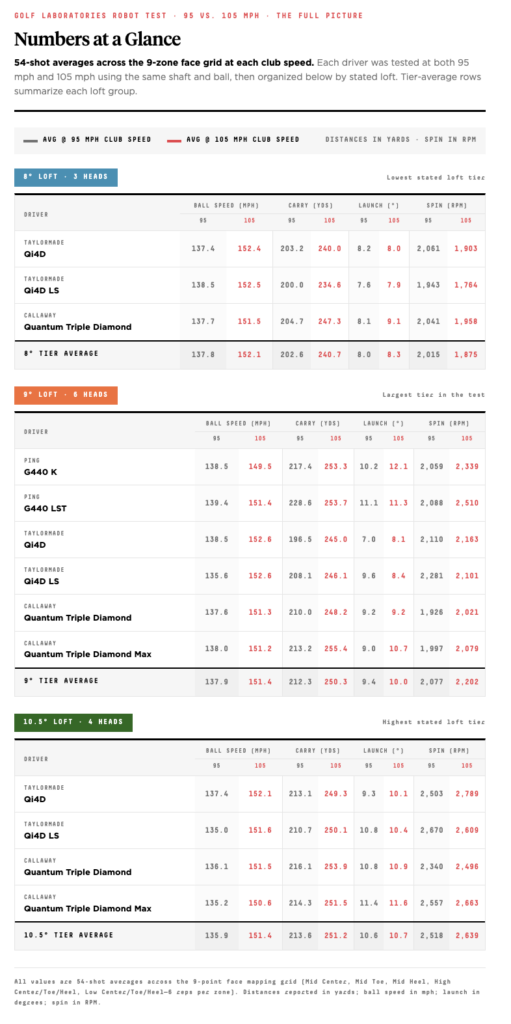
The full picture first. Every driver in the test got faster, longer and higher with an extra 10mph on the clubhead. That’s the part everyone expects. What’s less obvious is how uneven the gains are once you sort the line-up by stated loft.
Carry yards gained at 105 come out almost identical regardless of loft, about 38 yards (35 metres) across the board. But the way the ball gets there depends entirely on which loft tier your driver sits in. The 8-degree heads barely change trajectory. The 10.5-degree heads climb meaningfully higher. And, most interesting of all, the spin number doesn’t move in the same direction across tiers.
That’s where the testing becomes advantageous.
The 8-degree spin trap
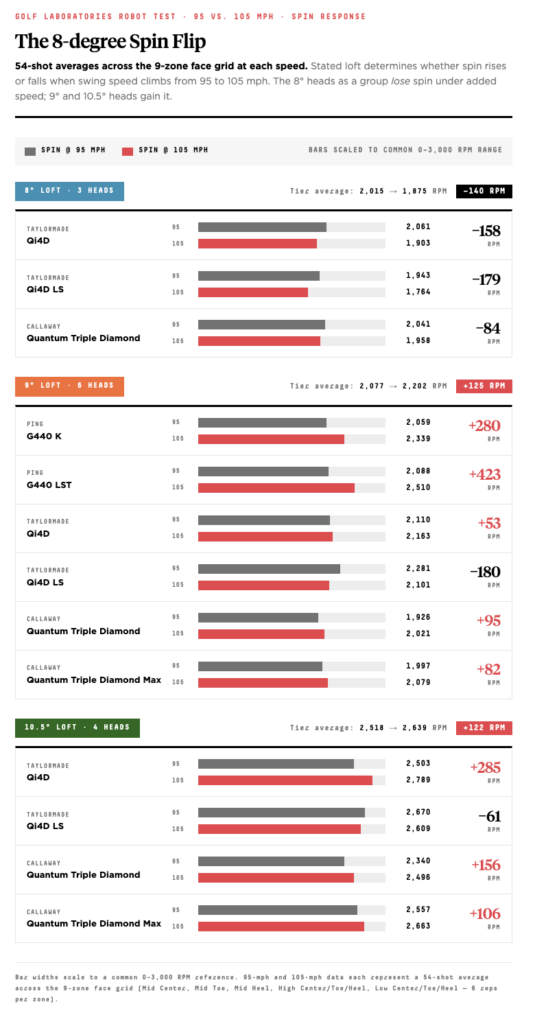
Here’s the one that’s worth flagging if you’re a player swinging faster than 100mph thinking about dropping into a lower loft. Across all three 8-degree heads in this test, spin actually went down when we bumped the speed from 95 to 105. The 9-degree and 10.5-degree heads did the opposite, picking up about 120rpm on the same change.
Why? At 8 degrees, dynamic loft sits low enough that swinging harder tends to de-loft the head a touch further at impact rather than add to it. The trajectory remains flat, and the spin axis loses energy rather than gaining it.
For a player with the speed and positive attack angle to handle an 8-degree driver, that can be exactly what they want. For everyone else, it’s a reminder that an 8-degree head you tested at 95 won’t behave the same way when you actually swing it at 105.
The launch-monitor ‘box’
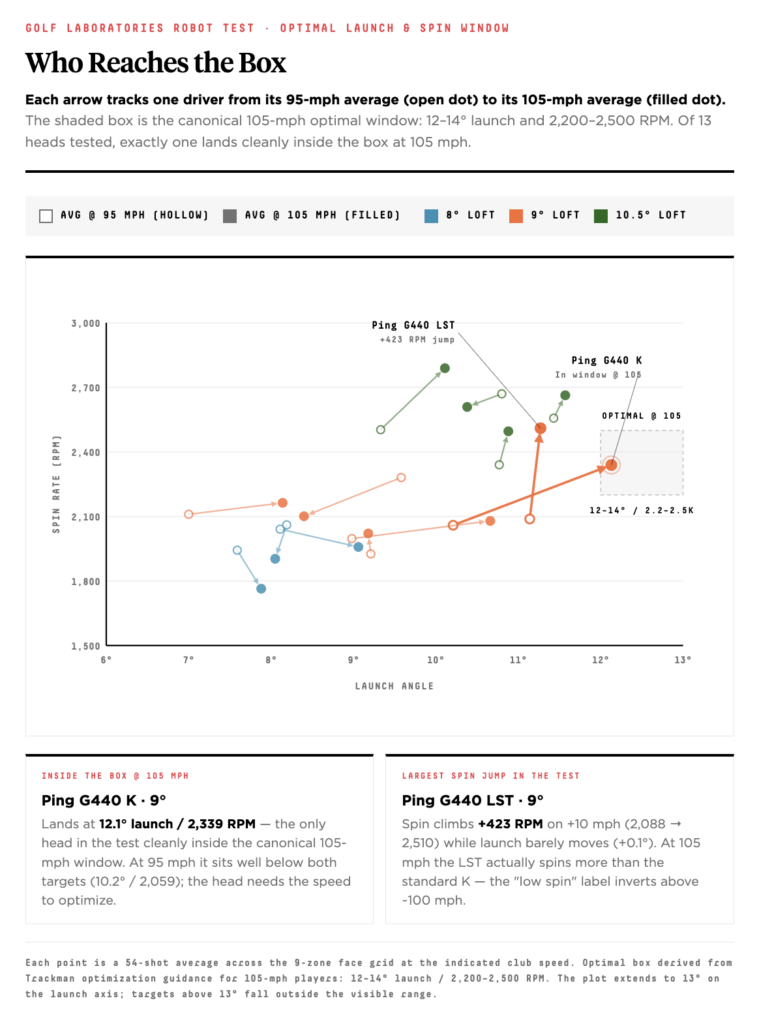
Most fitters work with a target window for 105mph players: roughly 12-14 degrees of launch and 2,200-2,500rpm of spin. Hit those numbers, and you’re using your speed efficiently. In some instances, you’ll see fitters tighten that window further to generate additional distance. In this test of 13 drivers, exactly one head landed cleanly inside those metrics at 105mph: Ping’s G440 K.
What’s interesting is that in contrast, the G440 K sits well below the optimal window on both metrics at 95mph. It’s a head that needs the speed to come into its own. The Ping G440 LST tells the opposite story – a driver marketed as low-spin that gains 423rpm of spin between 95 and 105, the largest jump in the entire test. Faster than 100mph, it actually spins more than the standard G440 K.
The “low spin” label isn’t speed-invariant. That’s something worth keeping in mind in the fitting bay.
Face stability gets worse the harder you swing
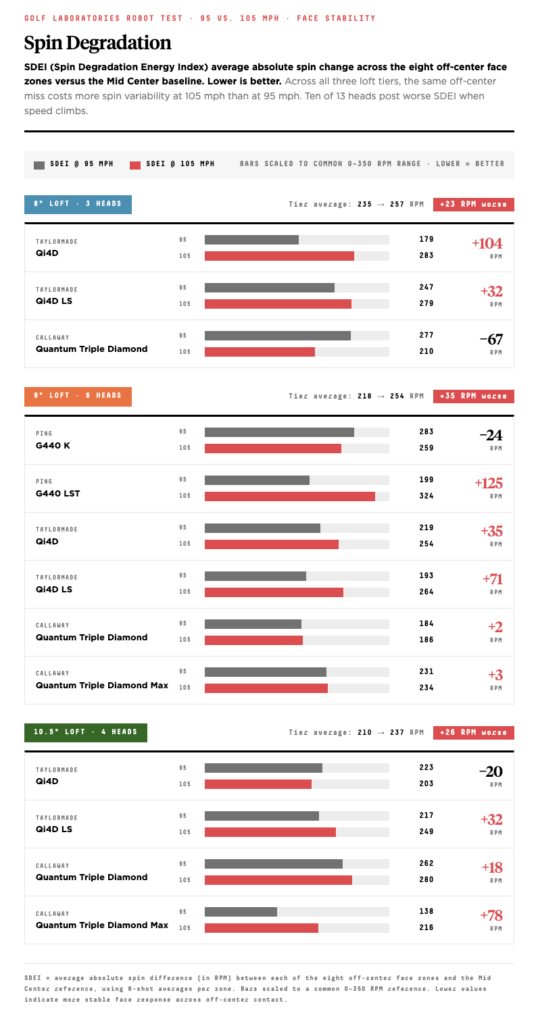
SDEI is our shorthand for how consistently a driver delivers spin across the entire face. Lower is better. Across all three loft tiers, every group got worse when speed climbed by about 25 to 35rpm on average. Ten of 13 heads degraded individually.
That isn’t supposed to happen if forgiveness scales with speed the way you’d assume. The real-world translation is that a forgiveness-marketed head you tested at 95mph isn’t going to feel quite as steady on mis-hits when your speed climbs. That’s a common result as speed increases.
Disperson splits by loft
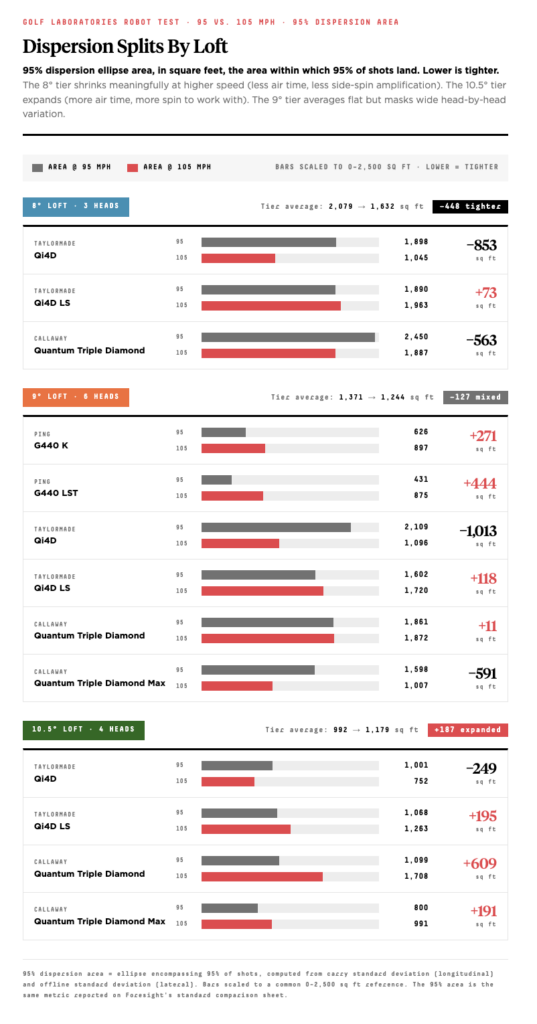
Dispersion at the loft extremes moves in opposite directions when speed climbs. The 8-degree heads tighten meaningfully as speed increases by 10mph: less hangtime, less spin to amplify sidespin penalties.
The 10.5-degree heads expand. The 9-degree tier averages flat but masks wide head-by-head variation, including both Ping models expanding by 270-plus square feet at higher speed.
For most players, the takeaway is simple: matching loft to your actual playing speed matters more for how the ball flies than for how far it goes.