
As has been the case since it started releasing its annual distance reports in 2019, the latest data from Arccos suggests that if there is a distance “problem”, it has almost nothing to do with how far average golfers are hitting the ball.
RELATED: What 3 years of Cobra driver testing reveals about chasing speed
For the eighth straight year, the average driving distance for men has barely moved, according to the GPS stat-tracking system’s analysis of 2025 users’ tee shots. The 2025 data shows the average male golfer’s drive in 2025 was 224.1 yards (204.9 metres), almost a yard less than it was in 2023 and approximately 4 inches longer than it was in 2018, the first year of the company’s annual survey. According to the company, the analysis is based on a random sample of more than 37,000 golfers, each with a minimum of 100 driver tee shots taken during verified rounds. The sample includes almost 10 million on-course driver tee shots hit on par 4s and par 5s.
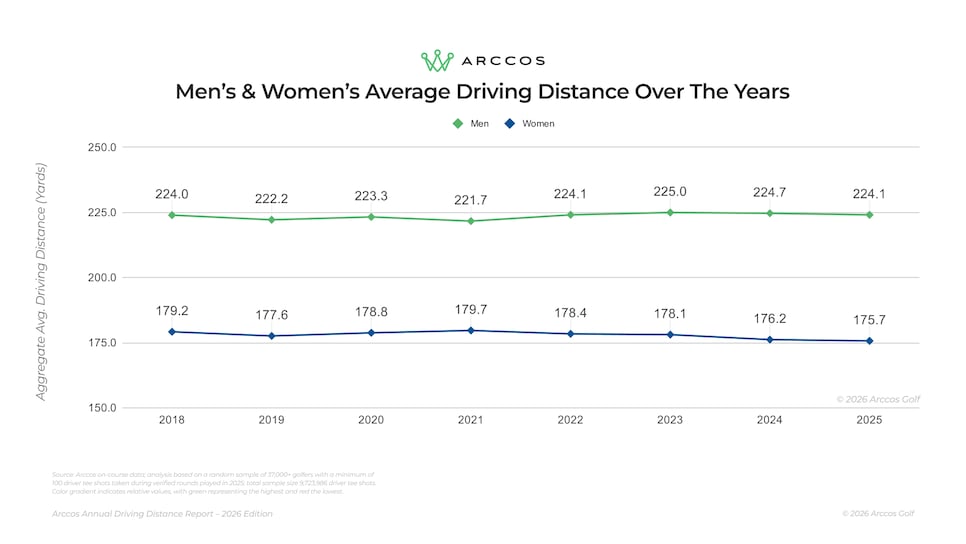
Since 2018, the average man’s tee shot fluctuated between a low of 221.7 yards in 2021 and a high of 225 yards in 2023. The average across the eight years of the Arccos survey is 223.6 yards, and while the 2025 average is about half a yard above the average, it’s exactly equal to the average in 2022.
The average woman’s drive actually regressed across that timeframe. According to Arccos data, women lost 3.5 yards between 2018 and 2025, with the average drive last year ending up at 175.7 yards (160.7 metres).
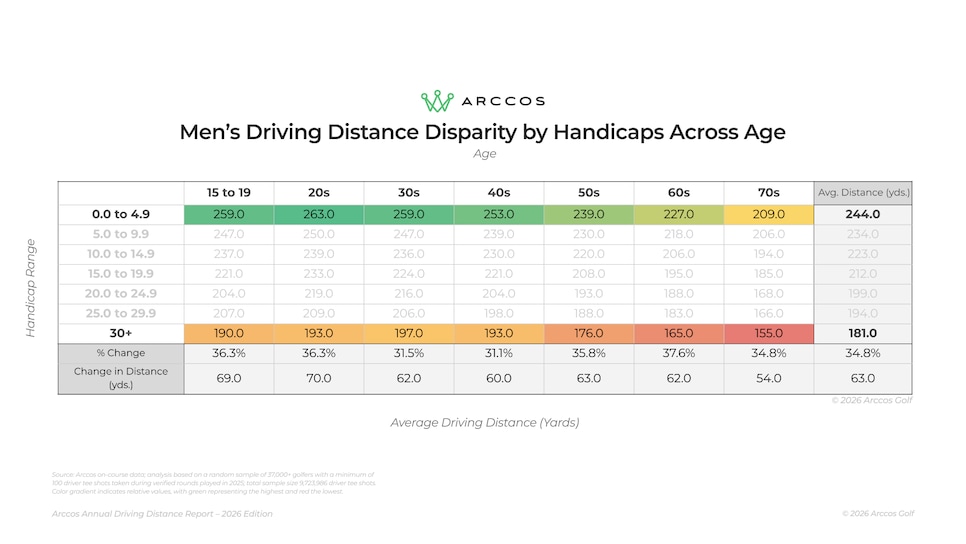
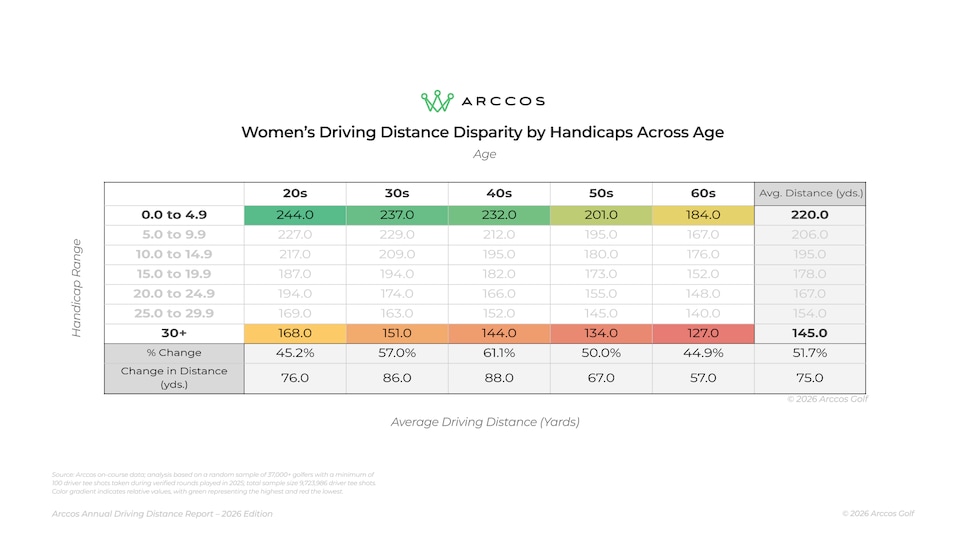
Across all groups of average golfers, sub-divided by age, sex and handicap, there has been no distinct distance spurt since 2018. For example, good players in their 20s (handicaps of 5 or less) are two yards shorter in 2025 than they were in 2018 (263 now vs 265 then). The prototypical average golfer, a 50-something male with a handicap between 10 and 15, gained one yard between 2018 and 2025, with a current average driving distance of 220 yards. The average 40-something female player with a handicap between 20 and 25 also is just one yard longer than she was in 2022.
Here’s a deeper look inside more of Arccos’ driving numbers:
Skill powers distance. Better players (those with handicaps lower than 5) were consistently the longest in the survey group. Across all age groups, those low-handicaps were an average of 35 percent longer (some 63 yards!) than 30-plus handicaps. They also were 10 yards longer than 5-10 handicappers, 21 yards longer than 10-15 handicappers and 45 yards longer than 20-25 handicappers.
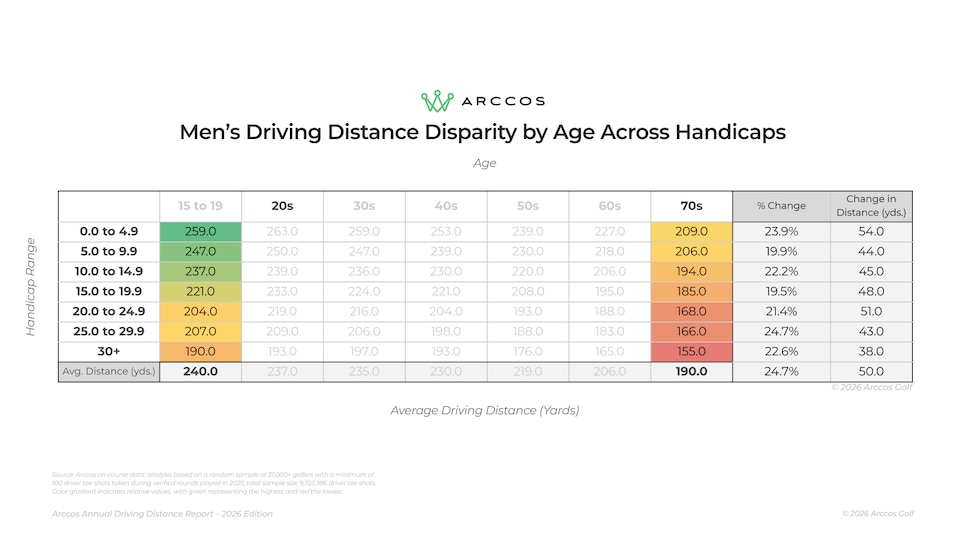
Age will do more than any rollback could ever do. According to Arccos data, there’s an average of 50 yards lost between the youngest and oldest golfers in the survey, with those in their teens averaging 240 yards and those in their 70s averaging 190 yards. What’s telling is that the distance drop-off becomes precipitous as you move into your 50s. Players in their 40s had only lost 10 yards compared to teenaged versions of themselves, but it was 21 yards in their 50s, 34 yards in their 60s and half a football field in their 70s. Women golfers lost 43 yards between the youngest and oldest groups in the survey.
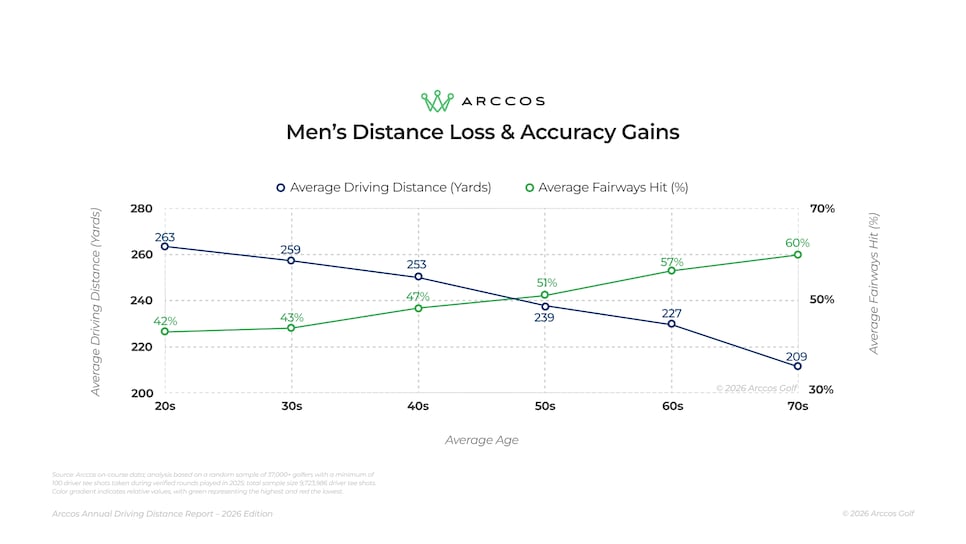
Seniority equates to accuracy. Older players lost distance based on Arccos’ numbers but they were finding more fairways. Players in their 60s and 70s averaged 52 and 56 percent in fairways hit, while players in their teens and 20s hit the short grass less than 40 percent of the time.
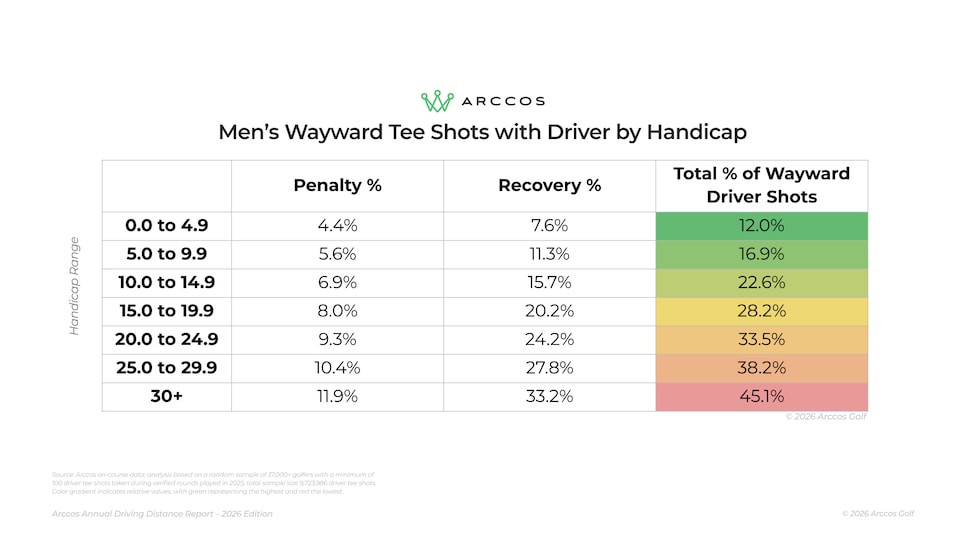
Skill isn’t everything, but it helps enormously. According to the company’s research, the lowest handicappers are only about 10 percentage points more accurate in terms of fairways hit than 30-plus handicappers (50 percent vs 40 percent). But those misses hurt more the worse you are. Arccos data showed that the percentage of wayward tee shots (those that found a hazard/penalty area, out-of-bounds or resulted in a punch-out) was the lowest with players sporting a handicap of 5 or less (just 12 percent) and was the highest among those with handicaps of 30 or higher (45 percent). Even average golfers (10-15 handicap) had nearly double the number of wayward tee shots vs low handicappers. Throw in the fact that low handicappers were 21 yards longer than 10-15 handicappers and 63 yards longer than 30-plus handicappers, and you can easily see that if you want that handicap to come down, straight and long beats short and crooked every time.
According to the company, Arccos systems have captured data on 1.5 billion shots since its inception more than a decade ago. The company launched its first sensor-less stat-tracking system earlier this year.