[Photo: James Gilbert]
There’s a cliché in golf that it’s hard to back up a low score with another low score. But what about seasons? Scottie Scheffler won nine times around the world in 2024 only to follow it up with a six-win season in 2025 that included two majors. His 2026 has been a little indifferent by his own standards, with some visible frustrations at times, but how does Scheffler’s game compare this season, statistically, to the past two years? And how does his current game set up for Shinnecock Hills and the upcoming US Open, in which Scheffler – whose has four top-10s in his past five starts in the USGA’s premier championship – will be a huge storyline as he attempts for the first time to complete the career Grand Slam?
Let’s dig in.
RELATED: Adam Scott reflects on ‘absolutely incredible’ milestone ahead of the US Open
If you look at Scheffler’s strokes-gained stat chart from each of the past four seasons, you can see just how impressive he has been. In 2023, his game had just one weakness. However, he hired Phil Kenyon, switched to a mallet putter and moved from being a poor putter, to an average putter and perhaps, now even better than that. It appears, his biggest strength is his lack of a weakness. His chart in 2025 is about as perfect as you’ll ever see.
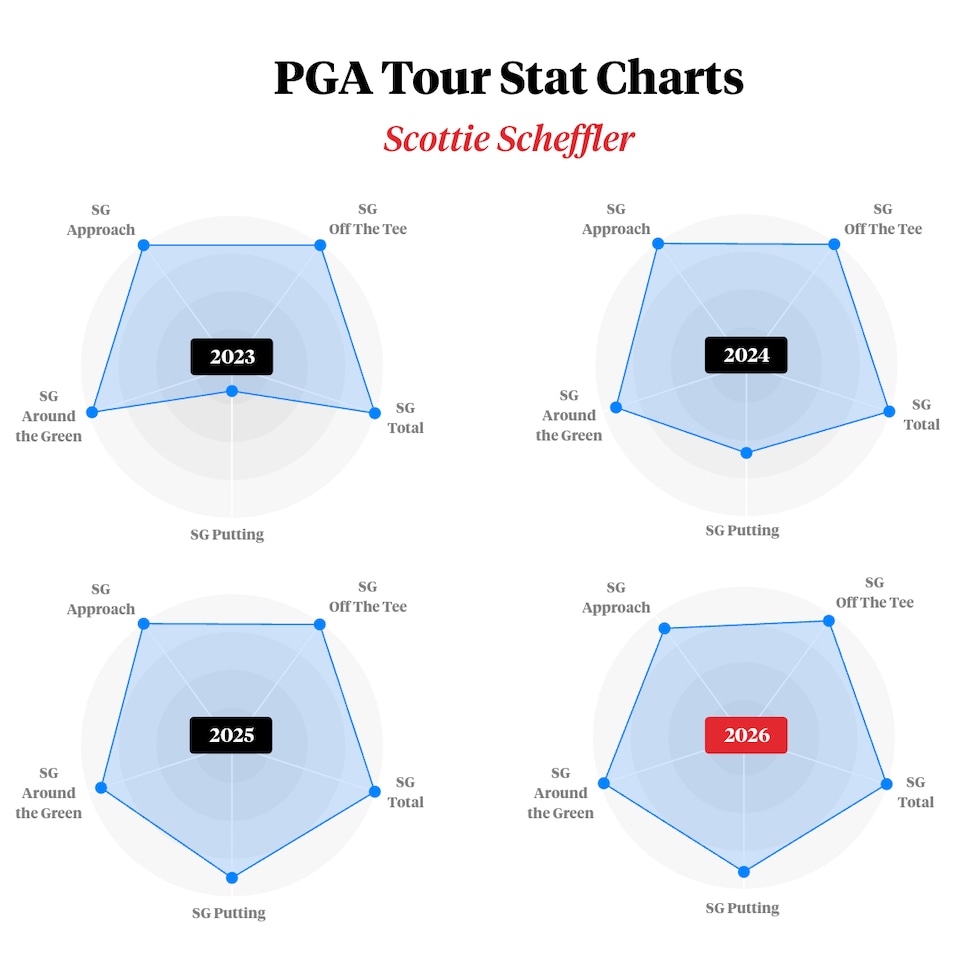
However, we have seen some changes in Scheffler’s game so far in 2026. There’s good news and bad news for the world No.1. Let’s start with the bad.
His approach play
It’s hard to put into words just how elite Scheffler’s iron play has been in recent seasons. But let me try. For three straight seasons, he led the PGA Tour in strokes gained/approach. He’s the first player in the strokes-gained era (2004 to today) to do that. Only Tiger Woods and our own Adam Scott have ever matched the levels that Scheffler’s approach play reached last season, gaining more than 1.2 shots per round on the field.
However, this season, that advantage has diminished. Through May, Scheffler is gaining 0.52 shots per round with his iron play, ranking 15th on the PGA Tour. That’s still elite, but not the levels he’s reached in recent years.
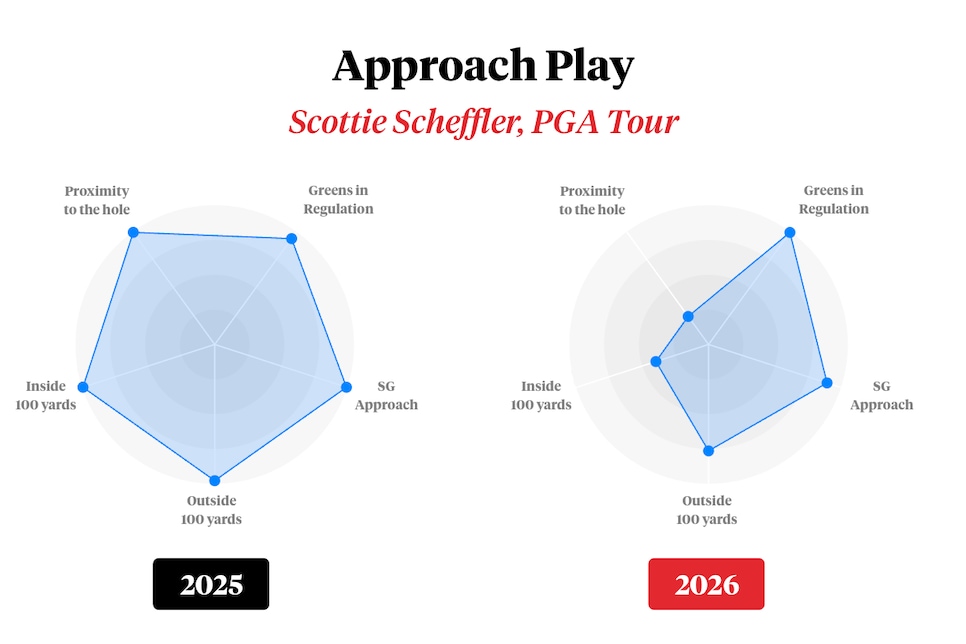
He still leads the tour in greens in regulation, finding the putting surfaces at a rate of more than 73 percent, but that doesn’t tell the full story. Having led the tour in proximity to the hole in 2025, hitting his ball four feet closer than the tour average, he ranks 135th on tour this season [see chart above], nearly two feet further away from the hole than the tour average.
Mind you, that may not be as much of a red flag at Shinnecock Hills as you think. Scheffler is known for playing to conservative targets most of the time with his irons, and at a US Open set up that is typically a wise approach. Yes, his stats are a noticeable drop-off from the lofty levels he’s reached in recent years, however, his iron play is still a strength and I’d expect to see that emphasised at Shinnecock.
Now for the good, or better, news.
RELATED: A closer look at the evolution of Shinnecock Hills’ iconic design
His fast ball
While Scheffler is not one of the PGA Tour’s longest hitters, he has long been one of its best. He ranks third in strokes gained/off-the-tee this season and has been in the top two in that category each of the past four seasons. His combination of length and accuracy is the foundation of his game. However, the data suggests he has developed more of a fast ball this year.
If you look at his driving distance across all drives, his average is narrowly down in 2026, nearly a yard shorter than it was last year. However, his average driving distance on the two measured “driver” holes is noticeably up. His average tee shot is 8.8 yards longer in 2026 (310.3 yards/283.7 metres) than it was in 2024. Switching into a new TaylorMade driver in March appears to have unlocked some additional speed. Scheffler’s clubhead speed is now 2mph faster (up to 120.9mph) than two years ago.
That distance has come at the cost of some accuracy; he is hitting 3 percent fewer fairways this season. However, it appears to be a net gain overall. In 2024, DataGolf had Scheffler as 4.6 yards longer than the average tour player and 6.6 percent more accurate. This season, Scheffler is 9.1 yards longer and 4 percent more accurate.
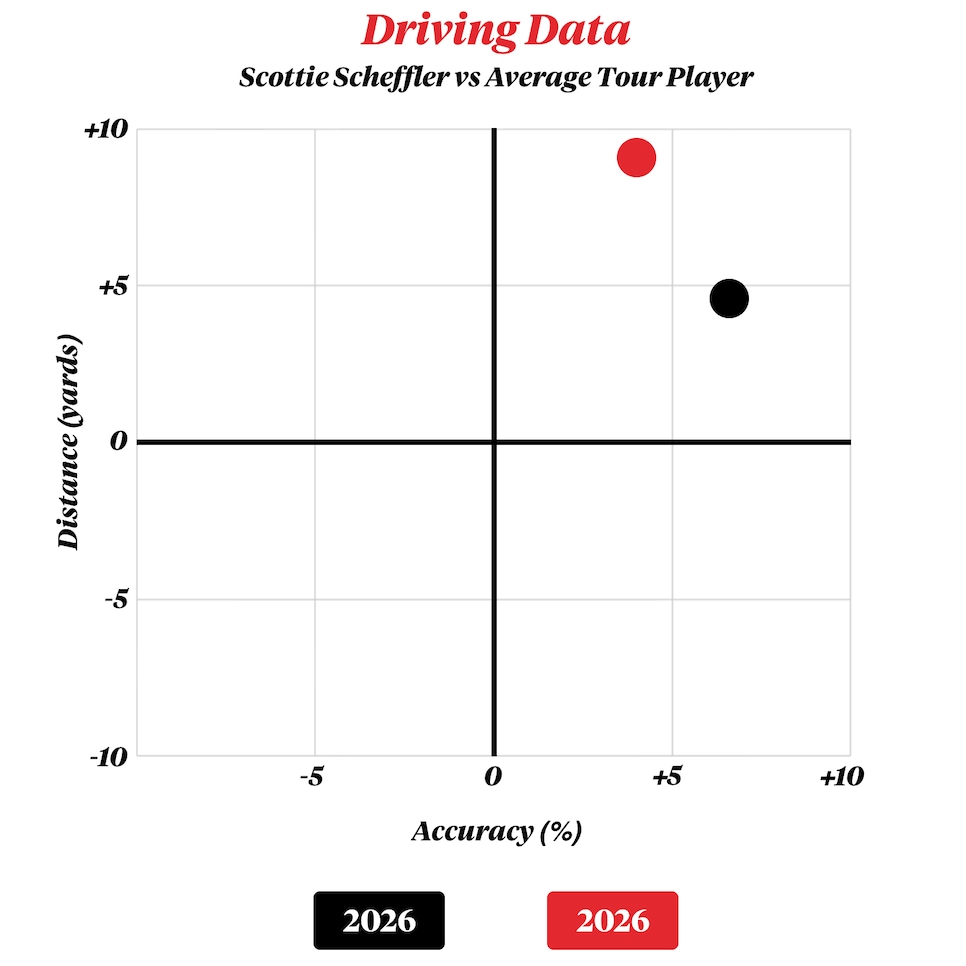
Project that forward to Shinnecock and it fits well. At 7,500 yards and a par of just 70, Shinnecock will be a long, hard test at the US Open. There are six par 4s longer than 470 yards (430 metres). Crucially, though, the fairways are wider than in previous visits to the course. At the 2004 US Open, the average fairway width at Shinnecock was 26.5 yards. This year, that number will be close to double that width. On paper, it suits longer hitters and doesn’t demand accuracy as much as in the past.
His underrated short game
It’s one of the worst kept secrets in golf: Scheffler’s short game is very good. He has ranked inside the top 20 in strokes gained/around-the-green in each of the past two seasons. Impressive for a guy who misses greens on fewer occasions than anyone else in the game. But when he does, he saves par nearly 70 percent of the time. And again, like many parts of Scheffler’s game, it has gotten even better.
In 2026, Scheffler ranks third on the tour in scrambling and fourth in strokes gained/around-the-green. If you look at the data of rounds played from January 1 to May 22, Scheffler has the best short game in golf.

Last season, he gained 0.3 shots per round around the green, which made up less than 12 percent of his overall advantage on his peers. This season, he’s gaining 0.5 shots per round with his short game, accounting for more than 22 percent of his advantage.
And before you ask, yes that, too, will suit the challenge of Shinnecock Hills. The layout is famed for repelling balls off the greens and creating awkward and challenging short-game shots. In 2004, Retief Goosen hit just six of 18 greens in the final round, yet scrambled to a 71 and won by two shots. Corey Pavin and Raymond Floyd were two of the best chippers of their respective eras and both won US Open titles at Shinnecock, in 1995 and 1986, respectively.
“I had heard some rumours about how difficult the greens were,” Scheffler said of visiting the course for the first time on June 1. “I was a little surprised at the width of the fairways, but the green complexes there are extremely difficult, and I think that’s where the greatest challenge comes from.
“The rough, also, was a really good penalty, I think, for the width,” Scheffler continued. “Once you start missing fairways out there, you have no chance. But the fairways are generous enough to where it provides you some opportunity and that way it’s just that the green complexes are extraordinarily difficult, and so they can put the pins wherever they want and make the scores as high as they could possibly want ‘em to be.”
His continued putting improvement
As we alluded to at the outset of this story, it wasn’t so long ago that a common line among golf media and fans was “imagine if Scottie Scheffler could putt!” I even wrote about it in 2024.
The week often referenced was actually at the Memorial Tournament in 2023. Scheffler finished one shot out of a playoff despite losing nearly nine shots on the greens (-8.52). He ranked last in the field in strokes gained/putting of those who made the cut. Yet, he lost by just one shot.
Fast forward two years to the 2025 Open Championship and Scheffler led the field in putting at Royal Portrush en route to his fourth major victory. And that wasn’t a fluke. Scheffler, with help from Kenyon, isn’t just an average putter now, remarkably, he’s an elite one.
He gained 0.38 shots per round on the greens in 2025, enough to rank inside the top 25 putters on the PGA Tour. This season, he’s gaining more than 0.5 shots per round. What was once a weakness is now a strength.
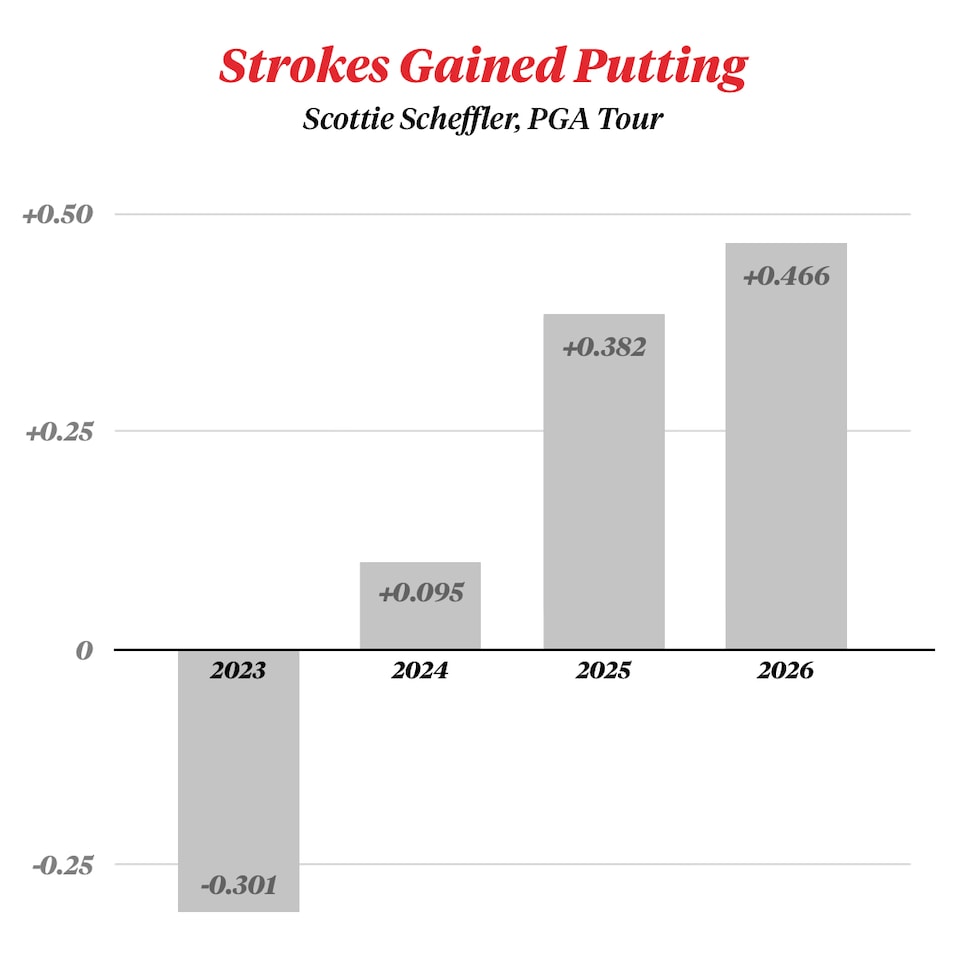
That kind of elite putting is well-suited to all courses but certainly fits well at Shinnecock. Players will face lengthy birdie putts from conservative approach shots as well as testing par putts resulting from balls running off the famously perched and sloping greens.
All in all, Scheffler’s game may look a little different to how it did over his recent dominant stretch on the PGA Tour. And his visible frustrations might lead people to conclude that he’s not the prohibitive favourite he has been in the past coming into a major. However, worryingly for everyone else in the field at the US Open this year is that, in aggregate, Scheffler is still close to that level – and perhaps even better suited to the challenge of Shinnecock than he ever has been.
Bottom line: if you think the career Grand Slam talk is overrated, think again. And don’t forget that Sunday of US Open week is also Scheffler’s 30th birthday. Talk about giving yourself a birthday present.