
A closer look at the evolution of Shinnecock Hills’ iconic design ahead of the 2026 US Open.
Shinnecock Hills Golf Club is one of the founding fathers of American golf. The members were the first in the US to incorporate their club, and they began playing their Southhampton site in 1891 on two nine-hole courses, one designated for men and the other built specifically for female players. As one of the five charter members of the United States Golf Association, Shinnecock hosted both the US Amateur and the US Open in 1896, just the second year each event was played.
The golf course morphed and migrated around the property in the early years, expanding first to 12 holes, then 18, and later into a completely different 18 that overlapped sections of the ladies course. The layout we know today, a fixture inside the top five on Golf Digest’s ranking of America’s 100 Greatest Courses, wasn’t finalised until 1931 under the direction of architect William Flynn. Flynn’s course sprawls across 200 acres beneath the gaze of the iconic Stanford White-designed clubhouse, looping through a tumbling, links-like section of fescue and sage before heading into a steeper, more exciting set of dunes on the second nine.
Though ample fairways provide room to manoeuvre, the best approach angles are reserved for players who can drive the ball long enough to reach the rare level sections of grass. Gusting winds off Peconic Bay and the nearby Atlantic Ocean hit players differently as the holes change direction, and scores are ultimately sorted at the crowned, sloping greens that can cruelly deflect weak and imprecise shots. It often feels like the closer you get to the hole at Shinnecock Hills, the harder the golf becomes. Getting the ball into the bottom of the cup is as challenging as it is at any course in the USA.
The first iterations of golf laid out at Shinnecock Hills in the 1890s – by Scottish professionals Willie Davis (1891) and Willie Dunn (1893 and 1895 – played primarily on the south side of the clubhouse and crossed back and forth over the Long Island Railroad. In 1916 the club hired C.B. Macdonald, who was also a Shinnecock member, and his associate Seth Raynor to modernise the design and move holes off the tracks. Macdonald and Raynor remodelled parts of the old Dunn routing and then added a series of holes that extended north towards the neighbouring National Golf Links of America, installing their favourite concepts like the Biarritz, Eden, Cape and Long. But when the state of New York announced in 1927 its intention to run the new Sunrise Highway through a section of the course, the club began purchasing land to the north and west for a new layout. The club’s architect, Flynn, kept the location of several Macdonald–Raynor holes but expanded the majority of the new design into this more topographically rich terrain.

HOLE 7: Par 3, 169 metres
The par-3 seventh was originally Macdonald and Raynor’s Redan hole. Flynn altered the bunkering but kept the angled, altar-like, front-to-back tilted green. Unlike the original Redan at North Berwick in Scotland or Macdonald’s version next door at National, tee shots can’t easily be chased on and need to be flown all the way to the front edge of the putting surface. The combination of wind, extreme green slope and the fatal bunker short right makes the seventh the most challenging version of the Redan to play. The 3.65 scoring average during the final round of the 2004 US Open confirms it.
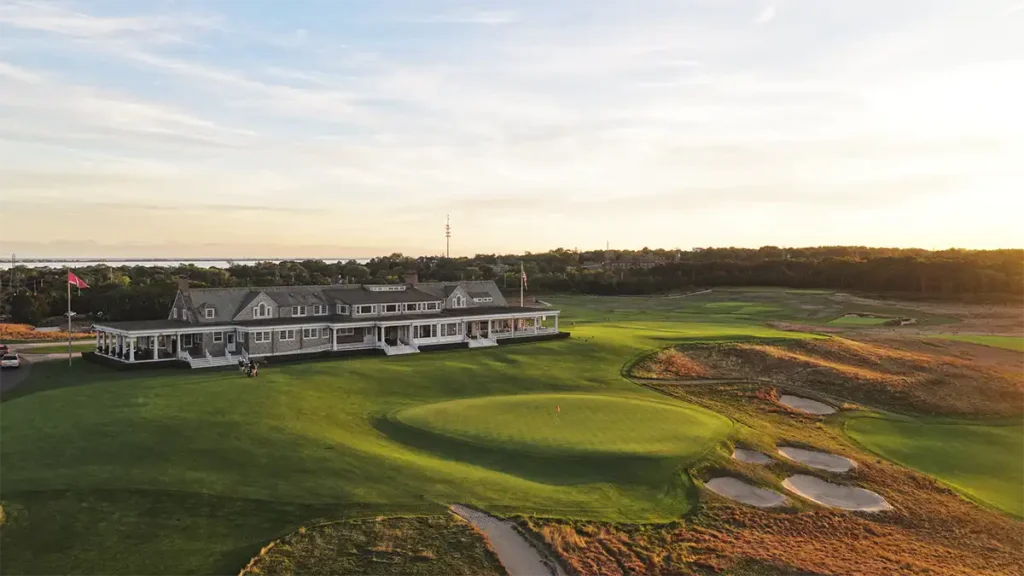
HOLE 9: Par 4, 440 metres
Another Macdonald hole that Flynn worked into his design is the mighty ninth, a par 4 that has few peers in terms of difficulty and uniqueness. The blind fairway is a scroll of glacial waves with a modestly level section on the left reachable only by the longest hitters. Most drives settle into uneven lies, leaving long, blind, curving approach shots to a wickedly tilted green sitting just steps from the clubhouse verandah and some 25 feet above a bank of fescue and bunkers. Coming up short is a common, costly occurrence, but being above the hole is almost as hazardous.

HOLE 11: Par 3, 142 metres
Lee Trevino once described the par-3 11th as “the shortest par 5 in golf”. In windy conditions, 5 is not a deal-breaker. The tee shot is 40 feet uphill to a skyline green banked over three deep bunkers, and a shaved embankment behind it leaves impossibly delicate chips and pitches back up to the tabletop putting surface. In the final round of the 2018 Open, Brooks Koepka was in the rough nearly 30 yards behind the green and looked to be dead. He pitched up and over into a front bunker, splashed out and then sank a 13-footer to preserve his lead. Under the circumstances it’s one of the great bogeys in US Open history.
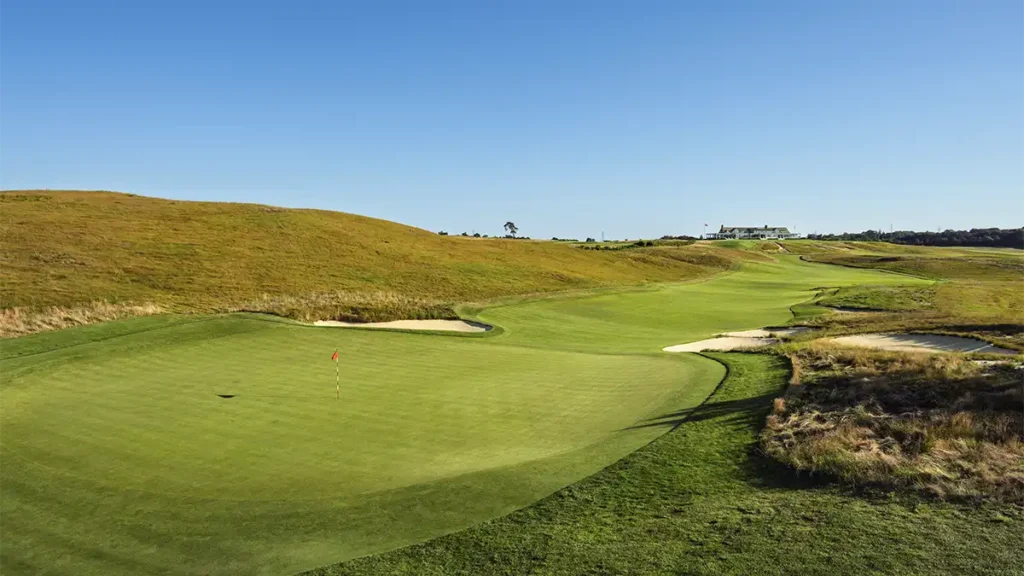
HOLE 14: Par 4, 475 metres
The 14th is the longest par 4 on the course, and it’s a beauty that plays downhill into a valley between high and low dune ridges. Flynn was known for walking properties repeatedly while routing courses, and he would have quickly identified this area’s valley and saddled green site as features that would comprise one of the most natural golf holes he’d ever build. The fairway was once lined with scrub pines before Shinnecock removed nearly all the property’s trees in the early 2000s, and the green is the rare one where flared wings corral rather than reject balls, helpful when bouncing in long approach shots.

HOLE 18: Par 4, 448 metres
The par-4 18th patrols the ground alongside the ninth hole like a twin serpent, slithering beneath it over a series of blind ridges. The drive must challenge a bunker carved into a shoulder on the left or risk shooting off a big fairway contour into the rough on the low side. Though the green is located away from the clubhouse near the foot of the ninth, it’s situated perfectly, hooked into a bowled pocket with a menacing back-to-front slope. Corey Pavin made the hole look easy with his 209-metre 4-wood that he hit to five feet to clinch the 1995 US Open, but it’s really a monstrous finishing hole.
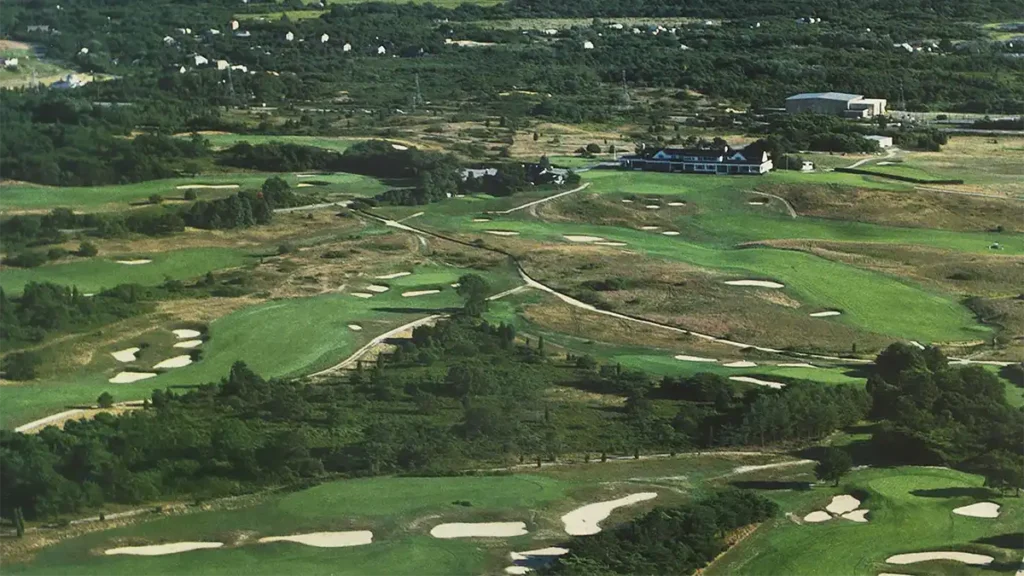
Clear vision
Oakmont Country Club has become the poster course for tree removal. Less discussed is the equally comprehensive deforestation of Shinnecock Hills. As seen in the above photo from the June 1986 issue of Golf Digest when the US Open returned to the Southampton site for the first time since 1896, large sections were covered in pine and other varietals. Since 2000, the club has cleared these groves, and only a few individual stands remain. Like at Oakmont, the result is a much more vivid sense of Shinnecock’s significant ground contour, with the added benefit of allowing the winds to rush unfettered across the layout, adding to the shot demands and allowing the turf to play firm and fast.
Photographs by Fred Vuich/USGA, Carlos Amoedo, Stephen Szurlej