“Caddies are even crazier than golfers. You know why? Because we know golfers are crazy, and we still want to work for them.” —Michael Collins
It has now been 12 years since I sat down with Michael Collins, ESPN golf host and former caddie who looped on the tour for a decade, at a hotel and a city I’ve since forgotten somewhere on the PGA Tour circuit. I wanted to ask general questions about the job, but also get to the bottom of what I found to be the strange (and increasingly infamous) dynamic between Bubba Watson and his caddie back then, Ted Scott, which at times seemed borderline hostile on Bubba’s part and had led to the social-media hashtag #prayfortedscott.
Collins is very funny, and the quote that runs at the top of this piece was just one of the many times he made me laugh out loud during our interview, but I’ve always found that his humor can overshadow a keen insight into the psychological nature of the game. Reading his words again this morning, it was eye-opening to see how well they applied to what we saw on Thursday at the Memorial—Scottie Scheffler’s two-minute monologue, seemingly directed at that same caddie, Ted Scott, on his frustration with … well, nominally missing the wind direction on a tee shot, but on a deeper level, maybe a little bit of everything.
See if this quote, from Collins in 2014, feels relevant:
“The aspect of caddieing that’s the most rewarding and yet the most maddening is the psychological side. What’s the hardest thing for a human to do? Look in the mirror and say, ‘It’s my fault.’ Imagine having to do that 18 holes a day. It’s why these guys all have sports psychologists, and it’s part of the gig for a caddie, too. You gotta listen to these dudes bitch, and then you gotta not let them get too low, you gotta not let them get too high.”
Collins should know. In his 10 years on the job, he caddied for players like Omar Uresti and Daniel Chopra and Rich Beem and Scott Piercey and Kevin Streelman. He had his moments of success, but he also struggled. He was fired over and over, like most caddies, and according to him, only one of his players had the courtesy of firing him face to face. He knows he was one of the lucky ones—his background in comedy and his comfort in front of a camera made for a natural transition to TV and radio, and he’s been on the beat ever since. But he went through the trenches, and the most interesting part of our conversation came when I asked him about Bubba’s outbursts.
Bubba, he told me, really wasn’t that bad. Seeing my puzzled face—to me, he seemed like the worst—he explained.
“This is the thing people don’t understand,” he said. “That outburst that Bubba had, he’s not really yelling at Teddy. He’s yelling at himself. As a caddie, the last thing you want is your dude to be jacked up and pissed at a bad hole, because if he can’t let it go, guess what’s happening on the next hole? He has to let it go, and if that means he’s gotta take it out on me, so be it, take it out on me. As long as we birdie the next hole, it’s all good. And people go, ‘How’s he treat his caddie like that?’ And then we go birdie-birdie-eagle and guess what? I’m laughing all the way to the bank. And so is Bubba.”
When we analyze what happened with Scheffler and Ted Scott at the Memorial, nobody’s words ring out more clearly than Collins.
As he knew too well during his playing days, the entire job of being a professional golfer is stressful for everyone, and there will always be moments where a player has to let off steam. In the worst moments, the human tendency to look for blame is irresistible, even when the blame belongs entirely to you. (Here’s how I relate: My unerring instinct, each time I lose a personal item, to suspect someone in my house of moving it, when it’s always my fault … and how that instinct is accentuated when I’m under time stress.) What we saw from Scheffler was a pressure release, and while we don’t know every element that went into it, it was clearly about more than a single shot or a single wind direction.
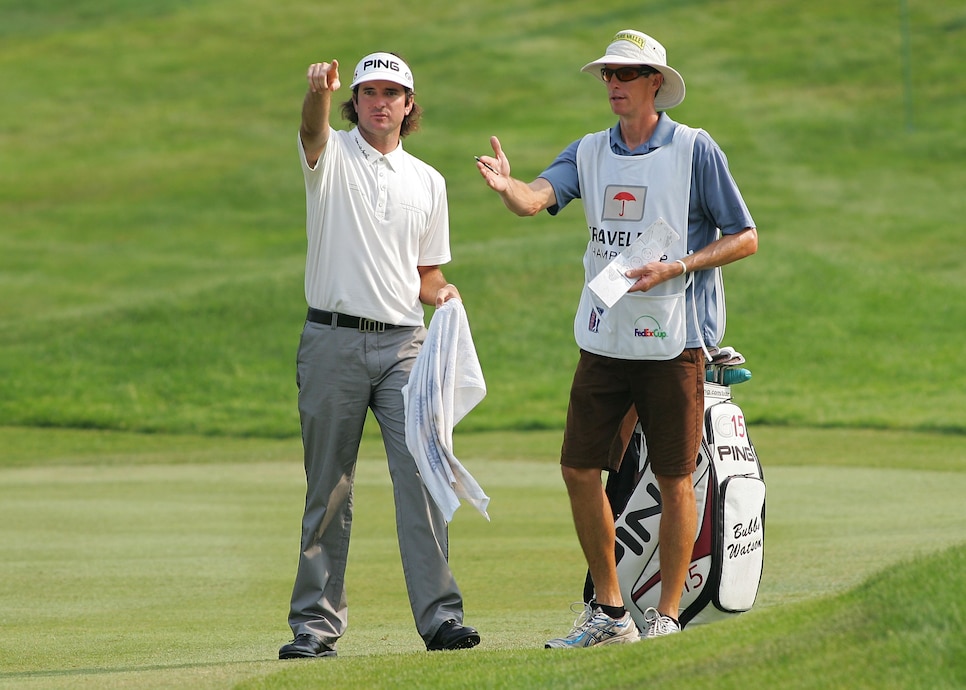
Ted Scott was frequently on the receiving end of rants when he worked as a caddie for Bubba Watson.
Michael Cohen
In the title of this post, I call that rant “forgivable,” but I’d go even further—the way Scheffler addressed the problem, petulant though it sounded, mattered because of where the words were directed. He didn’t yell at Ted Scott. He didn’t insult him. He spoke as if he were a distraught Shakespearean character out in the wilderness, railing at the gods for his cruel fate. Now, obviously he was angry specifically at Ted Scott, or at least chose to direct his own frustrations obliquely at Scott in that moment, but from where I sat, there was a kind of nobility in how he inserted a layer between his complaints and their intended target. Even if we knew what he meant, he kept it as dignified as possible and stopped it from being a humiliating encounter for Scott. All this in the middle of a white-hot rage; isn’t there some admirable restraint there?
The counter-argument goes that he should have known cameras were rolling, and that even if they made things right later, all the world would see is a guy moaning about his caddie and the caddie just standing there, taking it in silence. There’s a power dynamic at play there, and you could read it as ugly.
That might be a fair point, if we weren’t witnessing an extreme personality—the world’s greatest golfer—caring very deeply about his craft at a critical moment. When Scottie gets whiny, it’s never his best look, but it is a real insight into how he thinks, and how he behaves, when he can’t meet the absurdly high standards he sets for himself. What I’m saying is that if this is the price for greatness, and for caring, it’s pretty low on the historical scale. If I had to make a guess, I’d say that Ted Scott has a pretty high tolerance for this kind of thing, and sees it as part of the bargain.
Maybe one day—maybe soon—we’ll know what happened in the aftermath, and that will say so much more about Scheffler’s character than the original outburst. Reading through that old interview with Collins, I came across an anecdote from his time with Streelman. I’ll warn you, if I were reading this piece right now, I’d suspect the details were too perfect. Here’s how I wrote it up at the time, on the heels of the latest Bubba/Scott incident:
Collins understood my counter-argument, which was that people perceive the golfer and his caddie as something like a master-servant situation, and it seems particularly cruel and tone-deaf when someone like Bubba abuses the person beneath him, regardless of his real intention or the real dynamic. While that may be true, Collins said, each caddie has to understand the true meaning, despite how it may look, and sacrifice a bit of pride. He told me a story about caddieing for Streelman at the Travelers Championship, when he read the wind correctly but Streelman hit a thin shot and pulled it a little, sending it into the water.
“Mike, that was completely the wrong wind,” Streelman yelled. “Dammit, it was off the right.”
Collins said nothing, and a few holes later, Streelman apologized. When the words “I’m sorry” came out, Collins put the bag down.
“Don’t ever apologize to me on the golf course,” he said. “Ever.”
This article was originally published on golfdigest.com