Modern drivers are built to deliver explosive power off the tee, but raw distance only tells part of the story. If you’re serious about finding the right driver for your game, one metric deserves more attention than it usually gets: consistent spin rates across the face.
MORE: The equipment steps you can take to get back age-related distance loss
Recent work with the Golf Laboratories swing robot led us to create a new metric called “spin consistency.” Capturing data from nine locations on the face – three impact locations along the high, centre, and low sections – offers a comprehensive picture of how spin, launch, carry, and dispersion change on a mishit. The more you can get a mishit to perform like a centre strike, the better.
For this exercise, we analysed the spin rates across all nine impact points on the face – 95 mph, 10.5-degree heads – to determine if tight spin rates translate to a consistent driver. A tight standard deviation confirms spin (as well as launch) will remain relatively consistent, regardless of where you’re missing it on the face.
Why does spin matter? In simple terms, spin influences how high and how far your ball flies, how it curves in the air, and how it reacts when it hits the ground. Too much spin, and you’ll balloon shots that stall out mid-flight. Too little, and you might struggle to keep the ball in the air long enough to maximise carry. But the real issue isn’t just total spin – it’s how much that spin changes depending on where you strike the ball on the face.
Off-centre hits are inevitable – even for the best players in the world. That’s why consistent spin across the face is a hallmark of a truly forgiving and reliable driver. When a driver maintains similar spin numbers whether you hit it high on the toe or low on the heel, you’re more likely to see shots that stay in play, hold their trajectory and travel a predictable distance. That’s crucial not just for your confidence, but for lowering your scores.
Here are the five drivers with the tightest spin rate standard deviations across all nine points:
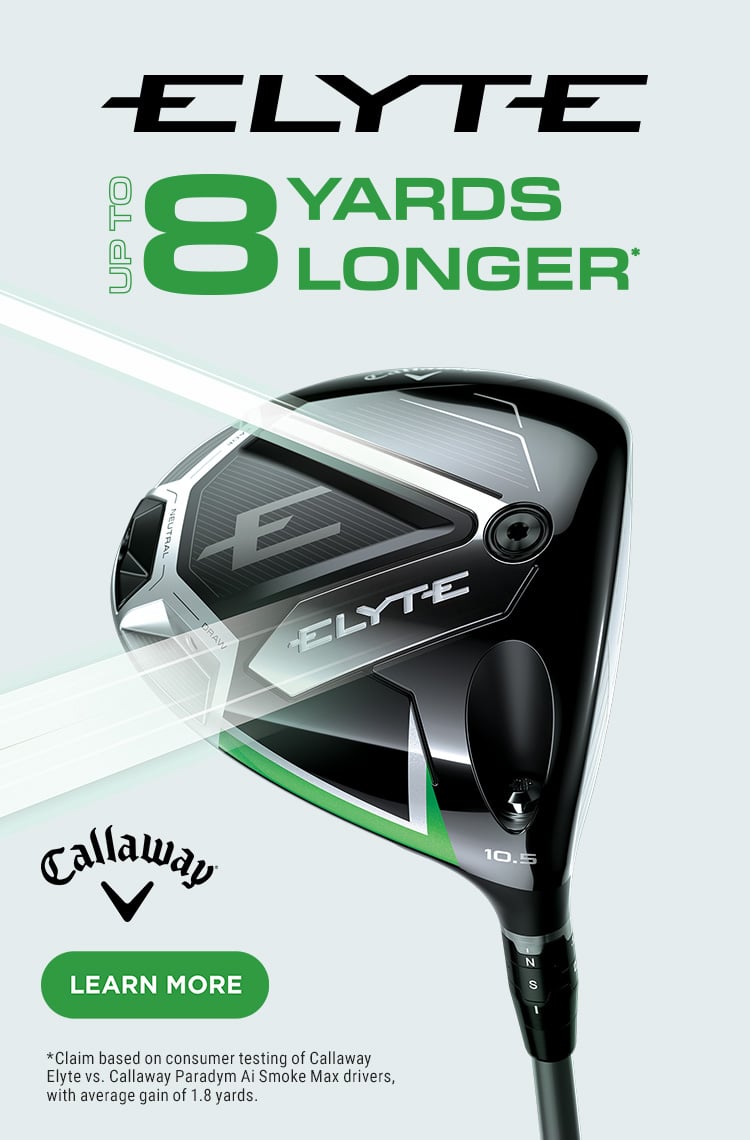
1. Callaway Elyte Triple Diamond (Standard deviation: 151 RPM; Max: 2,955 RPM, Min: 2,274 RPM, Average: 2,542 RPM)

The head shape is based on tour input and caters to higher swing speeds looking to reduce spin. Designed for better performance on off-centre hits compared to past TD models without enlarging the clubhead. The AI-designed face uses an asymmetrical thickness pattern to produce consistent ball speeds and carry distances across a broader range of impact locations.The sole features two switchable weight screws in the front and back. Placing the heavier weight forward lowers spin and flight; keeping the heavier weight back bolsters stability on mis-hits and increases launch. A thermo-forged carbon crown saves weight that is repositioned low for reduced spin. Developed through new 3-D-printing capabilities, the enhanced head shape has smoother curves for less drag while maintaining lower spin and stability on off-centre strikes.
Insights: Every mishit location on the face produced a playable spin rate, including the lowest number (2274). All three toe locations produced an average carry distance loss of 8 yards, one of the lowest recorded numbers during robotic driver testing. Triple Diamond all but confirms golfers with average swing speeds don’t need to shy away from low-spin products.
2. Ping G440 SFT (Standard deviation: 190 RPM; Max: 3,745 RPM, Min: 2,924 RPM, Average: 3,262 RPM)

The slice-fighting “neutral” face angle is 1.5 degrees closed compared to the G440 Max in a “draw” setting. The new 9-degree model provides slice correction for players with faster swing speeds, too. A redesigned interior portion of the hosel creates room for that area of the face to flex better while lowering the centre of gravity. A carbon-composite piece wraps into the back half of the crown to save weight that is then converted into a 23-gram adjustable weight in the rear perimeter that fits into two draw settings. The titanium-alloy face is thinner and more flexible to optimise ball speed across a broader area. The SFT is 3 percent lighter than the LST to make it easier for moderate-swing-speed players to control.The shaft’s stock length is stretched to 46 inches to create more potential swing speed.
Insights: The draw-biased model in Ping’s lineup is geared for those who fight a slice. While it boasts one of the highest average spin rates, its spin and launch characteristics are designed to keep the ball on the planet. For golfers who tend to miss low on the face, this one is worth consideration. All three low mishit locations saw distance drop by an average of 6 yards. The number was 6-7 yards better than several drivers we tested.
Callaway Elyte X (Standard deviation: 189 RPM; Max: 3,089 RPM, Min: 2,314 RPM, Average: 2,701 RPM)

The largest clubhead in the family improves mis-hits for golfers who tend to cut across the ball with an open face. The head has a draw bias and two weight ports on the perimeter to let golfers dial in even more draw. It has the highest measured moment of inertia (stability on off-centre hits) of any Elyte model. Optional heavier screw weight enables the head to reach a total MOI of 10,000 – among the highest in the industry. The new variable-thickness face uses AI analysis of thousands of swings to better match the performance needs of this type of player. The enhanced head shape incorporates smoother curves for less drag without sacrificing forgiveness or excessively increasing spin. The forgiving frame and new variable-thickness face improve downrange consistency. A thermo-forged carbon crown saves weight that is repositioned low for reduced spin.
Insights: Solid mid-spin performance across the board from Callaway’s draw-biased driver. It posted an average carry distance loss of just 7.4 yards on toe strikes – second only to the DS-Adapt Max K. With one of the highest minimum spin rates (2,314 RPM), it offers excellent protection against snap-hooks that can derail a round.
4. Cobra DS-Adapt Max K (Standard deviation: 222 RPM; Max: 2,915 RPM, Min: 2,024 RPM, Average: 2,455 RPM)

Minimizes mis-hits with the largest frame in the family and deep internal weighting in the rear perimeter. Its measured stability on off-centre hits (moment of inertia) is near the USGA limit and is the highest of any Cobra has brought to market. A 10-gram weight on the rear perimeter pushes mass lower thanks to a machined aluminium housing. Thin layers of carbon composite replace much of the crown and sole to save weight that is pushed to the back of the head for extra stability. The adjustable hosel has 33 settings for tweaking ball flight low, high, left and right. The face is designed with variable thicknesses across 15 distinct regions for more consistent speed across the face.
Insights: Should come as no surprise that DS-Adapt Max K also boasts one of the tightest carry distance loss numbers (6.6 yards). High toe misses gained 1.2 yards compared to a geometric strike. In total, toe misses across all three strike locations lost just 1.5 yards — the best average by nearly 6 yards. Spin rate average (2455) is eerily similar to the DS-Adapt LS (2417).
MORE: How to know if a clubfitter is right for you in just 3 minutes
5. Srixon ZXi Max (Standard deviation: 224 RPM; Max: 3,285 RPM, Min: 2,360 RPM, Average: 2,837 RPM)

This new shape for the Srixon line offers moderate-swing-speed players the most forgiving driver in company history. The ZXi Max produces a higher launch with slight draw. A 14-gram weight in the deep-centre perimeter enhances stability on off-centre hits. The face’s variable-thickness pattern uses a thinner (not thicker) middle section surrounded by thicker heel and toe sections to maximise ball speed across a wider area. This unique pattern required the development of a new titanium alloy that is stronger, lighter and more flexible. The crown and sole’s alternating rigid and flexible regions provide a power boost. The lightweight and thin titanium crown uses a lattice pattern of thicker, supporting bands that allow much of the crown to be thinner than a credit card. The face’s laser milling pattern stabilises spin and adds an element of forgiveness in wet conditions.
Insights: Like Ping’s SFT, Srixon’s latest Max delivers higher (albeit tighter) spin rates for golfers who want to increase carry and hangtime. Toe misses averaged just 8 yards of carry distance loss. Average spin rate (2837) was within roughly 100 RPMs higher than ZXi LS (2720) and ZXi (2946)