

[Photo: Scott Taetsch]
Aronimink’s architectural history has always been a curious case.
The club hired Donald Ross to build its golf course when it relocated to its new Newtown Square property, west of Philadelphia, in 1926. Ross was at the height of his career. He was the profession’s busiest, most experienced architect with active projects across the US. Because he was so prolific, he leaned on associates in different regions – Walter Hatch, Walter Johnson, Frank Maples and others – to oversee the construction of his designs while he was not there.
RELATED: Restored reverie at Aronimink
Ross’ plans for Aronimink were explicit – his routing worked in an out of corners and used the site’s long slopes to build strategy in tandem with less than 80 hand-built bunkers cut into the terrain. He also left field notes – hole-by-hole instructions – for crews to reference when they were shaping.
The course opened in 1929, but during construction the bunkering changed dramatically. Ross’s regular-sized bunkers were built as clusters of two or three smaller bunkers with lower faces, raising the total number to more than 200. Ron Prichard, who was the consulting architect at Aronimink from 1994 through the late 2000s, believes that Ross’s associate and foreman, J.B. McGovern, who was also a member at the club, made the bunkering alterations without Ross’ input.
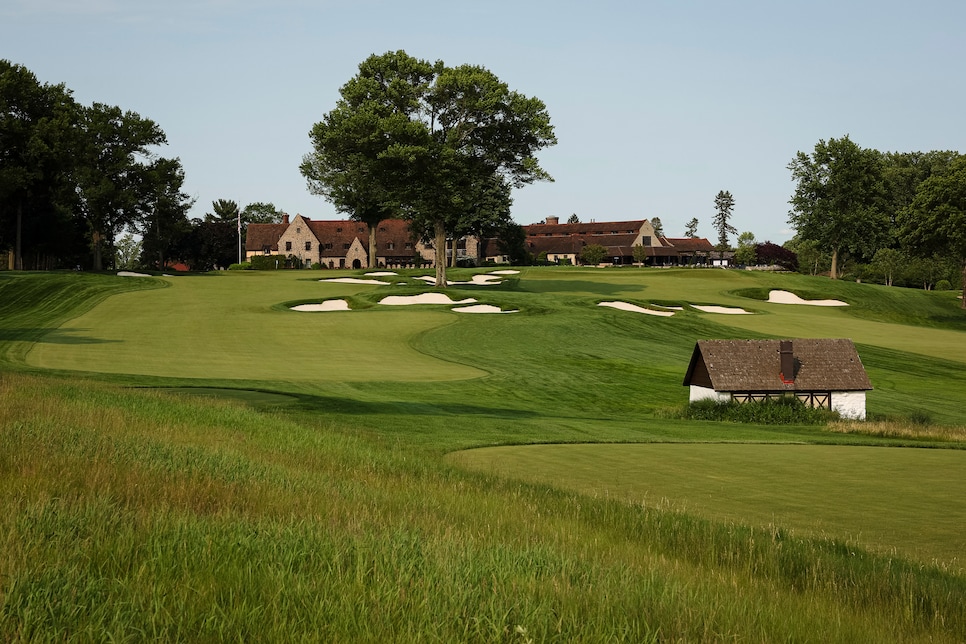
Cluster bunkers were reconstructed by Gil Hanse’s team to mirror aerial photos from the early days of Aronimink. [Photo: Scott Taetsch]
Over time and several subsequent remodels of the course, the smaller clusters were eliminated or recombined into larger, more regular shapes. Prichard’s work consisted of taking this heavily altered design and reproducing the course according to the blueprints Ross drew and intended, even though that course was never originally built.
Then in 2015, Aronimink hired Gil Hanse and Jim Wagner to conduct another remodel. They went a different direction. Rather than follow Ross’ plans, Hanse and Wagner chose to reconstruct the course that was actually built on the site using photos from 1929. In the process they increased the total number of bunkers to, once again, more than 200.
RELATED: The tree controversy is a very PGA thing, and also entirely misses the point
This is the version of the course that will be played during the 2026 PGA Championship this week. Aronimink’s history poses a philosophical question for architects and old clubs: should designers honour and resurrect the course that the original architects drew, or are they better off restoring the features that were actually built?
For Prichard, the answer, at least in the case of Aronimink, is the former. If he had inherited the McGovern bunkering scheme when he begin working with the club, would he have scrapped it and built the Ross version on the blueprints?
“I probably would have,” he says with a laugh. “I probably wouldn’t have been brazen enough to do that.”
To see what Aronimink will look and play like for the 2026 PGA Championship, watch our “Every Hole at Aronimink” drone flyover video:
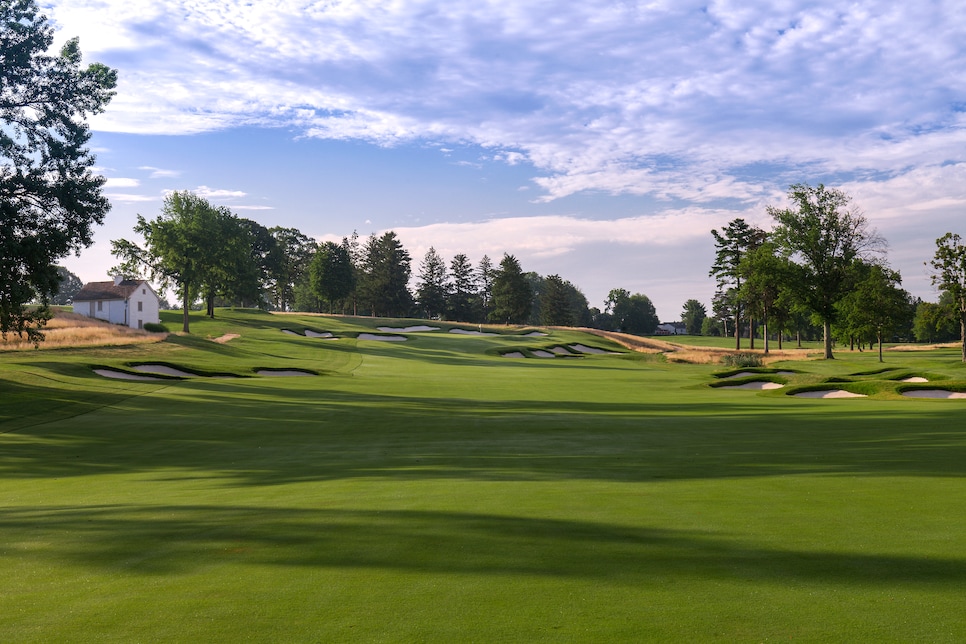
Donald Ross’ creative bunkering seen at Aronimink’s 11th hole. [Photo: Russell Kirk]
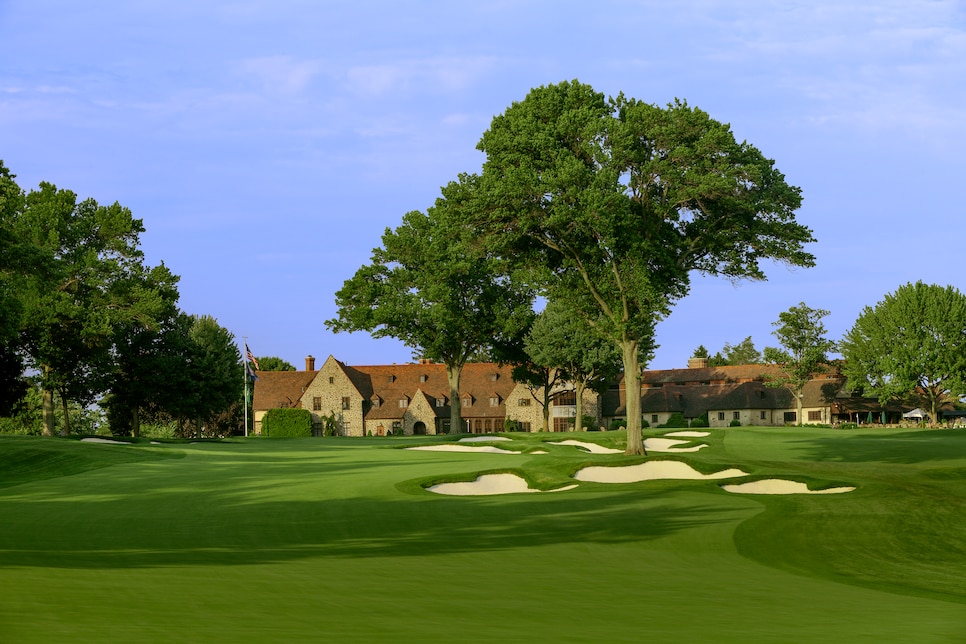
Aronimink’s home hole. [Photo: Russell Kirk]
More on Aronimink Golf Club
Aronimink is an object lesson in architectural evolution. After Donald Ross completed his design in 1928, he proclaimed, “I intended to make this my masterpiece.” That didn’t keep club members from bringing in William Gordon in the 1950s to eliminate out-of-play fairway bunkers and move other bunkers closer to greens. The course was later revamped by Dick Wilson, George Fazio and Robert Trent Jones. In the 1990s and into the 2000s, Ron Prichard, one of the profession’s original restoration specialists, began returning Aronimink back to Ross’ conception based on the architect’s drawings and field diagrams. But there was always a discrepancy between what Ross drew in plans and what was actually built in 1928. A more recent renovation by Gil Hanse and Jim Wagner, who live nearby, has put the course’s architecture more in line with what aerial photographs depict of the early design, particularly the bunkering that might have been imagined as larger in scale but built in smaller, more scatter-shot formations.
FULL GOLF DIGEST PGA CHAMPIONSHIP COVERAGE HERE