
Hanse and Wagner’s work at Aronimink Golf Club goes on display for the 2026 PGA Championship.
Donald Ross designed close to 400 golf courses, but he said this about only one of them: “I intended to make this course my masterpiece, but not until today did I realise I built better than I knew.”
He came to this epiphany in 1948 when he visited Aronimink Golf Club in the suburbs of western Philadelphia, a course he’d completed 20 years earlier. Architects often exaggerate the merits of their creations, but his assessment of Aronimink seems genuine considering the time he’d had to reflect on the property’s character, the elaborate bunkering and intricate green shapes. The club isn’t sure if he’d been back to see the course since construction, so the impression was evidently powerful.
The club moved to several locations before it found its permanent home in Newtown Square in 1926 on a rugged piece of former farmland that gave Ross room to build one of his most serious designs, measuring 6,619 yards (6,052 metres), among his longest to that point. The muscular holes charge across depressions, bank off slopes and ride over upland plateaus. Nests of bunkers ensnare drives at every turn, and the canted greens are full of wonderful little shoulders and slopes that slide balls around the perimeter edges.
Like most courses of its vintage, heavy-handed tree planting resulted in fairways and greens that were shadowed in woods. More than 20 years of careful tree removal, however, have allowed the architectural details to shine, and a 2017 remodel by Gil Hanse and Jim Wagner further returned the course to its opening-day foundation. Today, at par 70 and more than 7,300 yards (6,675 metres), it joins Merion and Oakmont in Pennsylvania’s storied triumvirate of championship layouts, hosting the 1977 US Amateur, a women’s and senior PGA Championship, and the 1962 and 2026 PGA Championships.
HOLE 1
PAR 4, 397 METRES
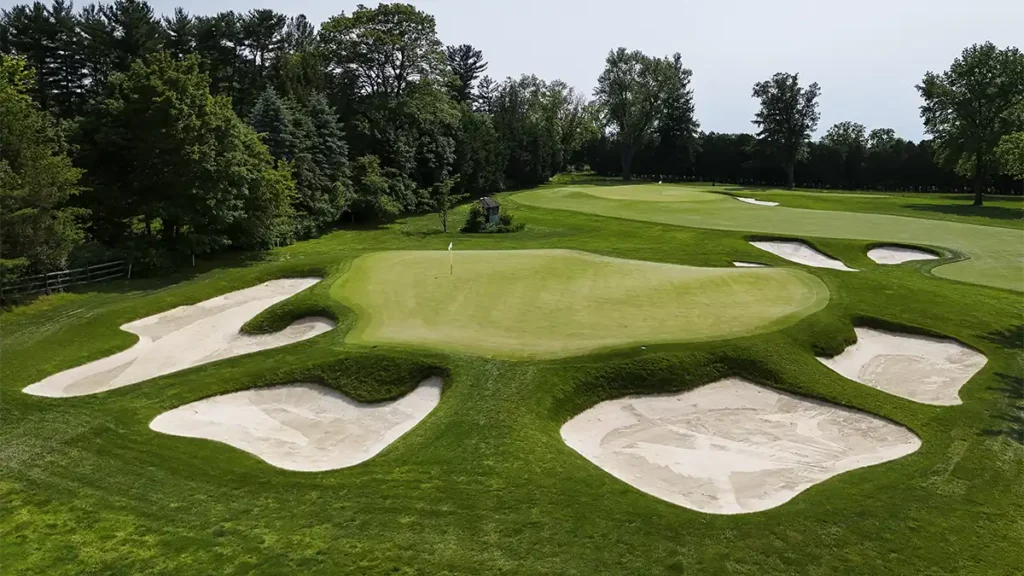
Donald Ross suggested that beginning holes should give the golfer a chance to warm up, to get the “swing of his stroke” under control. The drive at the par-4 first appears to fit the prescription with an ample, upward-rising fairway that catches but also deadens drives. The script flips on the approach that is steeply uphill to a semi-blind green with deep bunkers left and right.
The putting surface is the only one at Aronimink with defined upper and lower tiers, a formulation Ross used more liberally elsewhere, adding to the challenge of getting the ball on the correct level.
HOLE 5
PAR 3, 156 METRES
The short, island-like par 3 surrounded in bunkers was a Ross specialty that he used at Seminole, Oak Hill, Oakland Hills, Scioto and dozens of other clubs. Aronimink’s fifth is one of his more attractive versions, playing slightly downhill to an ample, tabletop green with wavy contours around the back edge. Though it can stretch to 170-plus yards, Hanse thinks it’s most intriguing when played extremely forward – so it’s just a touch shot for good players, especially coupled with a hole location in the front bowl that can yield birdies in bunches and even an ace or two.
BUNKERS
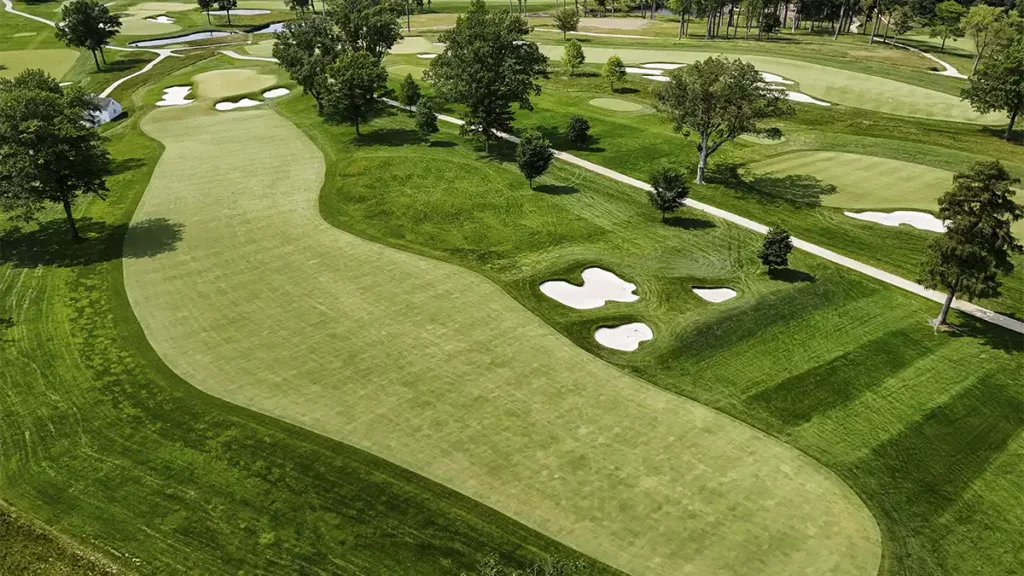
During the original construction of Aronimink, the large, singular bunkers that Ross illustrated on his blueprints were broken into smaller clusters, multiplying their number by a factor of three and giving the course a busy, shotgun-type look uncommon for Ross. It’s uncertain if Ross or his lead associate J.B. McGovern, who lived in Philadelphia and was there for the duration of the project, made the decision to alter the plans. What Ross drew is not what was built, even though his comments about Aronimink suggest he approved the changes. Renovations in future decades by other architects gradually reduced the number of bunkers, either removing them or recombining the clusters into whole shapes.
During their 2017 remodel, Hanse, Wagner and the club chose to recreate the as-built course based on late 1920s aerial photography. This meant adding more than 100 bunkers across the property and re-establishing the course’s unique appearance.
HOLE 7
PAR 4, 383 METRES
Ross used bunkers rather than doglegs at Aronimink to create movement, and the seventh is the last hole that truly bends. It’s also the most difficult fairway to hit. It’s a blind tee shot over directional bunkers that needs to be shaped into the reverse-camber fairway with a landing area that slopes away from the line of play. Drives that miss on the inside line get snared in a field of shaggy moguls, and those straying too far left kick down into the low rough. Even perfect drives leave a spicy wedge up to a green that looks like it’s about to slip off the side of the hill it sits on.
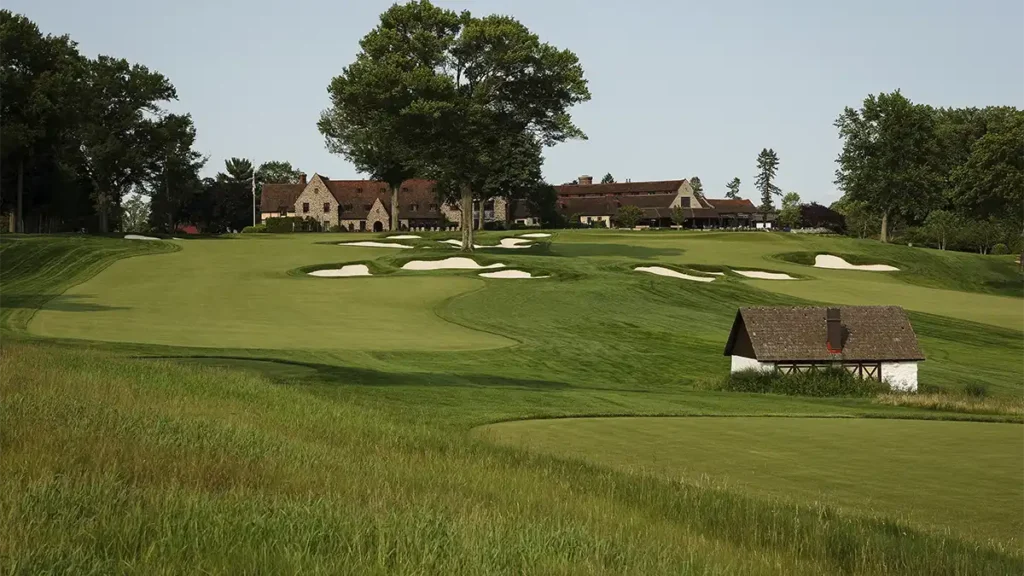
HOLE 11
PAR 4, 389 METRES
The most intensively bunkered hole at Aronimink is the par-4 11th. Twenty of them garnish the path, bracketing the fairway and circling the green. But more threatening than sand to a bad score, or a bad loss of the hole, is the green, the most severely sloped on a course full of severely sloped greens. The putting surface is so pitched towards the front that it can be a challenge to find usable hole locations, and leaving approaches above the flag on the right side of the green will certainly lead to three-putts.
HOLE 18
PAR 4, 448 METRES
It’s not easy finding extra distance at older, landlocked courses, but in 2025 a new tee location was added on 18 on the opposite side of a maintenance road that brings the length of this par 4 to 490 yards. The nearly 30 extra paces makes a difficult finishing hole a bruising one, putting it in the same weight class as the more famous closers at Merion and Oakmont. Second shots are struck uphill towards a mostly obscured green, and it’s another wild one with a strange array of brows and pockets that make long putting a treacherous and inevitable endeavour.