
[Photo: Mike Mulholland]
The spectre of mishandled course setups of the 2004 and 2018 US Opens at Shinnecock Hills hung over this week’s championship like the fog that delayed play early in the opening round.
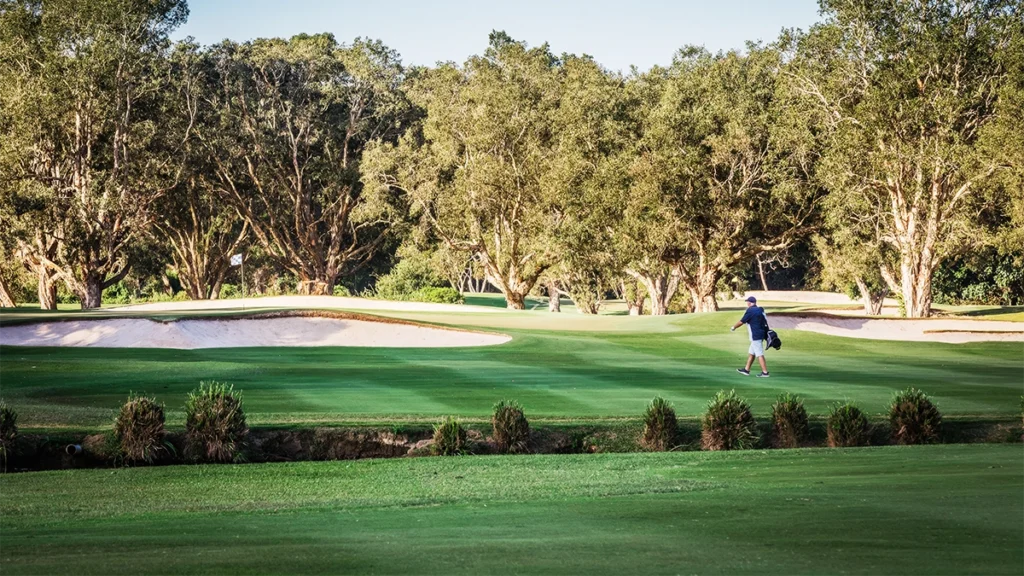
Fortunately for the United States Golf Association, both cleared. However, what we were treated to was less an exacting examination and more a muddled combination of see-sawing leads, club-throw penalties, bumpy Poa annua greens, hecklers and empty sunset finishes [pictured]. When peripheral elements of majors steal the show, the recipe isn’t quite right.
RELATED: Shinnecock stopped being polite and started being a US Open
No major is as score-obsessed as the US Open. The USGA will claim otherwise, but whereas every other organisation is generally content to let the conditions and the players’ skills dictate the outcome, the governing body in the United States and Mexico likes to place its fingerprints all over its showpiece event. It will twist, tweak and contort the golf course mid-championship – and sometimes even during play – in order to influence the outcome.
In 2014, when Martin Kaymer opened 65-65 so suck all the life out of the competition, the USGA dialled up Pinehurst No.2 to reduce the skill quotient and heighten the fluke factor. The result was a ho-hum final 36 holes where the drama was more about ‘by how many’ rather than ‘who’ as no one could get close enough to the unflappable German. Then there were the times when the quality of the greens was questioned before a ball was even struck, like 2015 at a thirsty Chambers Bay.
Meanwhile, the aforementioned 2004 and 2018 US Opens remain the darkest of black marks on the USGA’s credibility. This writer was on-site for the 2004 edition, and what began as a stern test turned into a Sunday carnival.
Shinnecock Hills presents a unique and delicate challenge from an agronomy perspective. Brutal New York winters can see heavy snow on the course as late as March, just three months before the US Open. Then there’s the sandy base of the layout, which allows it to dry out faster than most US Open venues. The club has a standard daily practice of watering greens in the early afternoon to preserve turf health, something the USGA communicated to the field would continue during the week.
RELATED: Why Shinnecock Hills has resisted change
The ever-present challenge is the Poa greens, which when combined with desired US Open green speeds, can turn putting into a lottery rather than a skill. As such, one of the most venerable layouts on the US Open rota still feels contrived when you see near-stationary balls bounce and wobble rather than roll. Some will say, “That’s just the US Open,” and they’d be correct… to a point. America’s national championship has long been as much a test of patience and perseverance in adversity as it is shot selection and raw execution.
Yet it takes a certain golf fan to truly enjoy the uncertainty when that happens. Winner Wyndham Clark’s mostly high-quality play and mostly large lead suffocated a lot of the drama from the week. It bordered on boring at times, which is not what you want from one of golf’s most prestigious events at one of its most revered venues.
If this US Open had been won at double-digits under par but the overall test less influenced by course setup, it surely would have elevated the spectacle and improved the watchability of the competition. What we witnessed was not unfair, but it was fluky.
The US Open returns to Shinnecock in 2036. By then, average driving distance in professional golf might be 350 yards. Which will only mean more course contortion.
Once again, we exit a US Open at Shinnecock Hills with a bitter aftertaste and with the USGA facing yet more decisions to make.