
[Photo: Carl Recine]
On Thursday and Friday, debates raged as to whether the setup at Aronimink was a unique success demanding intense strategic discipline, or whether – as our Joel Beall and the majority of players argued – its reliance on gimmicky pin positions had proven ineffective at rewarding good golf, instead producing a bunched-up leaderboard with scant birdie opportunities. The scoring average on both days finished beyond two strokes over par, and no matter where you settled on the great Aronimink question, the course had decisively crushed the notion that it would roll over and play dead for the alphas. This sucker had teeth.
RELATED: Joining LIV cost Jon Rahm’s legacy. He can start earning it back on Sunday
Then Saturday came, and for most of the morning, a kinder, gentler Aronimink emerged. We saw the Aronomink of soft conditions and windless skies, and the players, like shoots of grass poking their heads out after a harsh winter, seized the chance – Justin Rose shot 65, Chris Kirk shot 65, Kristoffer Reitan made two eagles to shoot 65, Rory McIlroy and Joaquin Niemann shot 66, and they all waited and prayed that they wouldn’t be left in the dust. They openly begged for deteriorating conditions: respites for me, but not for thee.
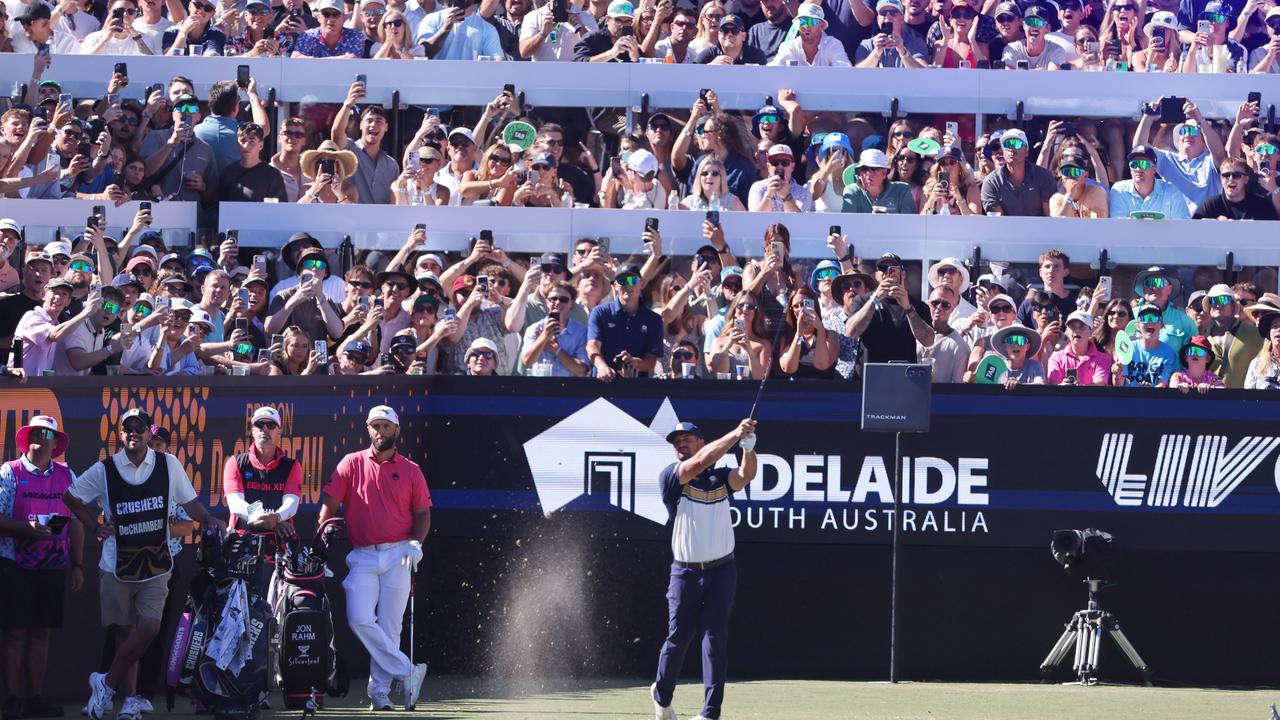
Aronimink obliged, mostly. We can’t quite say the bridge was burned the minute the morning wave crossed, but a look at the DataGolf stats paints a disparate picture of what ensued: a scoring average of -0.42 strokes for those who teed off at 11am or earlier – a good three strokes easier than anything we’d seen to date – and +0.42 for everyone after, with the difference more pronounced on the back nine. It’s not that none of the late wave thrived, because they did: Jon Rahm, teeing off at 12:50, went 32-35 to creep near the lead, Aaron Rai joined him with 67 to grab a share of the lead, and Patrick Reed put himself in position for a Sunday run with his own 67. (The world No.1, Scottie Scheffler, might have joined them if he had remembered how to make a four-foot putt.)
Nevertheless, the increasing wind and drier conditions restricted the extent to which anyone could break away, and in the end, despite some individual salvos, the leading score that had been four-under at the start of the day ended at – wait for it – four-under.
Well, almost. Fifty-four hole leader Alex Smalley, having perished in front of our eyes after a three-bogey-in-four-holes stretch to start his day, returned in zombie form, apparently bereft of nerves and other human feeling, to fight back to six-under, where he now stands alone. He may indeed be tougher than we think. (Rahm and Rai could have come in at five-under, but they refused to violate the sacrosanct four-under ceiling, nobly making bogeys on 18.)
At the risk of breaking it down to the point of absurdity, it was the early part of the late wave, from Xander Schauffele (66) to Matti Schmid (65) to Nick Taylor (65), all of whom teed off between 11 and noon, who had the better of things. Writ large, it’s everything that the likes of Rory, Rose, and Reitan could have hoped for – a leaderboard packed like a can of sardines, with no apparent limit on who might prevail on Sunday.
By round’s end, you could pick almost any player and fetch the same quote about the more forgiving pins that yielded up the early bounty. Let’s start with Reitan, if only because he was the first to enter the Player Interview Area:

Photo: Michael Reaves
“Overall I think the pins today were a little bit more forgiving or they weren’t as perhaps crazy as they were a little bit the first few days where they were sitting on top of the ridges a lot.”
Rose: “I think we’ve seen a lot of pins on crowns and edges… the pins are just a bit more predictable. The reason, I think when the pins get off of those little knobs and crowns, they’re not so much easier to get at, but they’re easier to putt at.”
Kirk: “Pin locations is a big difference, for sure. There’s a handful of really tough ones out there still, but for the most part, they’re much, much more accessible than they have been the last few days.”
Schauffele: “I thought the pin locations the first two days were pretty diabolical… today was a little bit easier with the pins.”
You get the point. The difference in the afternoon wave was prophesied by McIlroy, who experienced the start of the conditions that would hammer the late wave.
“It was whipping at the end, I think the last few holes for us, especially 17 and 18,” he said. “I’d certainly like it to blow as hard as that as the afternoon goes on.”
“Whipping” might have been too dramatic a word, but with gusts in the double digits and threatening 20mph, the early wavers fished their wish, and a leaderboard that we thought was crowded a day earlier now feels, give or take a Smalley, like Hong Kong’s Mong Kok district (note: the place that comes up when you Google “most densely populated place on Earth”).
Bizarre thoughts abound: is this golf’s microcosmic version of democratic socialism, where the rich are taxed and the poor are lifted? Have the ghosts of the farmhouses that remain on the grounds cast their spell on any soul who might humiliate them by going low? Has the working class spirit of the crass but indomitable Philly fan pelted a snowball at the Santa Claus of elite performance? Is this all just one giant crab bucket?
We owe these strange tidings to the vagaries of Aronimink, and the wind that swirls around its rolling hills. Nothing about this course has been predictable except its unpredictability, and the morning’s rogue wave giving way to afternoon carnage has set the stage for a heady brew of final-round chaos. We are witnessing golf gone wild, and if you can’t find it in your soul to love this madness, chances are you have a tee-time at Aronimink on Sunday.