

[Photo: Augusta National]
It’s not just the speed of the greens, or their undulations, or the layout itself, or the gravity of the Masters Tournament that makes conquering Augusta National so difficult for players. It’s the invisible threat posed on all who play the famed course.
The wind.
RELATED: Do you really have to putt well to win at Augusta National?
The wind doesn’t just blow at Augusta National – or swirl, as caddie Ted Scott explained to Golf.com – it hides from you. The trees obscure what players feel. It means the flagstick isn’t much help, either. Yet the moment the ball peaks above the Georgia pines, it gets slapped in a strange direction.
So how do you plan for something you can’t see or feel?
Marcus Svensson, founder of the Tour Wind app who works with players to customise the info to their game, explained the clever way that players account for this.
“At Augusta, the trees are laid in a specific way where you really can’t trust what you feel,” Svensson says. “The closer players get to their tee-time, I tell them to look at the wind forecast for the next five hours, and write down the hour-by-hour forecast and direction in the course guide.”
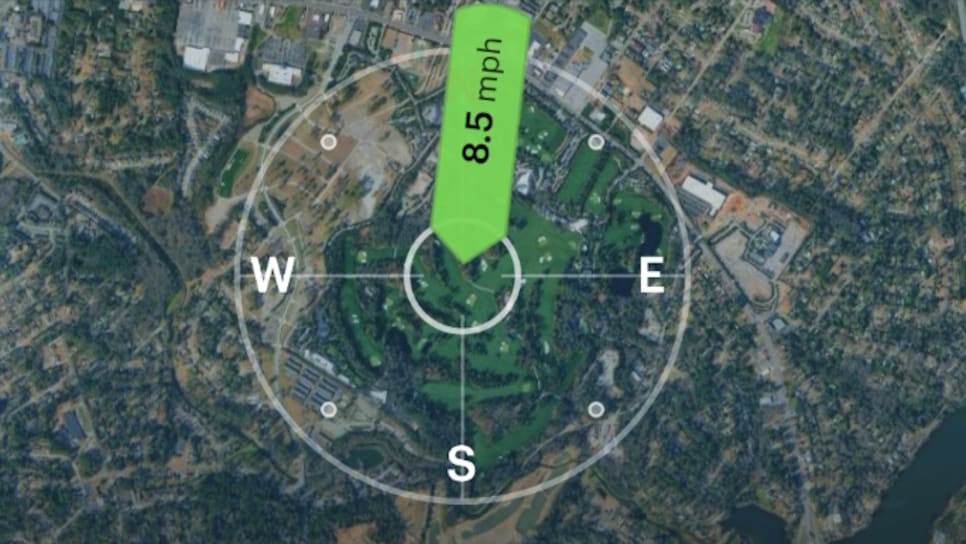
Svensson contends using the Windy app, and plotting these hour-by-hour forecasts, rather than relying on feel can make a bigger difference than you think. For instance, it’s not the windiest day out there on Monday in Augusta, but here’s the wind forecast in the morning: it’s blowing on average of about 8.5 miles per hour directly out of the north.
That wind direction means players, for example, have to navigate a right-to-left crosswind on the 15th hole, and play the 18th hole directly into the wind.
Yet later in the day, the wind direction switches. Now it’s blowing out of the north-east about a mile per hour less. So the 15th hole is playing almost directly downwind, and the 18th hole is more across.
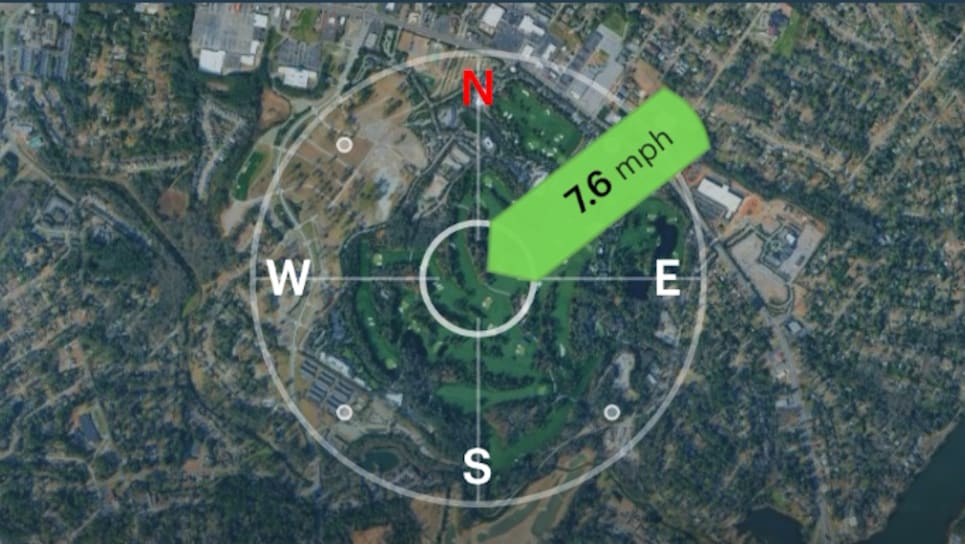
Apply the generally accepted wind formula to these situations (which you can find here), and you can see how big a difference it makes on each of these shots.
We’ll use a 150-yard shot to keep the maths convenient…
18th hole
Morning: 8.5mph headwind = -12.75 yards
Afternoon: 8.5mph crosswind = -5.7 yards
15th hole
Morning: 8.5mph crosswind = -6.4 yards
Afternoon: 8.5mph crosswind = +5.7 yards
Subtle differences, but important ones. And those can often be the difference at the Masters.