
Say the words Augusta National to any golf fan and the first thing that likely comes to mind is the greens. Vast in size and contours, fearfully fast in the second week of April and perfectly manicured at all times. To compete at the Masters, you need to first master the greens, right?
Well…
That might not be true anymore.
RELATED: New Masters video shares a fascinating glimpse into the mind of Rory McIlroy
While players will no doubt spend extra time on the greens this week at Augusta, getting used to the speed and slope, putting at the Masters may not be as crucial a skill as we once thought.
Take for example the past three golfers who have won the year’s first major. Jon Rahm four-putted his first hole in 2023. Scottie Scheffler four-putted his final hole in 2022. Rory McIlroy missed a short putt on the 72nd hole to win in 2025, forcing one more dramatic hole to finally claim his green jacket. That might seem like an example of selective memory, but the data backs up the recent trend as well.
Consider this: in each of the past five Masters, none of the winners have ranked inside the top 10 in the field in strokes gained/putting.
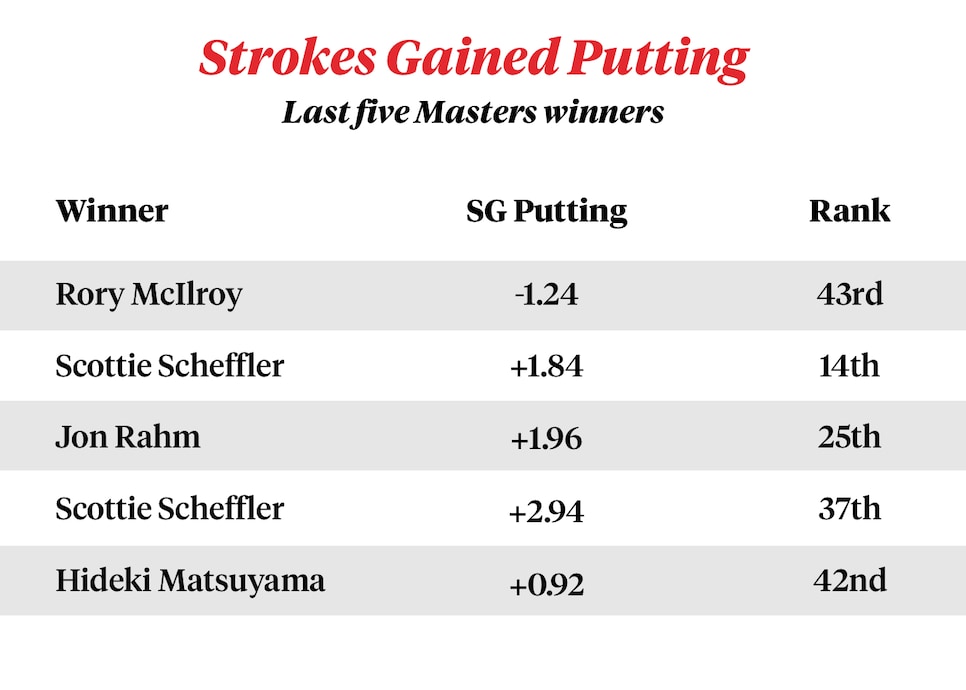
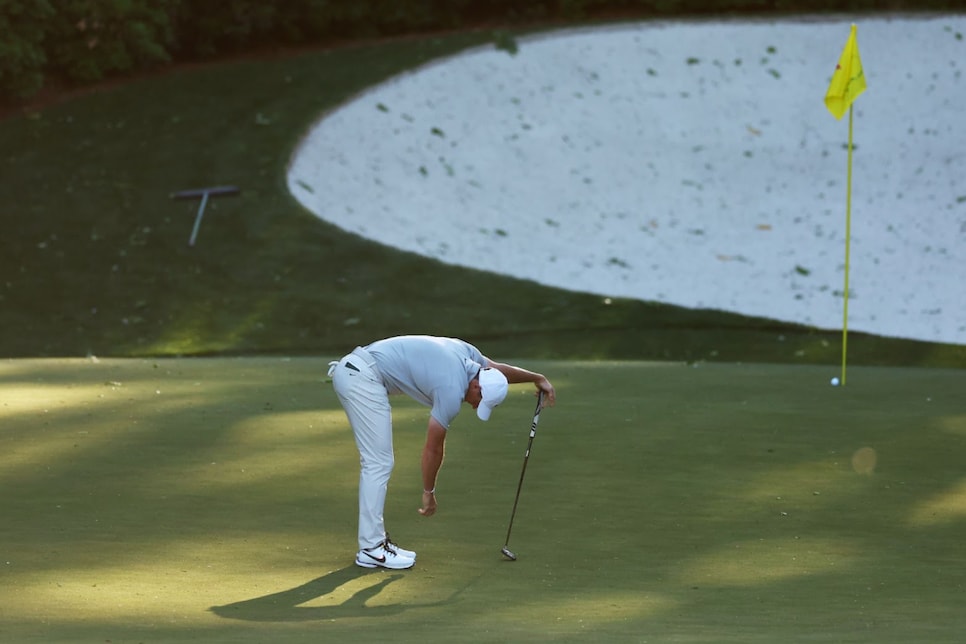
McIlroy actually lost strokes to the field on the greens last year. While he gained +2.15 shots putting in his second-round 66, he lost -1.11 shots in his opening round, -0.11 in his third round and -2.19 shots on Sunday. The latter ranking him 45th out of 51 players that teed it up in the final round.
So what’s going on?
The truth is that Augusta has become more of a ball-striking examination than a putting one. While players hit 13 percent more fairways at Augusta than on an average PGA Tour event, they actually hit fewer greens (4.3 percent less). And that is due to the Augusta greens.
The speed and slopes on the greens, which we’ve often viewed through the lens of putting, are actually very hard to hit with irons and wedges. Add to that equation the fact that course is now more than 500 metres longer than it was 25 years ago, and players are often trying to hit those same greens with longer clubs in their bags.
That is where McIlroy excelled.
Last year, he was 17 metres (18.6 yards) longer than the field average off the tee. In other words, he was able to shorten an increasingly long Augusta National layout unlike most any other player in the field. And from there, he ranked first in strokes gained/approach. He displayed the precision needed to find the greens’ nooks and crannies that are required for success at Augusta. He gained 2.31 shots per round with his approach play. No one else in the field gained more than two shots.
And the devaluation of putting isn’t just a Rory thing. All players find Augusta National’s greens harder than a typical tour setup. Remember, the average slope on a PGA Tour green is about 1.5 percent (i.e. breaking 1.5 feet across 100 feet), while the average slope on a green at Augusta National is 2.5 percent. Add green speeds of 13 to 14 on the Stimpmeter – again higher than the average tour setup – and it’s a lot for players to adjust to, never mind succeed.
Data Golf has measured every shot at Augusta National from the past five years and as a result can track what it calls “scoring variance”. Essentially, that means zeroing in on which of the four strokes-gained metrics (off-the-tee, approach, short game and putting) had the biggest impact on scoring. Over that time, approach play has had a larger influence on scoring in four of the five years, and was only narrowly lower than putting in 2023.
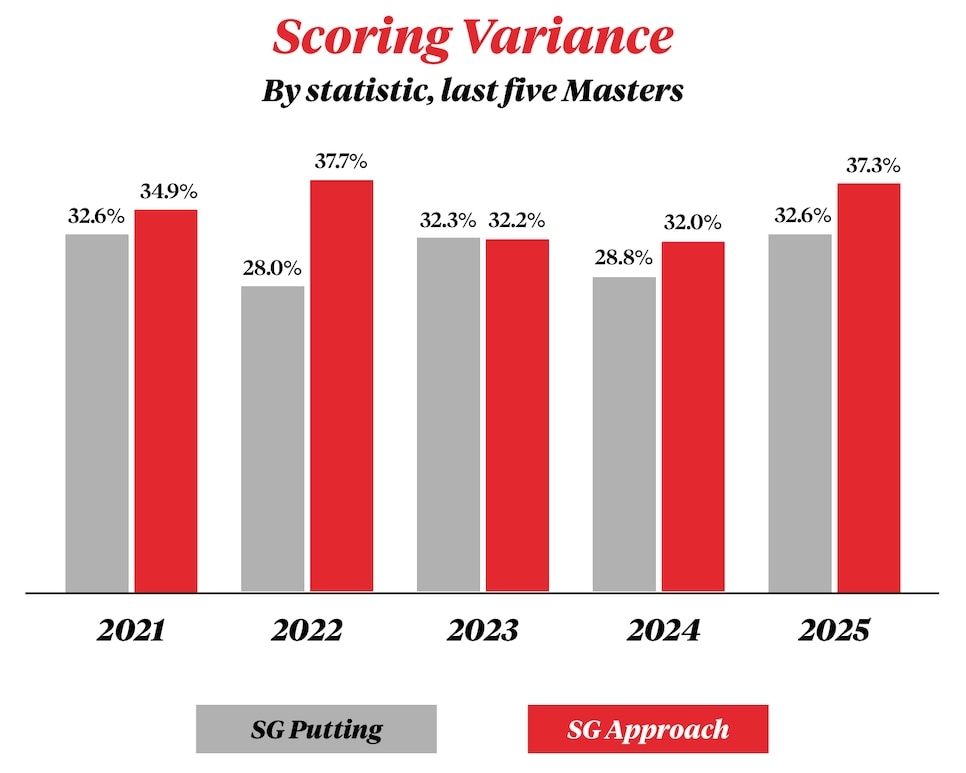
Clearly you need to hole putts to win any tournament. Even, as was the case for Scheffler, if you need four on the final green to do it. However, it’s also clear to see that the modern Augusta National layout and set-up is skewing more towards ball-strikers than putters.
Will that trend continue in 2026?