[PHOTO: Gary Lisbon]
News last week that Royal Queensland Golf Club has received government approval to use its returned parcel of land to develop a new short course continues a welcome trend in course architecture.
Whether inspired by clubs overseas or the growing number of Australian clubs thinking the same way – or both – it’s a positive movement for golf in numerous ways.
RELATED: Can short courses spark a movement in Australia?
Short courses work for every golfer. Expert and everyday players can sharpen their wedge play and short games on them, while perhaps more importantly, they serve as a wonderful entry and exit point to the game. Beginners and those in their twilight years welcome the reduced challenge, faster rounds and less taxing version of golf. To say nothing of the ‘fun factor’ at play, of course.
The backstory at Royal Queensland is: when the course was redesigned in the mid-2000s, it was done so to cater for the duplication of Brisbane’s towering Gateway Bridge, underneath which the course famously flowed for six holes. Mike Clayton’s redesign used only land to the west of the existing bridge. With the duplication now long complete, the 35-hectare parcel of land was returned to the club and left it with a decision to make on how best to use it.
The space was not ample enough for another nine holes and it was too distant from the clubhouse precinct for a relocation of the practice facilities. So building a short course represented the most practical use of the club’s “Eastern land”.
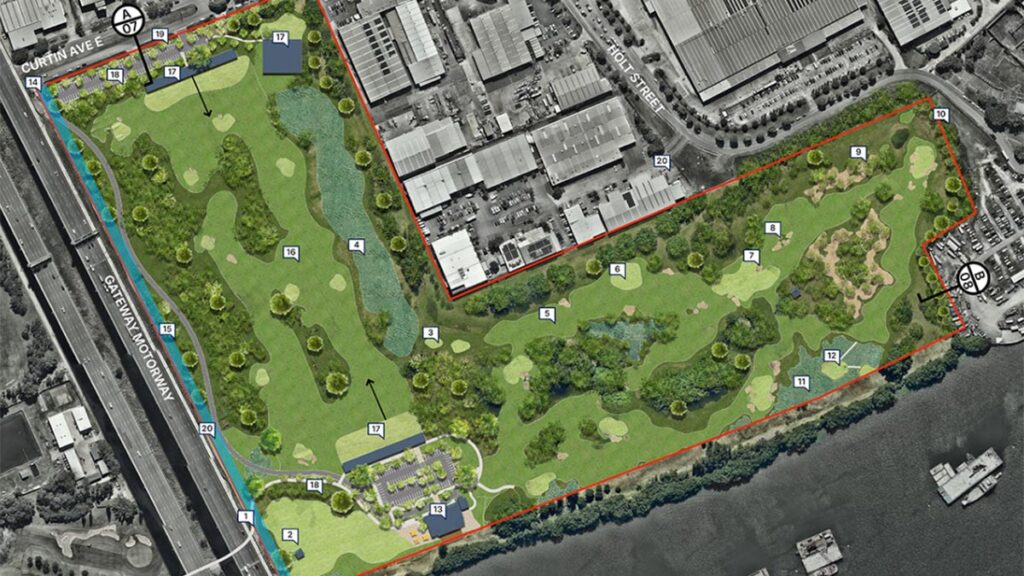
The new short course at Royal Queensland will occupy land returned to the club after the Gateway Bridge duplication project.
OCM Golf’s plan at the host golf venue for the 2032 Olympic Games features fluid teeing grounds, an island green in the saltmarsh, a 4,500-square-metre Himalayas-style putting green and a pavilion area on the riverside location.
RQ course superintendent Adam Mills told “The Cut”, the weekly newsletter of the Australian Sports Turf Management Association, that construction of the new holes has already started, coinciding with their preparation work on the main course, which will host the BMW Australian PGA Championship in late November.
Atlas Golf Services has completed its preliminary work on site and has now started construction, “The Cut” reported. Mills said he is confident that four holes will be turfed by the end of this year with all holes to be midway through grow-in by next winter. The short course is expected to be completed by late 2026.
RELATED: First Look – Kingston Heath’s proposed short course looks absolutely SPECTACULAR
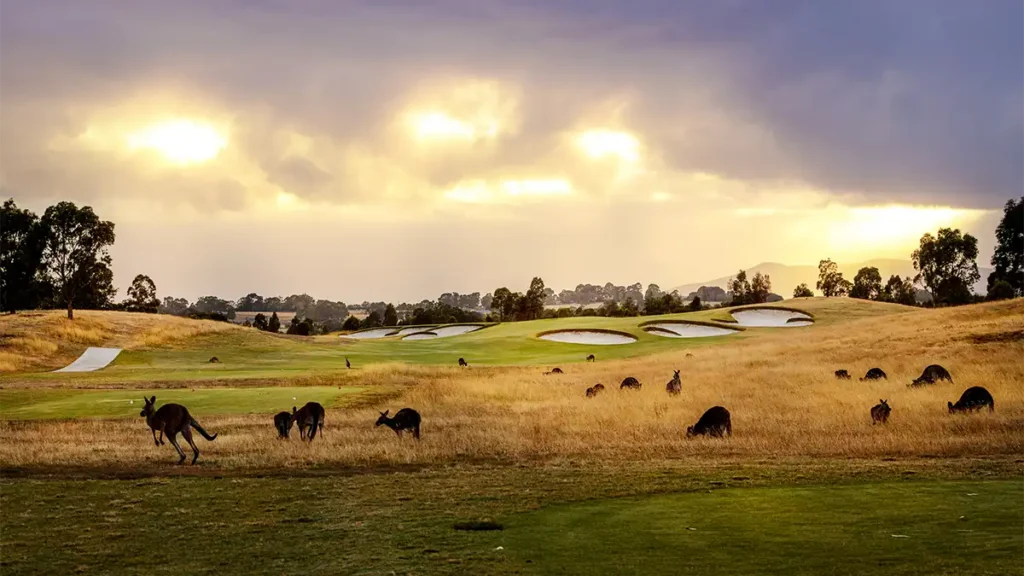
RQ’s short course follows on from the wildly successful “The Furrows” layout at Kingston Heath, also designed by OCM and opened in April 2023. With holes ranging from 50 to 140 metres in length and set up with similar geography to Royal Queensland’s site – where the short course is some distance from the clubhouse – it has become a treasured addition for the esteemed Melbourne Sandbelt club.

“The Furrows” added a new dimension to storied Kingston Heath Golf Club. [Photo: Gary Lisbon]
“It’s such an available site and it ticks so many boxes,” says Kingston Heath general manager Andrew Taylor. “You can get some space and some freedom on The Furrows, which most courses aren’t experiencing because they’re so packed.”
Taylor says the separation from the main course and clubhouse allows the club to “promote a different environment” on The Furrows. There might be loud music playing or a looser dress code. You might encounter an unconventional skins game across a group of six or seven players or perhaps an event or product launch. Meanwhile, Kingston Heath’s pennant teams practise there and junior and women’s clinics have found a natural home on the short course.
Prior to Kingston Heath developing The Furrows, 13th Beach Golf Links added a nine-hole short course in 2021, while Barwon Heads Golf Club tasked Neil Crafter and Paul Mogford with renovating its short course in 2008. Although not in exactly the same league – because its 14 holes are essentially full-length – the addition of Bougle Run at Barnbougle in 2021 mirrored the concept. In Perth, The Vines Resort last year announced its intention to downsize from 36 holes to 27 but with plans to add a short course to the facility.
RELATED: The Vines Resort to downsize from 36 to 27 holes, plus add a short course and driving range
Few clubs and courses have the luxury of sitting on surplus land, of course. And if they do, it might not be large enough to cater for a project as large as a short course. What’s more likely to happen in future – especially as land values and land scarcity increase in metropolitan areas – is 18-hole courses reducing to nine full-length holes plus a short course and perhaps a Himalayas putting green.
Such transitions would be delicate, representing a win on one hand and a loss on the other, yet the current climate in suburban golf suggests it’s a growing possibility.
Short courses sitting in tandem with full-length courses is a win for golf, but a loss of mediocre full-length holes in favour of modern, architecturally built short-course holes needn’t be viewed as a negative move.