
[Photo: Warren Little]
The collective announcement that the R&A and USGA would be working on new ideas in collaboration with the PGA Tour and the DP World Tour to find solutions to slow the rate of distance increases at the elite level of the game re-opened the question of where the rollback stands. While the ruling bodies are committed to implementing a change to the distance golf balls fly beginning in 2030, the overnight announcement suggests we are a long way from clarity. Here are some questions and answers.
Is the rollback dead?
The ruling bodies have been talking about the distance issue since the Joint Statement of Principles was released more than two decades ago. Since that announcement 24 years ago, driving distance on the PGA Tour has increased nearly 25 metres. In short, for various reasons, they delayed, deferred and studied without coming to a significant decision about a rollback until late 2023 when they announced the rollback to the Overall Distance Standard test. The R&A and USGA were initially firm in implementing the rollback in two stages, for elite players in 2028 and then all of golf in 2030. Now, they plan on implementing the ball change universally in 2030. But in the same breadth, the overnight announcement suggests they are collaborating with the pro tours on alternatives to stop distance increases and studying concerns that “the updated ODS testing approach may not achieve the desired results”. So, the rulemakers are firm that something is going to happen by 2030, but also saying there’s urgency to re-open the study of the problem. The more nothing is decided collectively, the more nothing is done. Maybe a rollback happens, but it seems like it’s going to take a lot more late-stage negotiating on a topic that 24 hours ago seemed to be settled.
Is 2030 a reasonable date? It seems like manufacturers have to start all over again.
Difficult to tell. If there is a significant shift in the Overall Distance Standard, it’s tight. Manufacturers have been working on rolled-back designs for a decade or longer. However, more recently their focus has been on designs that meet the new standard. Anything significantly altering that will take time.
It sounds like the R&A and USGA are no longer driving the bus when it comes to these kinds of rule changes.
It’s reasonable to believe two things here: one, the PGA Tour wants to be involved more. Two, the PGA Tour doesn’t want the headache of policing equipment rules. While the professional tours and the PGA of America have long been part of the discussions when rules are being proposed, they are not making the rules, they are abiding by them. Based on many of the post-announcement comments, the feelings about the status of distance at the elite level seem to be shared across the tours and the rulemakers. What’s not shared is what needs to be done or can be done, and indeed, what’s good for the business of the game. It seems the PGA Tour holds all the cards in this issue and its players will be more involved in how the rule-making process happens on this issue, and others going forward. The fact remains, though, that if its members don’t want to play a rolled back ball, its chief executive is going to ensure that is precisely the case. The R&A and USGA now seem to be trying to convince the PGA Tour to see its viewpoint, and the PGA Tour seems to be convincing the rulemakers to understand its business situation. Who needs the other the most? That seems an easy answer, and not one that is going to make those championing a rollback confident.
RELATED: The USGA delayed its rollback plan to save golf from something much worse
But couldn’t they make other changes beyond the ball to get the desired effect on reducing distance?
Based on USGA chief executive Mike Whan’s statements, what’s more on the table now are some rule changes that might only apply to the pro tours. Some of those ideas, which are known as model local rules because they only apply to a limited audience like the PGA Tour, were thrown out in favour of a simpler, more universal rule. That approach resulted in a change that wasn’t going to impact professionals as much because the same rule had to not take anything away from average golfers. But what could be implemented would be new restrictions on how hot driver faces are on the pro tours, or lowering their forgiveness on off-centre hits, reducing their size, shortening the shaft length limit. All of these were originally considered back when the USGA was getting ready to make a rule change, but were seen as non-starters. Both the tours and manufacturers were objecting to what’s known as bifurcation (different rules for pros than recreational golfers), and Whan seemed to be hinting that such a change could be one of the alternatives that could be looked at. Why pro golfers would be OK with these ideas now given their sudden heated objection to the ball rollback seems incomprehensible.
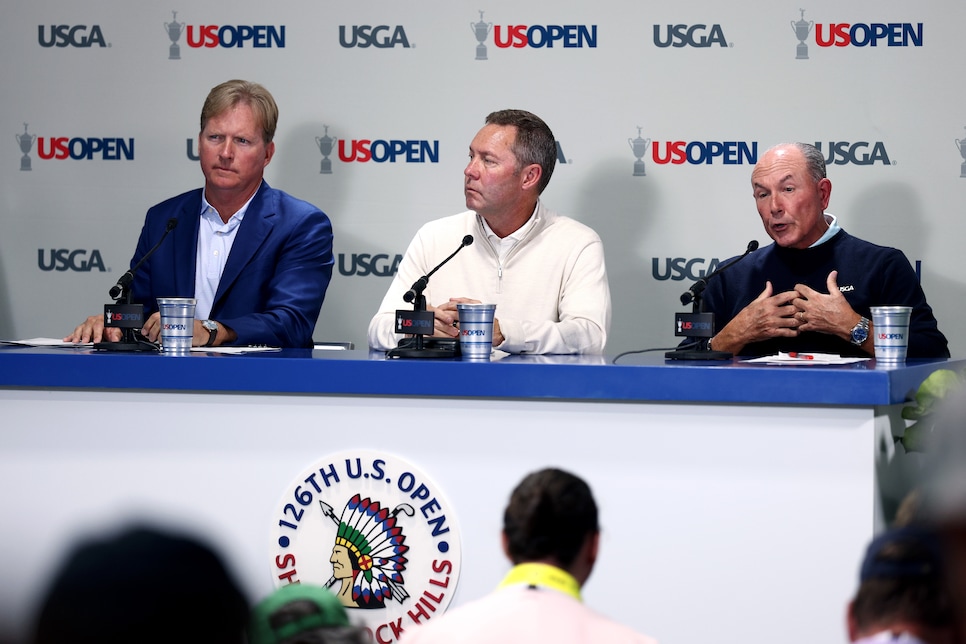
Photo: Mike Mulholland
If it doesn’t have the desired effect, won’t people will be turned off by a game of pitch-and-putt?
Go to any tour event and listen closely. Big drives and balls hit close to the stick are what bring cheers. Sure, there’s something to be said for watching Old Man Par put up a good fight. But like a bowler-dominated match in cricket or a defensive struggle in any of the football codes, it loses its appeal if you see it too often. People tune in to watch professionals do what the average golfer cannot – and part of that is seeing the pros hit the ball a long way and going low. They sure aren’t watching Bryson DeChambeau for his prowess with the irons. Besides, TV ratings in 2025 and 2026 are the highest ever.
Wasn’t the problem that tour players were already using balls that they said would pass the new rollback rules but were hitting them just as far?
While there were reports to that effect, no independent testing has been provided to suggest that’s what was happening with balls like the one Cameron Young purportedly has been using, a Titleist Pro V1x Double Dot. In the overnight press conference Whan dismissed the notion that there was any such new evidence. “Nothing we’ve seen technically was different than we envisioned,” he said. Now, is it entirely possible that R&D teams from manufacturers are working to develop golf balls that would pass the new ODS test but still go far when hit at high speeds? But that’s no different than what we saw with the groove rule change before. Are new wedges better in many ways than the old sharper grooved wedges that were outlawed? Well, yes, but when it comes to generating spin on shots out of the rough, these new wedges remain just a little bit worse. We suspect any player can hit any driver exceedingly far. But like Whan said, it seems very probable that if the rollback was implemented as planned, average driving distance on the PGA Tour would slow. For how long? Probably for as long as it takes for the average swing speed to increase by another four miles per hour, which is what’s happened in the past decade.
Is the disproportionate argument legit?
Let’s deal in data. In 2026, 23 individual PGA Tour events have been held. Only six have been won by players ranked in the top 10 in driving distance that week. Only one, Rory McIlroy at the Masters, led the field in distance. He is also the last winner to rank in the top 10. At the other end, seven winners were outside the top 40 in distance. Among them, PGA champion Aaron Rai (66th) and Brandt Snedeker at Myrtle Beach, ranking 74th with a paltry 274.2-yard (250.7-metre) average. The peashooters will always have a chance. As for everyone’s favourite Rory McIlroy/Russell Henley comparison, well, we tested it using a rollback ball and their launch conditions. Read about it here.
Is the ball the only culprit to distance increases?
Are golf balls better than ever? You bet. Are some players hitting the ball obscene distances? At times. But to blame it all on the golf ball is to make it a scapegoat. Distance gains have been caused by a “perfect storm” of equipment where launch monitors have allowed players to precisely marry clubhead, shaft and ball to their swings. Further, agronomy and course conditions simply cannot be overlooked. Just look at some of the wild swings in driving average on a week-to-week basis as evidence of the role course conditions play. Finally, take into consideration the almost maniacal fitness regimens of some players and they should be hitting it further. Something would be amiss if they weren’t. The ball was targeted because, on the surface, it appeared to be the easiest and most equitable way to slow down distance. That, of course, is open to debate. Should the PGA Tour and the USGA be keeping a watchful eye on what’s happening with distance? Of course. But a rollback is now more murky today than it was a day ago.