
Welcome to MythBusters, where we explore answers to some of golf’s most common questions through a series of tests with golfers and robots. Sometimes definitive, other times less so, our findings aim to shed new light on topics that have consumed golfers for years.
The majority of golfers play a slice off the tee, costing themselves valuable distance. The ball’s significant movement from left-to-right in the air (for right-handers) decreases distance due to the excessive amount of sidespin.
But what about the players who play less of a slice and more of a controlled fade? Is that moderate curve really costing them a meaningful amount of distance? And how would their total distance change if they straightened the ball flight out or even began to hit draws?
We tested this question with a swing robot.
Our test
To determine the distance disparity between a fade, straight shot and draw, we used the Golf Laboratories swing robot. With the help of Golf Labs founder Gene Parente, we hit a series of drives with a 10.5-degree driver swinging at 152 kilometres per hour, the average driver clubhead speed for men. We measured club and ball-flight data using Foresight Sports’ QuadMAX launch monitor.
Broadly, a fade off the tee is a byproduct of an out-to-in swing path and a more downward angle of attack, which is often (but not always) the result of an “over-the-top” move in transition. To replicate this type of swing, we set the robot to have a slightly out-to-in club path (negative 3 degrees) and a downward angle of attack of 5 degrees, which created a 19-yard (17-metre) fade, on average. You can see an example of this swing below. Notice how the club travels from out-to-in relative to the straight target line. This simulates the swing and ball flight for a player who approaches the ball on a fairly steep angle and plays a significant fade that falls short of an outright slice.
Your browser does not support the video tag.
For the straight ball flight, the robot hit shots with a 0-degree angle of attack and a 0-degree club path to simulate a perfectly neutral swing.
To create a draw, we set the robot to have a positive angle of attack of around 3.5 degrees and an inside-out club path of 3 degrees, which are typical numbers for players who hit a reliable draw off the tee. Just like their fade counterparts, these shots curved 19 yards from in the air.
What we found 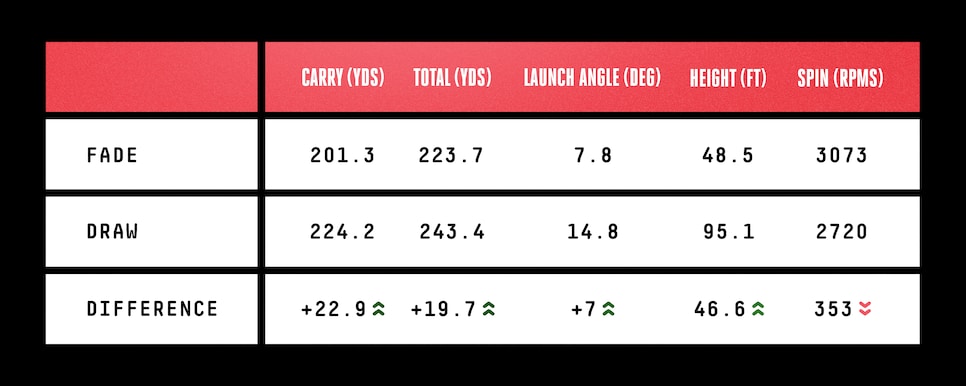
The fades carried just over 200 yards (182m) and averaged 223.7 yards (360m) total. These shots launched quite low, with a 7.8-degree launch angle, and flew low as well, peaking at only 48.5 feet (14.7m) in the air.
Moving from a fade to a straight shot, the straight shots flew 20 yards (18.2m) farther and averaged over 15 yards (13.7m) longer in total distance. This was due in large part to a higher launch angle of 13 degrees and lower spin (2,787 RPMs vs. 3,073).
The distance increases continued as we moved to the draws, with the draws carrying on average 224.2 yards (205m) and traveling a total of 243.4 yards (222m). Compared to the fades, these went about 23 yards (21m) farther in the air and nearly 20 yards (18m) farther total. Again, this was due in large part to an even higher launch angle (14.8) and lower spin.
 What it means
That the straight and draw swings produced such an improvement in distance speaks to the importance of optimising your launch conditions with a driver, a topic previously addressed in this series. Put simply, modern drivers are designed to maximise distance when they launch high with low spin.
In the case of the fade swings, the steep, downward angle of attack, with the clubhead traveling from out-to-in, created a launch angle that was far too low. This delivery also caused balls to spin too much as they took off. That combination of a low, spinny ball flight killed distance.
When launch conditions were improved, distance dramatically increased. By making the swing path more neutral and then in-to-out, the angle of attack of these swings became more optimal. Maximum distance is achieved with a slightly upward angle of attack with a driver. When that was achieved with the draw swing, we saw the most distance increase.
Our test shows that for an average male golfer who plays a 20-yard (18m) fade can gain around 20 yards (23m) of distance by learning how to hit a draw … all without increasing clubhead speed.
It’s worth noting that not all fades are created equal. Some higher-level players, including tour pros, play a fade that better optimises launch conditions. This is often achieved by minimising the downward angle of attack, which helps control spin and maintain sufficient distance. This power fade is a higher-skilled shot and different from the moderate fade played by average golfers.
Through each of the shot shapes that we tested, we did not change the driver’s adjustability settings. That said, with modern technology allowing for drivers to be adjusted to suit many different delivery patterns, a golfer may find more optimal results while hitting a fade simply by adjusting their driver to launch higher, have less spin, and use more of a draw bias.
Finally, it’s worth noting we aimed to test the distance loss caused by a fade, but not necessarily a banana slice. Those golfers who fight a slice of more than 20 yards (18m) may find even greater distance benefits by learning to hit a more neutral shot shape.
Verdict
For those who play a fade off the tee, you don’t need to increase clubhead speed to hit the ball farther. Instead, by moving from a moderate fade to a draw, you can expect to gain nearly 20 yards (18m) of distance, all with the same clubhead speed. Of course, making such an improvement in your swing isn’t easy, but even if you move from a big fade to a straighter ball flight, you can still increase distance by over 15 yards (13m).
This article was originally published on golfdigest.com