
Royal Birkdale, The Open’s most even-handed links, remains one of golf’s truest tests of total command.
Of the 10 links courses that currently host The Open Championship, Royal Birkdale is often described as the most “fair”. The dunes of the Birkdale Hills site near Southport on the north-west coast of England are among the tallest and most rugged in the rota. The golf holes are set in between valleys, streaming like smooth water over the low points and making for placid footing among the turbulent surroundings.
There’s very little quirk at Birkdale and less of the random bounce and unpredictability intrinsic to other links. The flat lies and absence of blindness make it a favourite competition site for professional and high amateur play. What you see is usually what you get, and the design consistently rewards straight driving and acute distance control.
The club dates back to 1889, but the Birkdale course played today is the product of a major 1931 redesign by Frederick Hawtree and five-time Open champion J.H. Taylor. That rather-late modernisation meant that Birkdale didn’t host an Open until 1954, three years after it achieved “Royal” status. Since then, Royal Birkdale has hosted the Open 11 times, including the 2026 Open, placing it second only to St Andrews during that duration and validating its status as one of the sport’s timeless and trusted tournament venues.
Golfers visiting the UK and Ireland typically must adapt their games to the unique verities of links golf. Royal Birkdale’s dunes, firm turf, wild brush and wind are quintessentially links, but the calm surfaces and straight-ahead layout offer a sense of familiarity. Birkdale is a level playing field, and the only advantage it confers is to those in total command of their game.
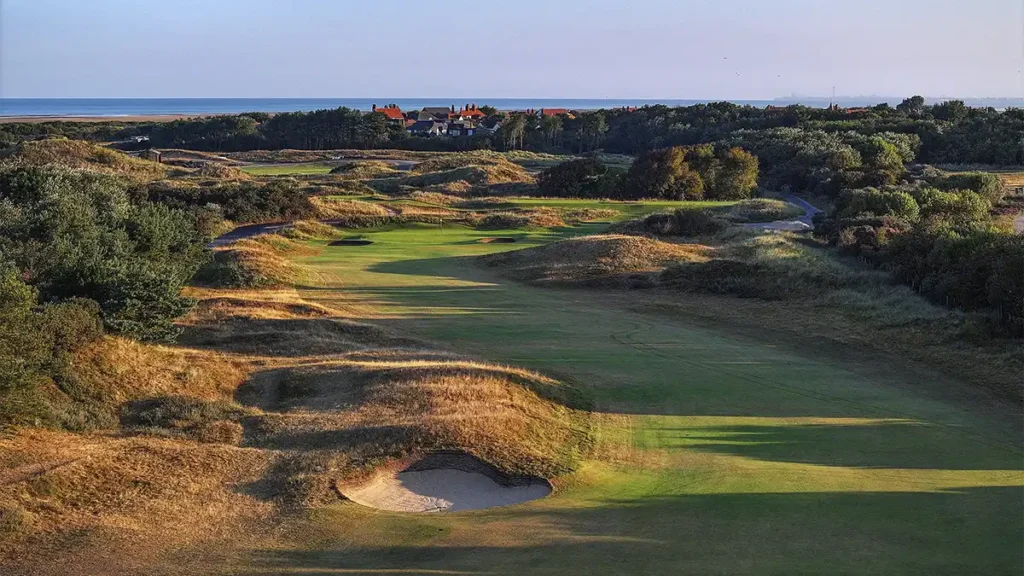
HOLE 1
PAR 4, 447 YARDS / 409 metres
Birkdale’s first hole wastes no time demanding players be on-point. Along with Royal Portrush, this is one of the most stringent starting holes in the Open rota, averaging nearly 4.4 strokes per round over the past three championships. It begins in some of the property’s mellowest dunes, but a penal bunker notched into the face of a mound on the left pinches the fairway before it sweeps left behind it. The narrow landing area and out-of-bounds on the right means most players won’t try to squeeze driver past it, leaving them a longer, semi-blind approach to a green guarded in front by two pot bunkers.
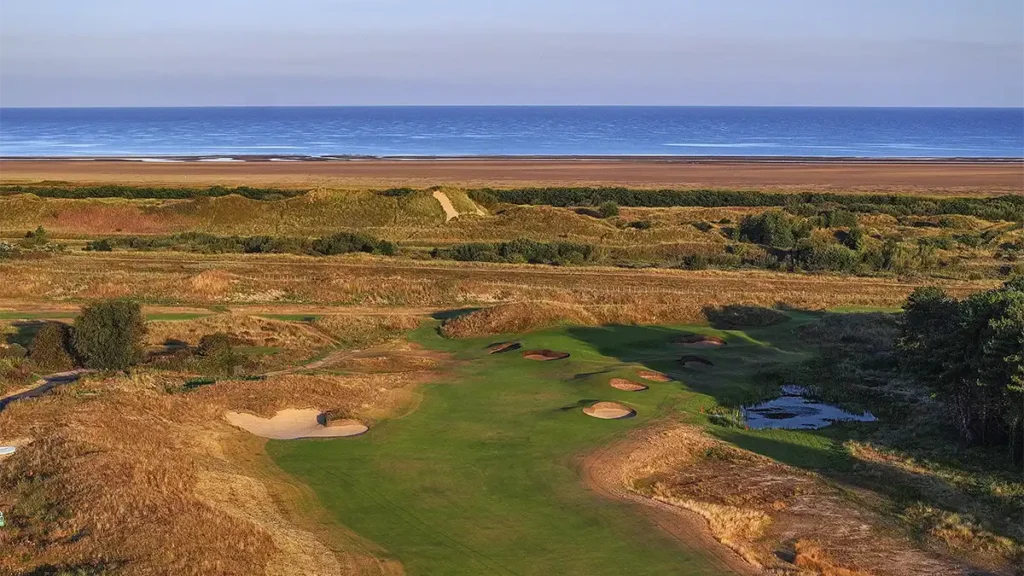
HOLE 5
PAR 4, 322 YARDS / 294 metres
The short, blind par-4 fifth was altered during a major 2024 remodel by Tom Mackenzie of the British design firm Mackenzie and Ebert. It still bends to the right but is 25 yards shorter, and grassy dunes on the inside corner have been removed and replaced by an open sand barren. The putting surface was also shifted left and cocked nearly 45 degrees behind a field of sod-wall bunkers. With all targets now visible from the tee, some players will be tempted to hit driver, but those who do will want to keep their misses short since the green drops off steeply left and over the back.
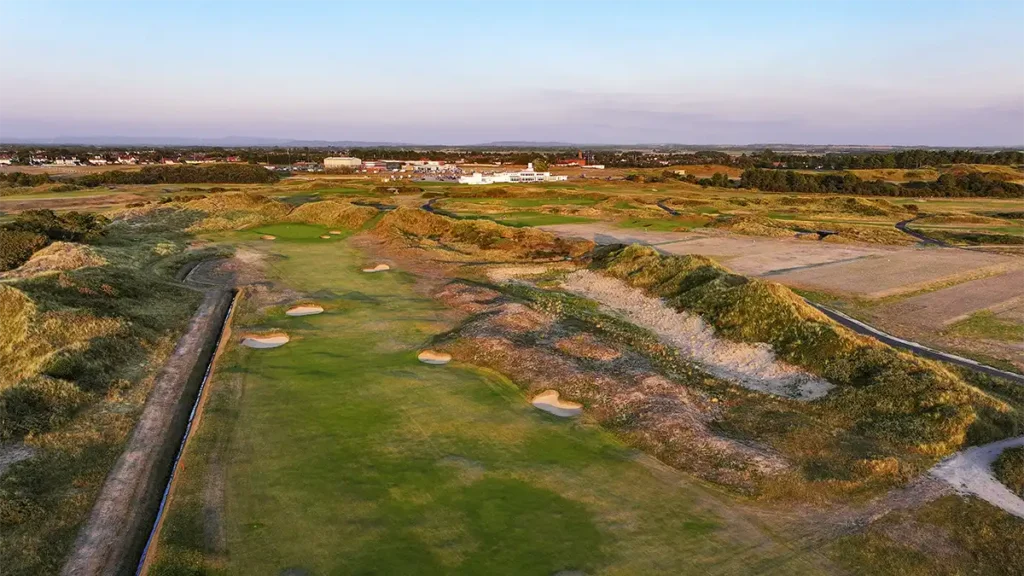
HOLE 13
PAR 4, 502 YARDS / 459 METRES
Open Championship theatre doesn’t get more bizarre than what occurred here in 2017 when Jordan Spieth flared his final-round drive so badly it settled on the outside shoulder of the dunes on the right, 70 yards from the edge of the fairway. Twenty-nine minutes and several rulings later, he was in with a remarkable bogey, sparking a birdie-eagle-birdie-birdie run that clinched the claret jug. The fairway has been widened towards a ditch on the left but still favours drives that hug the right bunkers, and the expanded area left of the green will catch long bailout approaches since there’s no room to stray right.
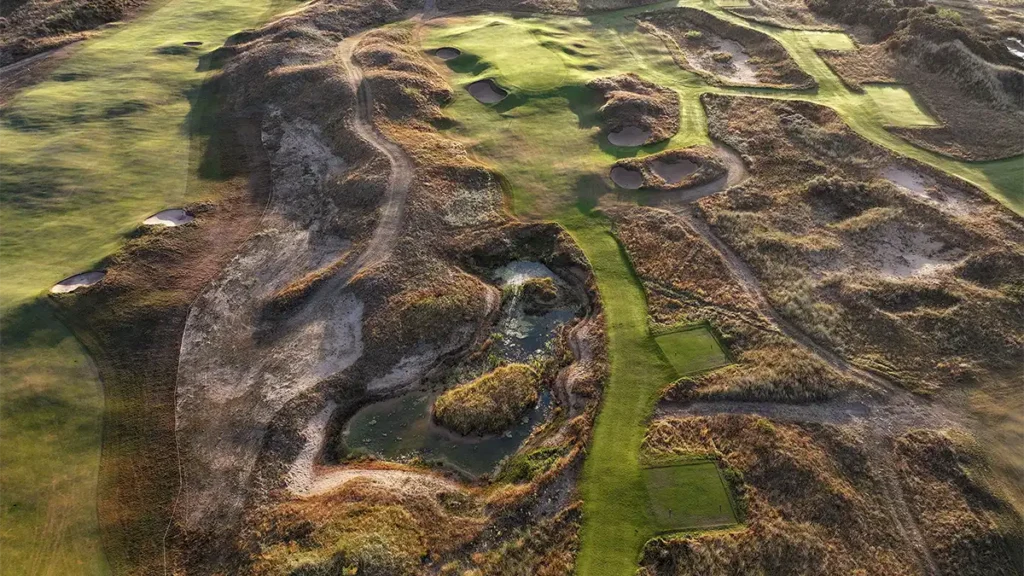
HOLE 15
PAR 3, 241 YARDS / 220 METRES
The 15th hole is a new addition to Royal Birkdale for the 2026 Open Championship. Mackenzie created it during the 2024 remodel as a replacement for the par-3 14th that was converted into a short-game practice area. It fits neatly into the space between the old par-5 15th (which now plays as the 14th hole) and the par-4 16th, and gives the layout the long par 3 it was lacking at 241 yards. The ability to get up and down from the sunken short-grass area to the right is critical since long incoming shots trying to avoid the two pot bunkers on the left will often bounce through the axis of the deep, angled green.
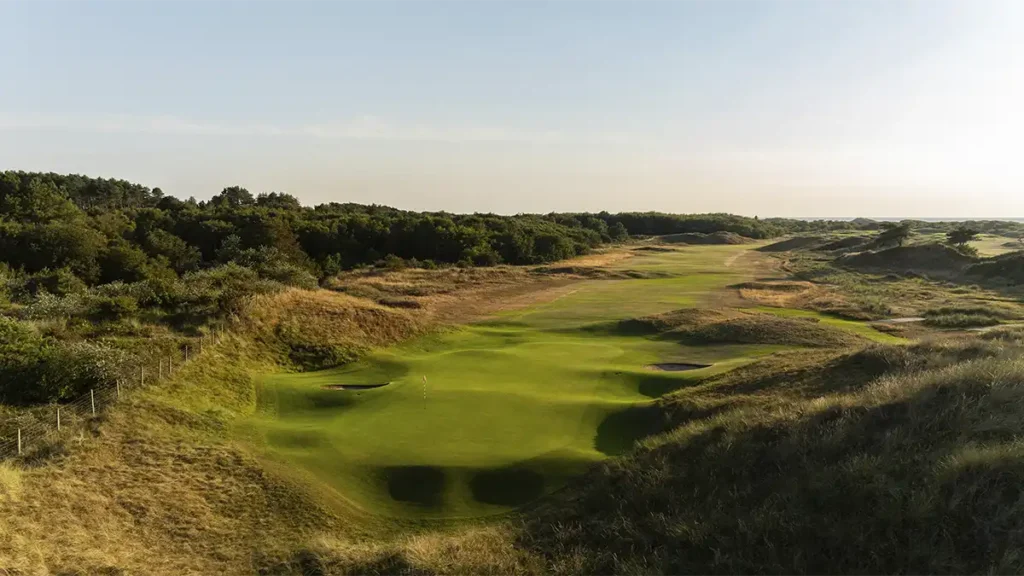
HOLE 17
PAR 5, 566 YARDS / 518 METRES
Birkdale’s only two par 5s, 14 and 17, occur late in the round and have been statistically the easiest holes during its previous three Opens. No one on the leaderboard will feel out of it with these holes still ahead. The slender fairway snakes right to left through a valley of willow scrub, and in normal conditions long hitters can cut distance by carrying a carved-out bunker in the left rough. The green was rebuilt and extended before the 2008 Open by Martin Hawtree, grandson of original architect Fred Hawtree, and is the most significantly contoured, rising in a series of steps into a beautiful amphitheatre of dunes.

THE CLUBHOUSE
The modernist structure of Royal Birkdale’s clubhouse dominates the grass and dunes surrounds with its bright, white, two-storey façade, strong horizontal geometries and centrepiece rotunda windows. This is purposeful: the architect, Lancashire native George E. Tonge, said he wanted the Art Deco-inspired building that opened in 1935, just a few years after the newly remodelled links, to “intrude” upon the course. More than that, the clubhouse has given Birkdale an unmistakable brand – one look and golfers know where they are.
Photographs by David Cannon/R&A/R&A via Getty Images
Brought to you by