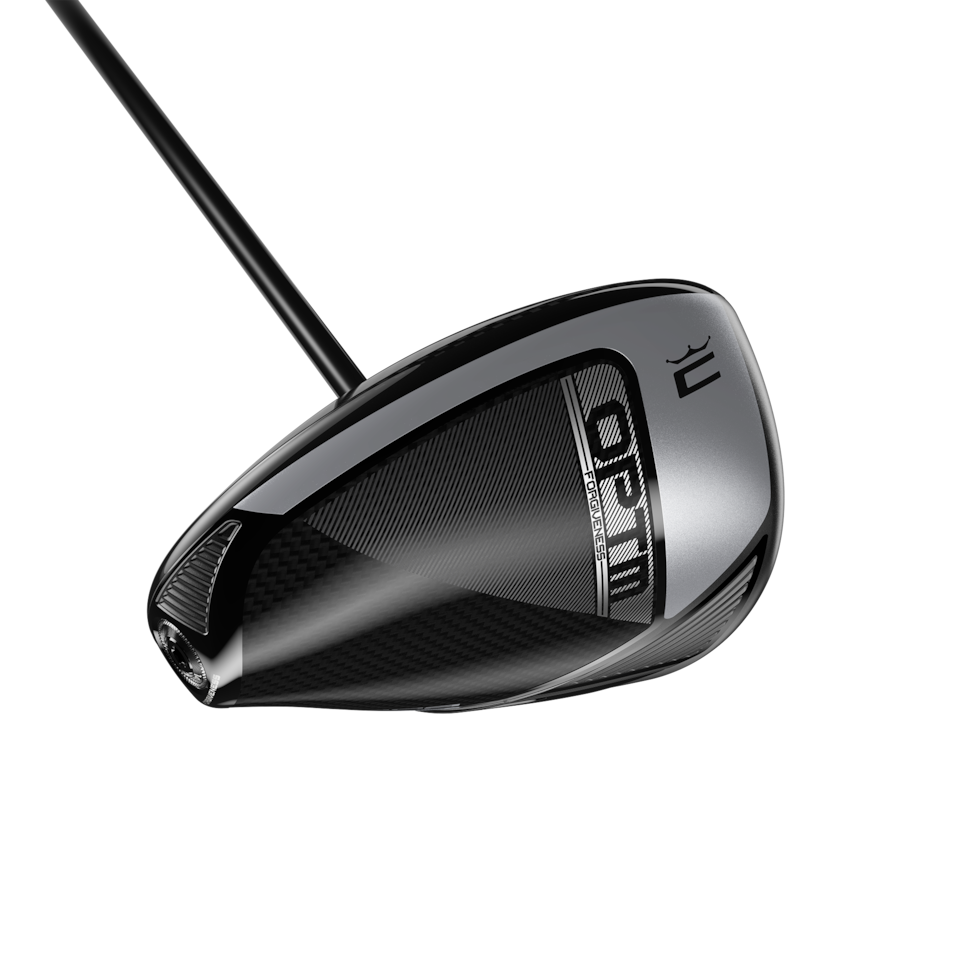
WHAT YOU NEED TO KNOW: The Cobra OPTM family of drivers looks to take a new step toward enhancing stability and forgiveness through special shaping and balanced internal weighting for more consistent distance and dispersion. The line features four models: the low-spin-with-forgiveness OPTM X; the maximum forgiveness OPTM Max-K; the forgiving, draw-biased OPTM Max-D; and the multi-adjustable, aerodynamically-shaped OPTM LS.

PRICE & AVAILABILITY: $999. OPTM X (9, 10.5 degrees); OPTM Max-K (9, 10.5, 12 degrees); OPTM Max-D (10.5, 12 degrees); OPTM LS (9, 10.5 degrees). Each is offered with a 33-way adjustable hosel (+/- 2 degrees). Available for pre-sale January 13, at retail across Australia from January 20.
3 Cool Things
1. Stable stability. Because golf clubs are not symmetrical objects and golfers are not infallible robots, golf club science is hard. Golfers were just beginning to understood what it meant for a clubhead to be stable on mis-hits, what’s been called moment of inertia (MOI). The rules even limited that stability in one direction (technically, along the one “axis of inertia” that splits the club up and down).

Like all three-dimensional objects, a golf club has three principal axes of inertia, and any impact will cause rotation not merely along one of those axes but around a combination of all three of them. (The three axes are the just mentioned heel-toe rotation, the crown-sole rotation that adds loft for high impacts and delofts for low impacts, and the toe-up/toe-down direction along an axis that runs from front to back.) Understanding not merely the rotation but the intensity of that rotation across the entire range of mishits on a driver face is essentially what Cobra is trying to control with its OPTM lineup.
While there also has been talk about 10K MOI drivers to increase their stability, Cobra’s R&D team thinks that the amount of rotation, what’s called the “products of inertia” (POI) needs to be reduced as much as possible to provide the best results. While high MOI makes for consistent ball speeds even on mis-hits, even with higher MOIs, the clubhead still bends and twists a little bit, leading to shots that don’t always go exactly as you think they should. That’s where POI comes in, said Clayton Evans, one of Cobra’s lead engineers.
“If we can reduce the products of inertia and still maintain good moments of inertia and still maintain a good centre-of-gravity position for that particular driver, this can help to make a club more accurate in real life,” he said. “This is real. This works. This is math.”
Specifically, the OPTM drivers try to control the amount of wobble, or technically “torques,” on even the slightest mis-hit, which is almost never directly in line with one of those principal axes.

“When something starts to get out of balance, bad things start to be introduced,” Evans said. “We want to keep all of that as low as possible. Zero would be nice, but since our shapes aren’t squares or cylinders, it makes it hard. So, products of inertia in a nutshell is that torque about one axis and how it creates angular acceleration or rotation about another. And the scope of what we’re doing with these designs is to reduce these products of inertia to obtain better accuracy, better straightness and even better feel.”
Toward that end, each of the four OPTM models creates different shapes, and then balances the internal weighting both front to back and left and right to better align those bending and twisting rotations on mis-hits and produce more consistent distance and direction.

2. Multiplicity. All of that science is compelling stuff but it should not be overlooked that these models incorporate a whole host of other practical features. That includes weight-saving, thin-ply carbon-composite panels in the crown and sole, a variable thickness face design with 15 separate thickness zones to improve face deflection across a broader area, interchangeable sole weights in the X (two) and LS (three) models, and the company’s 33-way adjustable hosel to dial in ball flight from fade to draw that was introduced last year.
3. Models. The four models offer distinct approaches to forgiveness, shaping, aerodynamic efficiency and adjustability.

X: With balanced front and back internal weighting, this model offers a larger front-to-back shape than the LS to emphasise forgiveness while maintaining low spin, targeting players who prefer playable shots and more distance rather than workability. Interchangeable weights in the front toe and rear enable players to tweak launch and spin.

Max-K: It sets up as the largest footprint of the four models and the most forgiving on off-centre hits with a combined MOI designed to be more than 10,000 grams-centimetres squared. The broad address profile deepens the centre of gravity for maximum forgiveness and high launch, and the shape also lowers the rear skirt section to provide a lower and deeper centre of gravity for easier and higher launch along with increased stability on off-centre hits.

Max-D: A similar profile to the Max-K, it adds internal heel-side weighting, lighter overall weight, less toe side face curvature to make it the most draw-biased driver in Cobra’s history.

LS: With more internal weighting pushed toward the front of the head, this model provides the best option for players focused on lowering spin, as well as those favouring a more compact shape for enhanced workability. There are three movable sole weights (11, 7 and 3 grams) to allow the golfer to tweak ball flight between a neutral, low and high flight, as well as added forgiveness, lower spin or varying degrees of draw or fade bias.