
[Photo: Bettmann]
In observance of one of the most historically significant victories in the annals of golf – though one often overlooked – the USGA has returned this week to Scioto Country Club for the 46th edition of the US Senior Open. The championship that begins on Thursday marks the fifth USGA event and the third US Senior Open held at the boyhood home of Jack Nicklaus. But this one celebrates a milestone worth amplifying. For several reasons.
RELATED: Majors season continues with US Senior Open in Ohio
Almost 100 years ago to the day, on July 10, 1926, Bobby Jones made major-championship history at Scioto with his second victory in the US Open. With his one-stroke triumph over Joe Turnesa on a muggy and emotionally draining weekend in central Ohio, Jones became the first player to complete the elusive “Open Double”, adding the US Open title to his triumph in the Open Championship just two weeks earlier at Royal Lytham & St Annes in England. No one previously had won both in the same calendar year.
Furthermore, Jones mastered a setup that was a vast departure from previous editions of America’s national championship, including the site of his first US Open victory in 1923 at Inwood Country Club in New York. The course that the USGA presented that week would come to establish a standard the governing body would employ repeatedly for decades to identify what it deemed a worthy US Open champion.
Finally, in the wake of overcoming nerves so acute that he sought medical attention on the morning of the 36-hole final day, Jones, reflecting on the championship a few days later, was moved to make an observation about his experience and the challenges of tournament golf that echo through the decades and remains pointed and pertinent today.
• • •
Jones was no stranger to Scioto, a Donald Ross design that opened in 1916 not far from the banks of the river that inspired its name. That might explain why he was in no hurry to reach Columbus after becoming the first amateur to win the Open Championship since Harold Hilton in 1897. Jones had played in a pair of exhibitions for charity at Scioto, the first time in 1918 to support America’s efforts in World War I. On June 7, 1924, Jones returned for another match that benefitted the American Olympic Fund. Jesse Guilford upstaged Jones with a 77 to Jones’ 79. In attendance that day was Thomas B. Paine, a member of the USGA executive committee, who was impressed with the club and its golf course. In co-operation with Scioto’s head professional, George Sargent, winner of the 1909 US Open, Paine successfully arranged for Scioto to host the 1926 championship.
After capturing the claret jug at Lytham on June 25, Jones and several fellow golfers, including Walter Hagen, arrived in New York aboard the RMS Aquitania on Friday, July 2. He was showered with a ticker-tape parade and awarded Freedom of the City. A dinner in his honour was held that evening at the Hotel Vanderbilt. Jones declined the invitation until his fellow golfers were included.
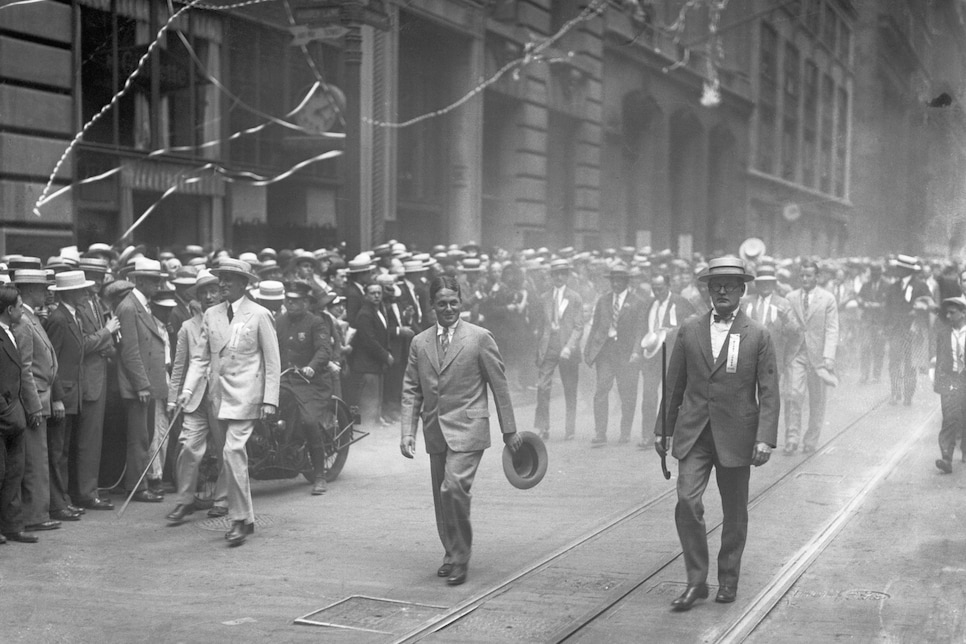
After winning the Open Championship in 1926, but before heading to Columbus in Ohio to compete in the US Open, Bobby Jones was honoured with a ticker-tape parade in New York City. [Photo: Bettmann]
Scheduled to leave for Columbus the next day, Jones instead slipped out to nearby Flushing, New York, to enjoy a casual 18 holes with members of the Pomonok Club. Then he and Walker Cup teammate Watts Gunn made for Washington DC for an exhibition at Burning Tree Golf Club before catching a train that pulled into Columbus on July 6.
Jones’ sole practice round the next afternoon was a miserable affair on a layout he barely recognised. Though it wasn’t actually a practice round. In those days, players participated in matches before the championship, usually pitting amateurs against professionals. Heavy rough and heavier overnight rains made conditions laborious. Newspapers reported that Jones “played like a man who is heartily sick of golf”, and that he “slapped and topped some shots”. He and Gunn lost to Hagen and defending champion Willie Macfarlane, 5&3. Jones had lost the US Open to Macfarlane in a 36-hole playoff the previous year at Worcester Country Club after Jones called a penalty on himself that cost him outright victory in regulation.
But the real story was the golf course. One of the youngest courses to host America’s national championship, Scioto had been upgraded with numerous new bunkers, renovated greens and more than 50 additional yards for a par-72 test of 6,736 yards (6,159 metres). The weather was hot, but so were the competitors, who found rough up to 10 inches lining narrow fairways. A bemused Sargent countered the griping by noting that the rough would not be an issue… if it were avoided.
Although the criticism was incessant, the rough remained untamed. Two players who held their tongues were Jones and Hagen. Meanwhile, diminutive Bobby Cruickshank tried to temper some of the bombastic comments with a more playful observation, remarking, “I lost my ball in there yesterday, and when I went in after it, I got lost myself.”
Narrow fairways and punitive rough became essential elements to the USGA’s formula for future US Opens.
With Glenna Collett, the US Women’s Amateur champion, in his gallery that also included a young hometown sports enthusiast named Charlie Nicklaus, a better-rested Jones opened with a two-under 70, second only to Bill Mehlhorn, who tied Sargent’s course record of 68. A Friday 79 from Jones, however, appeared disastrous as once again he called a penalty on himself when a gust of wind caused his ball to move on the 15th green as he addressed it.
Trailing by six strokes, Jones awoke early on Saturday with an upset stomach so debilitating that he requested a physician. He was taken to the nearby home of Dr Earl Ryan, whose only fee for administering a helpful dose of medication was a request for one of Jones’ golf balls at the end of the day. Though nausea remained, Jones managed to cobble together a 71 before a thunderstorm blew through. At four-over 220, he stood third, trailing just Turnesa at 217 and Mehlhorn at 219.
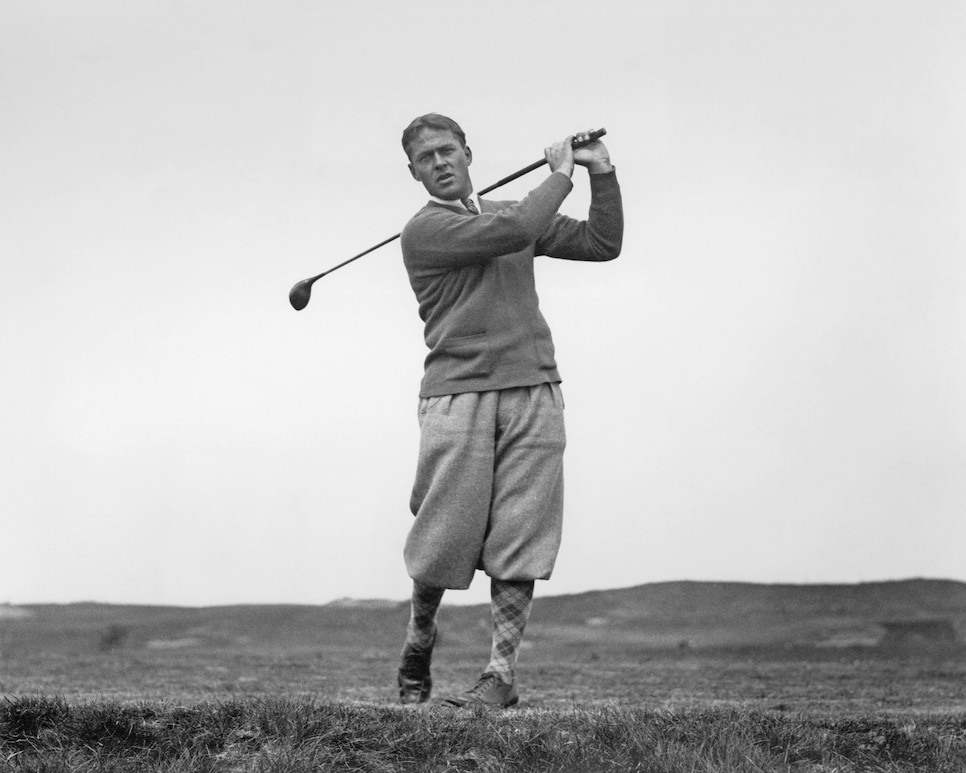
Photo: Central Press
The final round was contested amid grey skies and stiff breezes, but the heat remained oppressive. Having eaten little throughout the day, Jones bogeyed three of the first five holes to slip to seven-over-par. Somehow, he gathered himself for the finish, playing the remaining 13 holes in two-under as winds increased. When he reached the par-5 finishing hole, he wasn’t aware that Turnesa had come home in 40 for a 77 and a six-over 294 total.
It was about 3pm when Jones encountered William C. Fownes, the USGA president, on the 18th tee. Knowing where things stood and that Turnesa had faltered, Fownes advised Jones to “go after your 4 here”. Jones proceeded to blast a 310-yard drive on the 480-yard finishing hole. His second with a mashie expired 20 feet past the hole, and Jones two-putted for a birdie that he had to have for an inward 35 and a final-round 73. He was in at 293. After holing out from mere inches, he spied Dr Ryan in the gallery and tossed the ball to the doctor.
The elder Ryan eventually gave the ball to his only grandson, Dr Jim Ryan, a Columbus cardiologist. He graciously has allowed the club to display the ball in its trophy case.
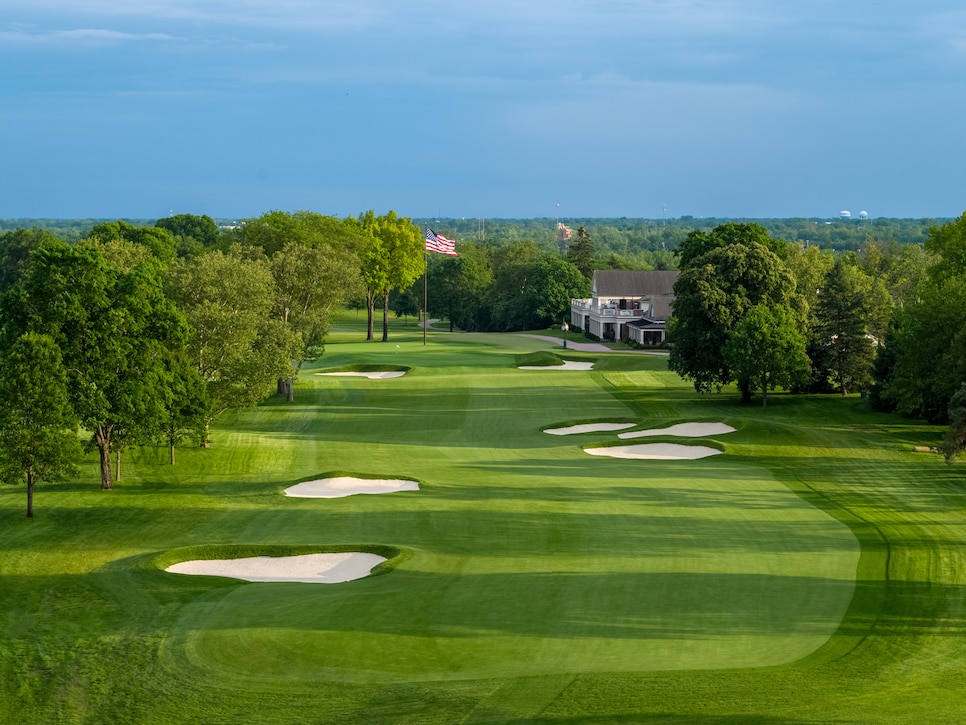
Photo: Evan Schiller
Having finished 90 minutes ahead of the rest of the field, all Jones could do was return to his downtown hotel and wait, and he was certain he had not done enough. When he received the phone call informing him of his victory, Jones broke down and sobbed. In his autobiography, Down the Fairway, published in 1927 and which was inspired by his consecutive Open triumphs, Jones wrote that the events of those three days in Columbus, piled on top of the preceding weeks of high-pressure golf, had exacted a heavy emotional toll.
“I dragged myself back to the hotel with a lot of good players still not knowing who might catch or pass me, and [to tell the truth] so bewildered I didn’t care much. I got to the room and Mother was packing my things and blew up completely for the first time in my life. Anyway, I never did sit down and cry before. Mother said that would be about all of championship golf for me. Next thing I knew they were calling me on the telephone, telling me to come out and get the cup.”
Jones called the victory a miracle that “must have been in the books before the tournament started”, and a “clear demonstration of destiny in golf”.
• • •
Eleven days removed from that tension-filled victory, Jones was still ruminating on his good fortune and the physical and emotional reserves that he summoned to emerge with his fifth major title. In a wide-ranging interview with his friend and biographer O.B. Keeler, Jones offered up perhaps the most recited – and widely misquoted – comment on the pressures of tournament golf.
Taking up more than 25 column inches, the story was titled, “Jones Tells How He Plays Golf.” Prompted by Keeler to expound on “the nerve strain in tournament play”, Jones distilled the essence of competitive golf more profoundly than any words uttered since.
“There are two kinds of golf,” he began in setting up an insight of conspicuous wisdom. “There is golf – and there is tournament golf. And they are not at all alike, inside.”
Stop right there. That last word is crucial, but it mysteriously disappears in succeeding recitations throughout time. Jones was making a distinction that went beyond the challenges of shot-making or itinerant strategic challenges on championship layouts. Tournament golf requires a psychological and emotional investment that is all-consuming – and the pressure is most intense in strokeplay championships.
He continues with why the two types of golf are not alike inside: “I have found that out from experience, much of it bitter. I’m more nervous before medal competitions than matches. In a match you have a single human opponent who may make some mistakes. In medal play you are up against old man par, who never gets down in the one putt and never takes three. The first round of an open championship always causes me the most suffering. It’s worse than the last, oddly enough. You see, in starting I don’t know how I’m going to be hitting my shots the first few holes.
“The start at Sciota (sic) was torture, because I had played wretchedly in practice and was uncertain if I could hit the ball decently. I do not think nervousness hurts my game. The more nervous I am the better I play usually. I suppose it means being keyed up. Some of the sloppiest rounds I have played I was not nervous at all. As to the strain, I don’t seem to be conscious of it during a round. Afterward – well, I know something has been done to me. I sort of collapsed at Columbus after getting back to the hotel. I was all in.”
Two months after leaving Ohio, Jones lost to George Von Elm, 2&1, in the final of the US Amateur at Baltusrol Golf Club in Springfield, New Jersey, preventing the Georgia titan from claiming that era’s “Triple Crown” and a third straight claim to the Havemayer Trophy. The loss would be Jones’ only blemish in that championship in a five-year span.
But that hiccup hardly mattered. In Down the Fairway, Jones referred to 1926 as “the Biggest Year I’ll ever have”. Of course, he did not know what lay ahead, that four years later he would complete the greatest single season in history with the Grand Slam. His gut-check performance at Scioto ignited a run of greater dominance that was as much about embracing pressure as it was execution. In the final 11 majors of his career, Jones won eight of them, including, of course, all four in 1930.