
[Photo: NurPhoto]
There’s a swing tip that’s been handed down through generations of golf instruction: sweep your woods. Don’t take a divot, don’t hit down, just let the club work through impact on a shallow arc and trust the loft to do the work.
It sounds reasonable. According to data from recent robot testing with Golf Laboratories, it’s also more nuanced than that – and for most of the clubs in this test, getting a little steeper is worth the experiment.
RELATED: Do you need more speed to add 20 metres? Our robot test suggests otherwise
More than any other spot in the bag, the gap between your driver and longest iron remains a mystery. Most golfers patch it with whatever club came in the set, or take a recommendation on faith and move on. Few actually know what those clubs are doing at impact – how the ball is launching, how much it’s spinning, whether the attack angle they’ve grooved over years of practice is helping or quietly working against them.
For this test, we ran Ping’s most recent fairway woods (G440), hybrids (G440), utility iron (iDi) and long iron (G440) on the swing robot at two different swing speeds (85 and 95mph) and attack angles (neutral and negative three degrees) to determine how much head delivery at impact affects launch, spin and carry.
Fairway woods 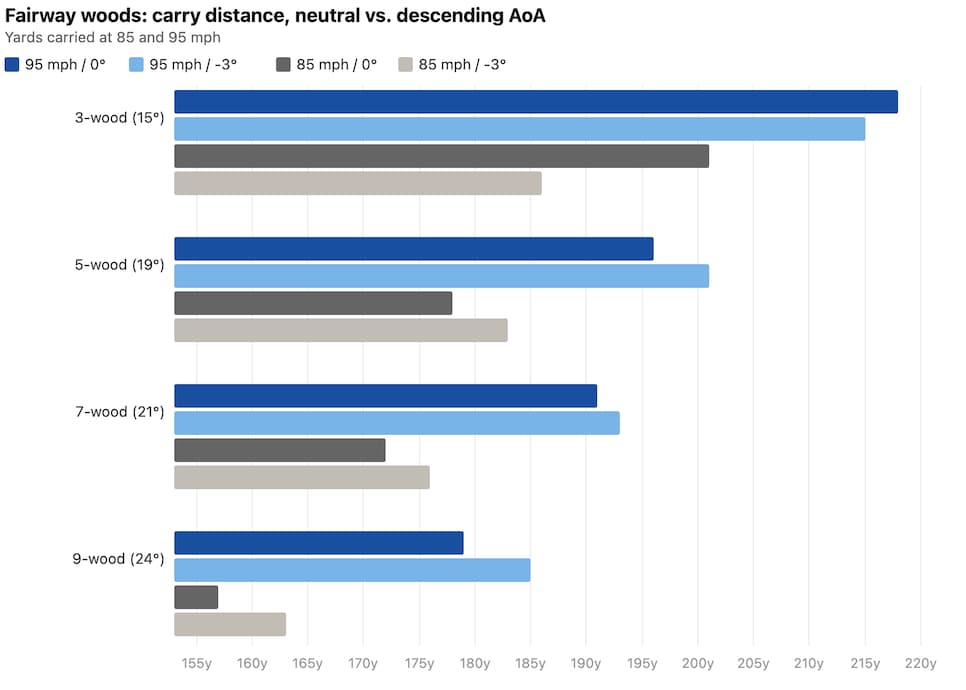
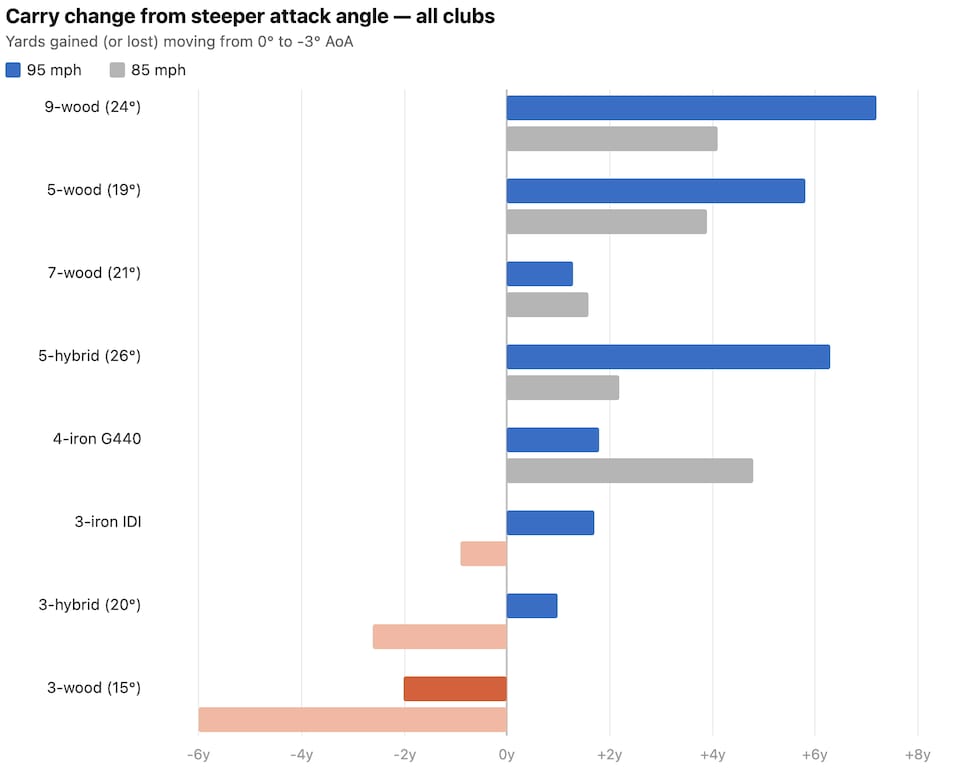
The most dramatic finding belongs to the higher-lofted fairway woods. The 9-wood spun at 6,300rpm with a neutral attack angle – a spin rate that sounds reasonable for a club designed to launch it high and stop on a dime. Move to a descending blow, and the rate drops to 5,835rpm, with carry jumping nearly seven yards at 95mph and four yards at 85mph. These numbers establish a baseline for fairway woods. When you hit down on the ball with a high-lofted fairway wood, spin drops and distance increases.
The 5-wood tells a similar story: nearly 700rpm of spin lost at 95mph, and almost five yards of carry gained. Less spin on a club already launching high means the ball stops climbing early and carries farther instead of peaking. Again, the physics make sense.
What’s interesting is the 7-wood only saw modest carry gains of roughly two yards at both speeds, with spin dropping meaningfully at 85mph but holding relatively flat at 95mph. It benefits from the steeper angle, just less dramatically than the 9-wood or 5-wood.
The 3-wood is the outlier, and it’s an important one. Unlike its higher-lofted stablemates, the 3-wood actually lost carry with a steeper attack angle – down two yards at 95mph and five yards at 85mph. At 15 degrees, the club is already running lower spin numbers (3,928rpm at 95mph neutral) and a flatter, more efficient ball flight. There’s simply less high spin to correct. Forcing a descending blow here drops the launch angle without a proportional spin benefit, and carry suffers for it. The sweep-it advice, it turns out, is actually right for the 3-wood.
 Hybrids
The hybrids split interestingly. The 5-hybrid gained nearly six yards of carry at 95mph with a steeper AoA, with spin dropping over 400rpm – a meaningful response that mirrors what the higher-lofted fairway woods showed. The 3-hybrid was much less affected: a marginal carry gain at 95mph but a slight loss at 85mph. Both hybrids in this test were delivered with a slightly positive attack angle, the robot naturally sweeping through impact, which reflects how most players approach these clubs. Getting steeper helped the higher-lofted one more, which makes intuitive sense given where its spin numbers started.
Long irons
At the iron end, the story shifts again. The iDi 3 utility was largely indifferent to attack angle – barely a yard of carry gain at 95mph and a slight loss at 85mph, even as spin dropped notably at slower speeds. The G440 4-iron, a game-improvement design built for players who want forgiveness and don’t mind playing a larger profile, was actually the biggest carry beneficiary at 85mph: plus-5.6 yards with a steeper blow. That’s a meaningful number for a mid-speed player, driven by spin dropping more than 400rpm without a crippling loss of launch angle. For slower swingers carrying a game-improvement iron, a slightly more descending strike is worth pursuing.
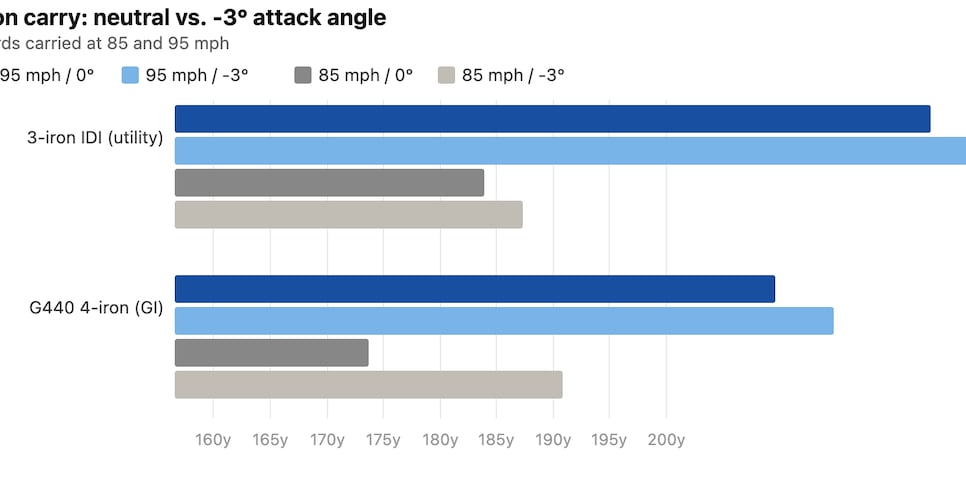
The practical framework this data builds is more nuanced than a single swing tip. The 3-wood wants to be swept. The 5 and 9-woods – and to a lesser extent the 7-wood – reward a descending blow. The 5-hybrid benefits from getting steeper. The G440 4-iron at moderate speeds does too. The utility iron is mostly neutral.
Insights
3-wood recommendation: Sweep it at both speeds. The 3-wood already runs with efficient spin and a flat trajectory. Steepening costs carry at 95mph (-1.9 yards) and 85mph (-5 yards) with no meaningful benefit.
5-wood recommendation: Go negative at both speeds. Spin is running high at neutral (5,703rpm at 95mph), and a steeper AoA brings meaningful carry gains – 4.7 yards at 95mph and 3.9 yards at 85mph.
7-wood recommendations: Lean negative at both speeds. Gains are modest (1.3 yards at 95mph, 1.6 yards at 85mph) but consistent, and total distance improves more noticeably – worth the slightly steeper approach.
9-wood recommendation: Going negative at both speeds reduces spin for noticeable distance gains. The biggest carry gains in the entire test were 6.7 yards at 95mph and 4.1 yards at 85mph.
3-hybrid recommendations: Steeper costs 2.6 yards of carry with minimal spin benefit. At 95mph, the gain is marginal (1.2 yards). Club performs well with a natural sweeping motion at both speeds.
5-hybrid recommendations: Spin is high at neutral (5,755rpm at 95mph), and a steeper AoA brings real carry gains: 5.9 yards at 95mph, 2.2 yards at 85mph, with better total distance across the board.
3 utility iron: Stay neutral at both speeds. Carry gains are negligible (+1.8 yards at 95mph) and disappear entirely at 85mph (-0.7 yards). The utility iron delivers its best results – controlled flight, predictable carry – with a near-neutral attack angle.
4-iron: Going negative at both speeds, especially at 85mph, leads to more distance. The biggest surprise in the test: an extra 5.6 yards of carry at 85mph with a steeper AoA. Slower swingers in particular will benefit from a more descending blow with this club.