One of the benefits of independent robotic testing is its ability to validate insights that might initially seem implausible. For example, the most forgiving driver in this year’s crop (at 95 mph/152km/h) was actually a low-spin model — Ping’s G440 LST.
TOUR NEWS: Rory McIlroy’s dramatic 72nd hole eagle leads to Irish Open title and first since winning Masters
In recent years, we’ve seen low-spin offerings shore up off-centre consistency in a big way, but this is the first year where low-spin took the forgiveness crown over drivers with the word “Max” stamped on the head.
The revealing insight is a reminder that while most drivers are bumping up against the distance ceiling on geometric centre contact, mishit performance keeps improving with every release cycle.
Below are three drivers that stood out from the pack in overall forgiveness.
Testing protocol
Every 10.5-degree driver is tested at 152 km/h (same shaft; neutral AoA) using a 9-point face mapping that captures data from 90 percent of the face.
The swing robot hits six balls from eight mishit locations on the face (high, low and middle quadrants). The data is then compared to a geometric centre strike to determine the severity of the mishit penalty.
Standout drivers
Ping G440 LST (6.6 yards of carry distance loss)
Even before testing the G440 LST on the Golf Laboratories swing robot, we had a strong sense that it could be something special.
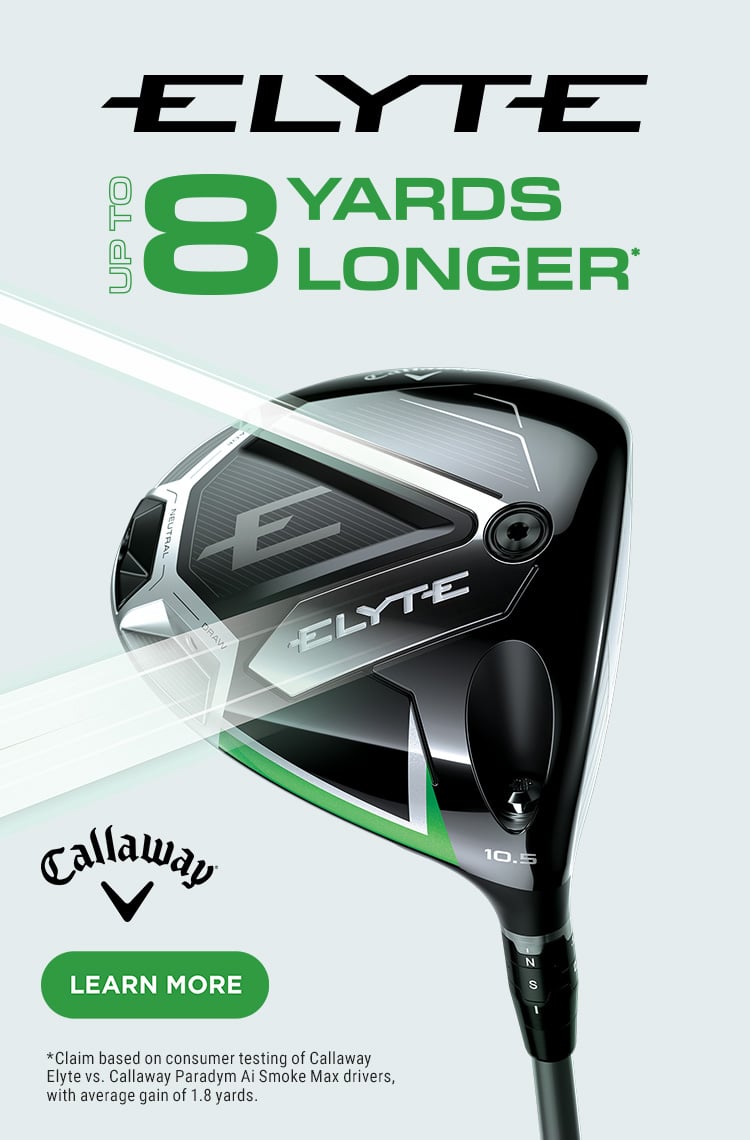
Our MOI measurements confirmed that the LST proved more forgiving than all but six of the drivers we analysed, placing it in the same league as Callaway’s standard Elyte and Cobra’s DS-Adapt Max-K — two models we expected to excel on off-centre hits.
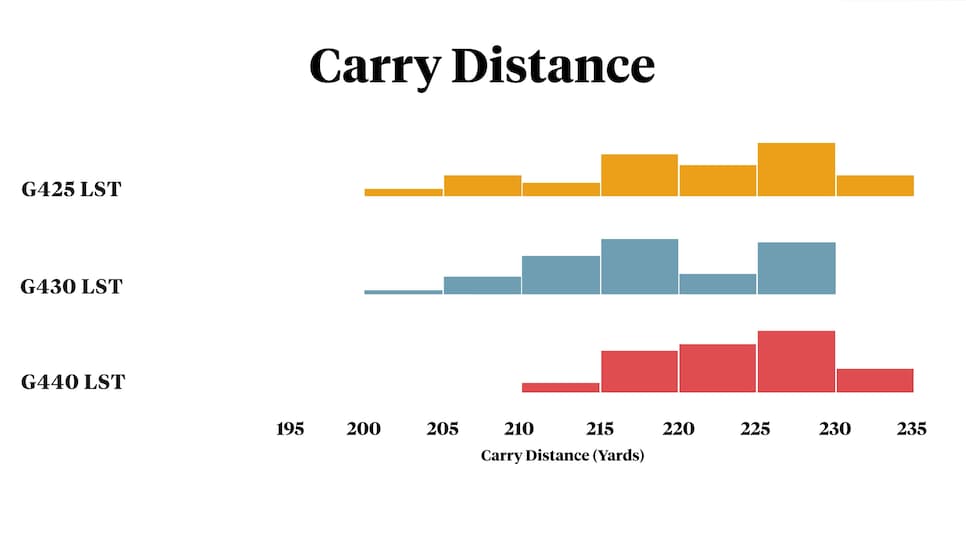
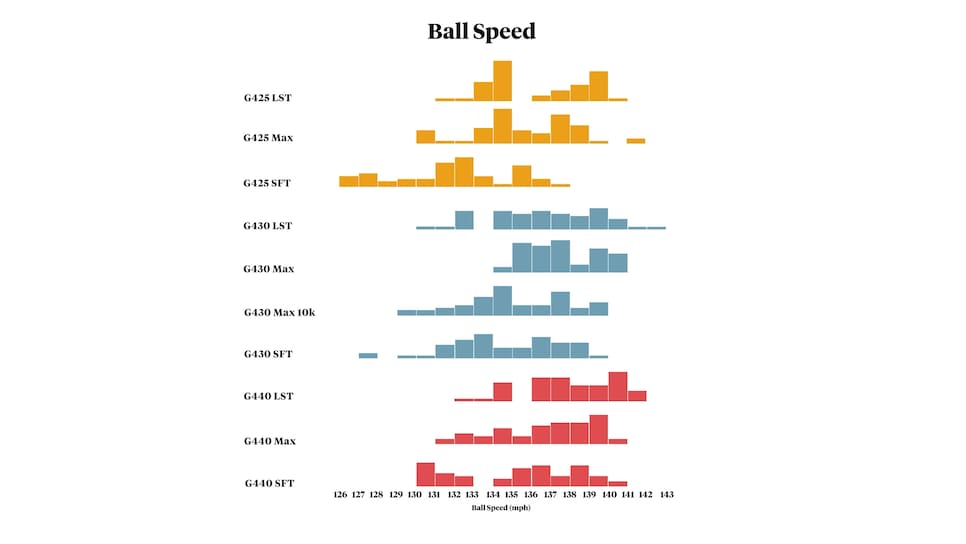
Performance has improved on mishits, and there’s more top-end speed—closer to what we saw with the G425, but with some incremental gains. Ball speeds also ticked up, with several shots recorded between 138 and 141 mph (222 km/h and 226 km/h). So, if you were wondering whether the G440 LST sacrificed speed for forgiveness, the answer is clear: it didn’t.
If you need another reason to pay attention to the G440 LST, consider this: on a high-toe miss, carry distance dropped by just 1.8 yards compared to a centre strike. In other words, the robot saw less than a one-metre loss — a best-in-class carry delta on one of the most common mishits.
TaylorMade Qi35 (8.4 yards/7.7metres))

Another driver with impressive ball speed retention across much of the face, Qi35 delivers an intriguing blend of forgiveness and spin. Six of the eight mishit locations recorded a single-digit carry distance loss, as the standard head kept pace with Qi35 Max.
For golfers who don’t necessarily want to use a larger profile, the swing robot confirmed it’s possible to stick with the standard model and reap similar performance benefits.

Even more impressive was Qi35’s ability to add distance at the top end. Compared to the successful Qi10 — Rory McIlroy and Scottie Scheffler still use a “Dot” variation of the Qi10 — Qi35 managed to add almost 10 extra yards (9 metres), which can be attributed to fewer bad shots on the low end and a higher concentration of the 54 shots the robot struck, ending up around 196-210m at 95 mph (152km/h).
Golfers expect the “standard” head in the lineup to have a reasonable level of forgiveness. What makes Qi35 different is its ability to possess low-spin speed and max model forgiveness.
RELATED: Scott Hend reigns in Spain after European Legends Cup win
Callaway Elyte Triple Diamond (9.9 yards/9m)
%20copy.jpg.rend.hgtvcom.966.544.suffix/1745861772986.jpeg)
Callaway’s Elyte TD isn’t just another low-spin option. It possesses impressive ball speed and recorded more 235-yard shots than any Callaway driver in the last three years. The strong distance numbers can be attributed to a face design that helps retain speed on penalising mishits.
%20copy.jpg.rend.hgtvcom.966.544.suffix/1745861773164.jpeg)
And if you live in the high-toe miss zone (welcome to the club), you’re not going to get torched on distance. We’re talking a 4m drop, which is minimal by today’s standards.
Elyte TD’s average spin rate and dispersion trend in the same direction and actually beat out the standard Elyte and the more forgiving Elyte X on spin consistency, further confirming TD’s ability to mitigate a noticeable drop in performance, regardless of impact location.