How small-space golf experiences are driving participation in Australia.
Across Australia, a new generation of golf facilities is reshaping the industry. From par-3 and putting courses to enclosed driving ranges, small-space designs are enabling golf clubs to develop unused parcels of land and diversify their income beyond traditional sources.
The movement illustrates a broader shift in how the game is being delivered and experienced across Australia.
These facilities are designed to appeal to a wider audience, while also proving commercially viable at a time when clubs are searching for sustainable, long-term growth. To dive deeper, we visited four facilities that are finding success with golf in small spaces.
Shortees: Three is the magic number
Set in Sydney’s Northern Beaches, Shortees is perhaps one of the clearest examples of golf adapting to modern lifestyles. Originally a modest pitch-and-putt facility, the par-3 course was redeveloped in 2023 into something far more contemporary: a social-golf destination built around accessibility, atmosphere and speed of play.
Upon arrival, the tone is immediately clear. A sign at the clubhouse reads: “Black Socks, Footy Socks, No Socks, No Shirt, All Welcome.” It is the antithesis of the traditional golf-club message, and intentionally so.
Shortees has embraced a relaxed, community-focused identity that appeals to those seeking an experience rather than simply a round of golf.
Scott Williams, co-founder of Shortees, explains the philosophy behind the concept: “The Shortees experience is unlike any other golf experience. People, when they come up here, they’re not just coming for the round of golf. They’re happy to sit down afterwards. They’ll have something to eat, they’ll have a drink. So people start to really engage at a community level with us as well. Obviously people are more and more time-poor these days, so the ability to come and play 18 holes in less than two hours is quite attractive.”
Built on a former refuse site, Shortees demonstrates how unconventional pieces of land can be repurposed into commercially and socially vibrant golf venues.
Williams says the welcoming atmosphere has been instrumental in attracting demographics often under-represented at traditional golf clubs.
“We have the best and the worst golfers you’ll ever see in your life,” he says. “We see a lot more participation from non-golfers and women because of the access and the ease of play. We don’t view ourselves as anti-traditional golf, I love the traditional game. But we offer something totally different, which can sit alongside more conventional venues and introduce new people to the game.”
Oxley Golf Club: A Putting Course with Serious Financial Impact
At Oxley Golf Club in Brisbane, the introduction of a small-space golf facility was driven by a need to improve financial performance and strengthen long-term sustainability. The club needed a solution that would attract new people, while remaining consistent with the feel of a traditional golf club.
Aaron Muirhead, general manager of Oxley Golf Club, recalls the motivation behind the project: “When I first came to the club, there was an issue with cash flow and obviously profits that they were seeing each year. So I did a bit of research into the courses that had done mini-golf. Some have clowns and windmills and all that sort of stuff. I didn’t want to go down that line. I wanted to do something that was more replicative of a smaller golf course.”
The club partnered with Himalayas Golf to fulfill that vision, creating an 18-hole putting course designed to feel like a miniature version of what you experience on the main course.
“Our turnover now is about 32,000 to 33,000 rounds on the putting course per year. Ultimately, this revenue has paid off the money that we borrowed for the build, in about three-and-a-half years,” Muirhead says.
Beyond financial performance, the project has helped reposition the club as a community destination, hosting regular events such as night markets that attract new visitors to the club.

Flagstaff Hill Golf Club: Becoming a Community Hub
At Flagstaff Hill Golf Club in Adelaide, small-spaces golf has played a pivotal role in transforming the club’s identity and evolving it into a true seven-day venue.
The addition of a putting course has created new revenue streams and community events, while simultaneously introducing new players to the game in a low-pressure environment.
Chris Coulter, general manager of Flagstaff Hill Golf Club, describes the impact: “The addition of a putting course has brought a lot of people here to the club. A lot of families. Normally it’s the first time people experience golf. They can then flow on into our clubhouse where they can use our bar, use our restaurant and join up as social members – which has gone from about 50 people to nearly 500 now. Golf clubs have to do that now, look at other ways to expand outside our normal offerings.”
The putting course serves as a reliable revenue generator for the club, but more importantly as an accessible entry point to golf for the entire community.
Swing City: Reinventing the Driving Range
If Shortees, Oxley and Flagstaff Hill demonstrate the social and financial potential of compact golf, Swing City showcases its technological future.
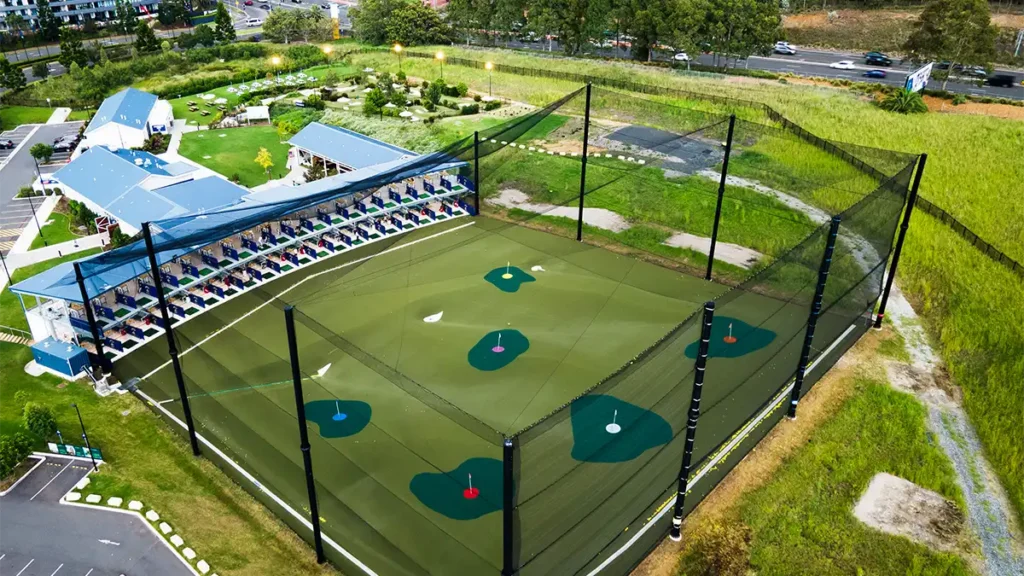
Located on a constrained suburban site outside Sydney, Swing City features a putting course alongside a “Smart Driving Range” that re-imagines what practice facilities can look like in land-limited environments.
Instead of requiring the 250-metre footprint of a conventional driving range, Swing City operates within about 50 metres. Players still see initial ball flight, while advanced tracking technology delivers detailed performance feedback on-screen. Balls are then funneled automatically into collection areas and returned to the hitting bays without manual retrieval.
Paul Jansen, chief executive of Himalayas Golf, views the concept as a forward-thinking solution to modern land constraints: “You really only need 50 to 60 metres. You’ll see your ball flight, and then you turn and look at the screen. This range was really the first of its kind in the world, and now you are seeing similar projects across the globe.”
The implications are significant. Technology-driven practice environments make golf development feasible in urban and high-density areas where conventional facilities would be impossible to build.
More Than a Novelty
Across Australia, small-space golf is emerging as one of the most significant developments in the modern golf industry. These facilities are attracting new players, enabling utilisation of otherwise unusable land and creating diversified revenue streams that support long-term sustainability.
At the forefront of this movement is Himalayas Golf, a firm that specialises in creating compact golf facilities around the world. Jansen says the Australian examples illustrate a broader shift in perception around the game itself.
“Sometimes golf has negativity around it of being exclusive and pompous,” he says. “If you were to look at the examples in Australia, they’re far from that and they’re doing very, very well. That’s great for the game of golf.”
The message is clear: small-space golf or off-course golf is not a passing trend. It is becoming a core component in how golf grows participation, engages communities and ensures long-term success for both clubs and golfers.