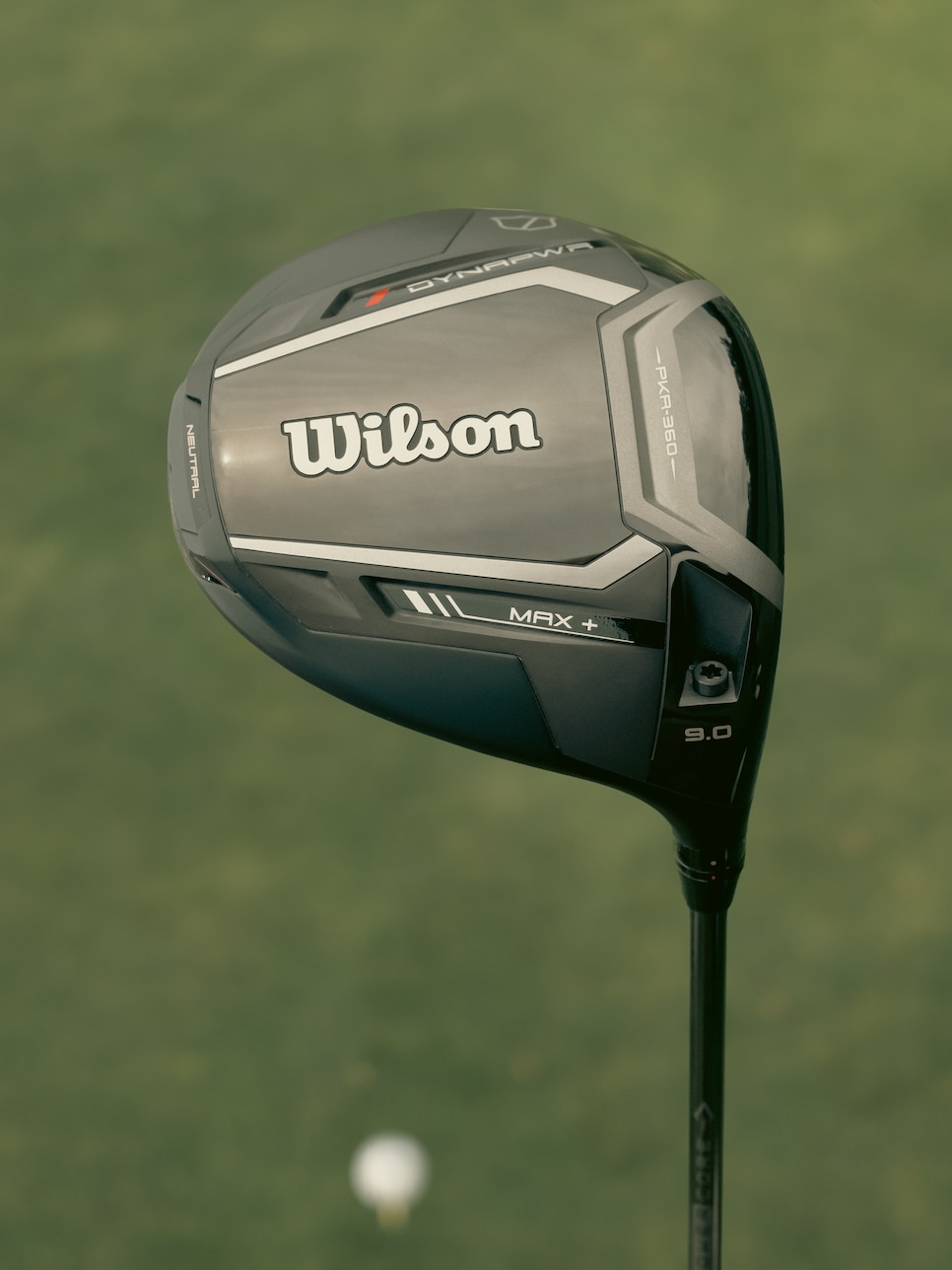
WHAT YOU NEED TO KNOW: The Wilson Dynapwr Max+ pushes the company’s driver lineup to a new model with the highest rating for stability on off-centre hits (moment of inertia) than any driver in company history. The super-stable head uses a weight-saving carbon composite crown and internal rib structures to produce more perimeter weighting while maintaining a softer sound than some other all-titanium max-MOI drivers.
PRICE: $899.95. 9, 10.5, 12 degrees. 12-degree also available in a Lite version, including a 40-gram shaft.
RELATED: Wilson Staff Model irons: What you need to know
3 Cool Things
1. Maxing out. The coin of the realm when it comes to forgiveness in drivers has become the measurement of moment of inertia (resistance to twisting on off-centre hits). While the USGA has limited the way the head of a driver twists on off-centre heel and toe strikes at 6,000 grams centimetres squared, many companies are pushing new limits for how the head twists on high and low mishits. They’re then combining those two measurements for the highly sought after 10,000 MOI designation or the proverbial “10K” driver. Wilson’s Dynapwr Max+, the fourth model in the revised Dynapwr lineup introduced in 2025, pushes that limit to become Wilson’s most stable driver head.

Getting there involved a myriad of construction techniques and shaping tweaks. Most notable is the use of a carbon composite crown, and while Dynapwr line already has a carbon crown option in the Dynapwr Carbon model, the saved weight is used differently on Dynapwr Max+. The Carbon model uses that saved weight to lower the centre of gravity and push it forward. The Max+ is all about extreme stability in a much larger chassis, which extends the CG farther away from the face for more stability and consistent ball speeds in favour of highest centre-hit ball speeds.

“It was an exploration into every avenue to develop and design forgiveness performance while keeping that better player appeal that we’ve been targeting,” said Jared Guttmann, Wilson’s manager of advanced golf R&D. Guttman noted that the Max+ avoids pushing a heavier head weight to reach its extreme MOI, allowing it to also maintain a more conventional swing feel.
The carbon composite frees up mass that in part is redistributed in the form of a 26-gram adjustable weight in the rear centre of the perimeter (vs 19 grams on the Dynapwr Max). Like on the Max, it’s asymmetrically balanced with a heavier and a lighter side that can be flipped to achieve more heel-side or a more neutral weighting.
2. Sounding board. The carbon crown was key not just in what it might allow from a forgiveness standpoint but how it also enhanced sound and feel in such an oversized footprint.
“From a better player appeal standpoint, sound and feel was critical to developing this driver,” Guttman said, noting the team looked at not just how the carbon composite was being used, but also its thickness, the connection points to the titanium body, and the placement of internal ribs to control vibration. “Getting to 10K MOI, we were not going to go that way if we could not get a club that performed from a sound and feel standpoint. It was a labor of love that got us to where we are right now.”
Wilson’s engineering team used finite element analysis to simulate how the head would vibrate and where structural ribs could be placed to control and damp vibration. Those include structures that stretch from heel to toe on the inner portion of the sole and a series of ribs that extend on the rear interior. The former had the added benefit of pushing mass lower in the head, while the latter increased the perimeter weighting in the rear of the head. Guttman said a key improvement was controlling not merely the volume and pitch but the duration of the sound for a more compact hit sensation.
3. Reading faces. Wilson’s Dynapwr drivers have continued to explore the use of AI to calculate its array of variable thicknesses on its faces (known as PKR-360 for “peak kinetic response,” and the Dynapwr Max+ features a distinctly new design that not only optimises ball speed consistency, it also saves as much as five grams in the face that can be used elsewhere for stability and lowering the CG.
The Max+ face area is similar to the Max, and while the face insert weighs less, it also features more potential appeal to better players because the toe side shaping peels back a bit for a less closed look at address. The Max+ face also takes advantage of asymmetrical bulge and roll, including a sharper radius to produce more consistent downrange distance based on spin and launch.
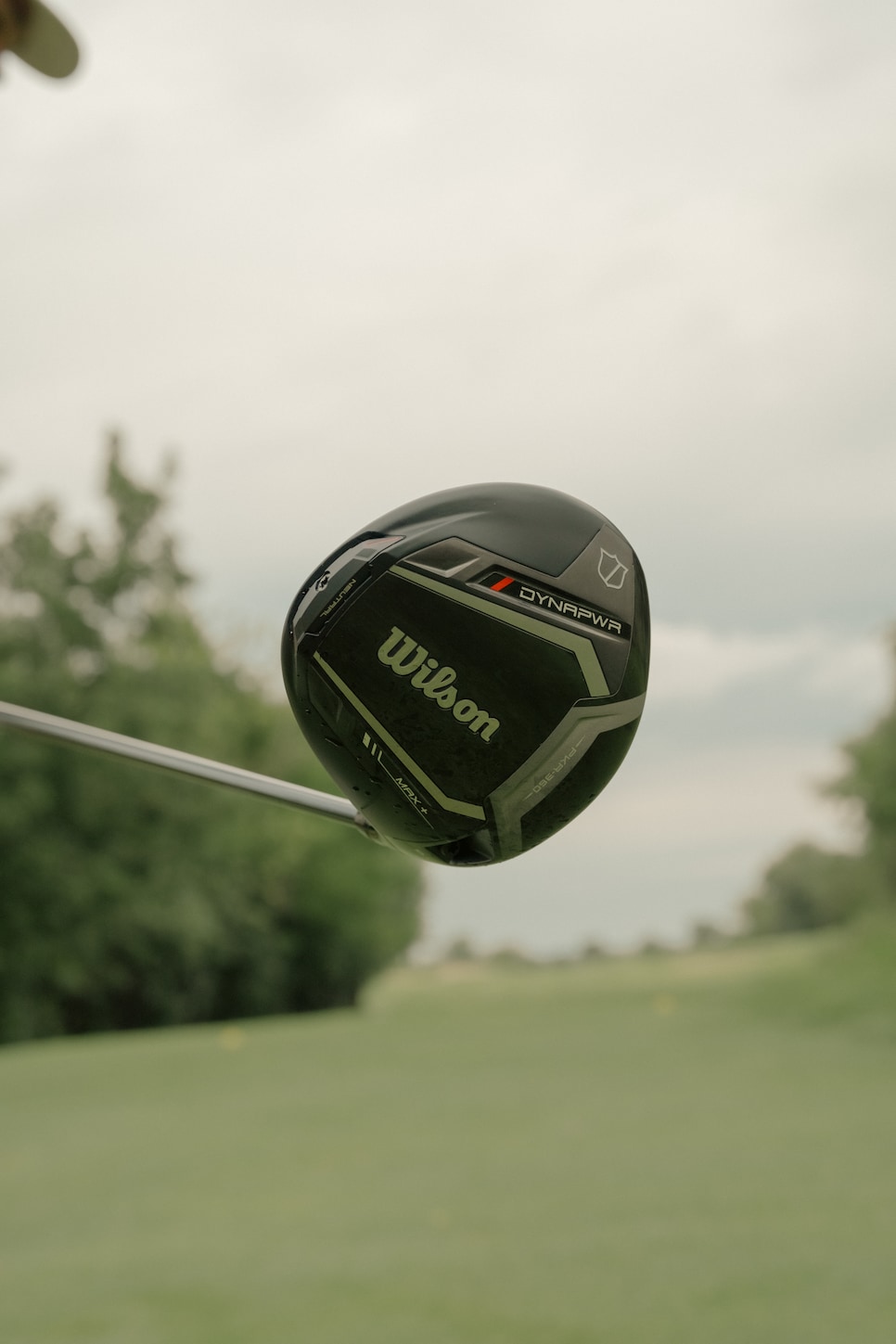
Those more dramatic changes in face thicknesses save weight but also create more localised flex to improve launch, ball speed and control spin.
MORE: Wilson Staff Model, Staff Model X golf balls: What you need to know
“It’s not just an optimisation of the face insert itself, but it’s also the transition areas, the top line and the leading edge as well that gets adjusted in our optimisations,” Guttman said. “We really have the largest deltas of thicknesses across some of those regions, which gets us more consistency and allows us to find more ball speed, more compliance.”
The optimisation routine behind the PKR-360 face designs attempt to get the ideal mix of ball speed and forgiveness, or essentially the least amount of variance across the major impact areas of the face. According to Wilson, the optimisation process was performed across 512 CPU cores running parallel simulations, and every optimisation run resulted in more than a thousand design iterations.