
[Photo: Andrew Redington]
Mike Davis returns to Shinnecock Hills Golf Club this week for the 2026 US Open, as interested as ever in the championship and how it plays out on one of the most storied courses in America but no longer invested in the outcome.
RELATED: Why can’t they get Shinnecock right?
The former chief executive of the USGA and long-time setup man for many of its championships, Davis has attended the US Open every year as a guest of the organisation that he left in 2021 to pursue a career in golf-course design and development. He no longer endures the pressure of getting a US Open setup just right, but, by the same token, he no longer has the opportunity to tackle a challenge that brought him more enjoyment and fulfilment.
Shinnecock Hills, in Southampton on New York’s Long Island, played with both his anxiety and excitement.
Davis was chief assistant to Tom Meeks for the 2004 US Open at Shinnecock, a championship widely criticised for a setup that wasn’t just over the edge but nearly off a cliff. Symbolising how badly the USGA had erred were the unplayable conditions at the par-3 seventh hole, where the first few groups in the final round struggled to finish because the unprotected and raised putting surface had become too slick and dried out. Officials took drastic action and watered the green between groups. Somehow, Australia’s Robert Allenby shot an even-par 70, while Retief Goosen and Phil Mickelson carded 71s in finishing first and second, respectively, Goosen winning by two strokes at four-under 276.
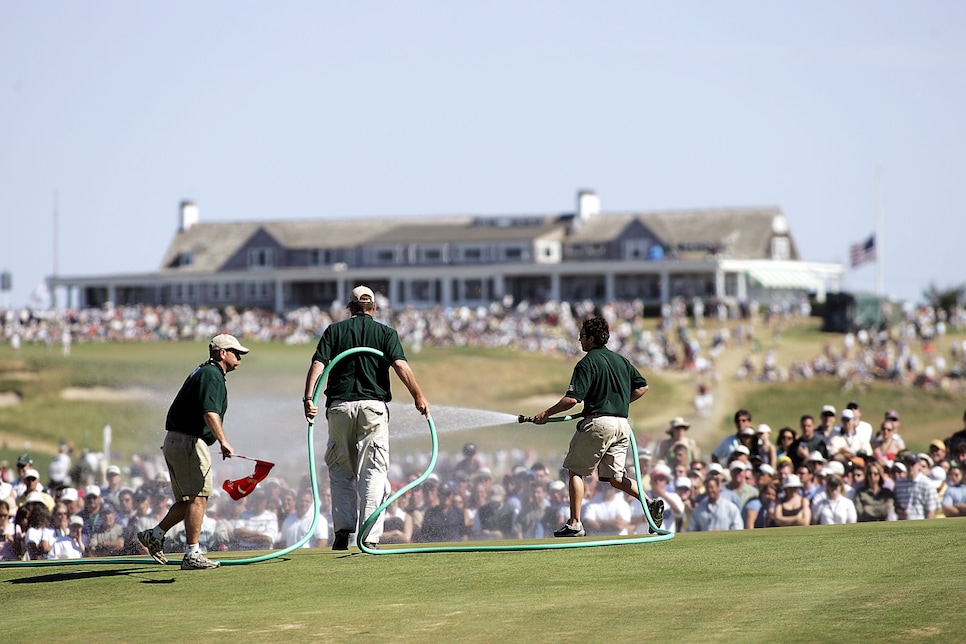
Groundskeepers water the seventh green during final-round play at the 2004 US Open at Shinnecock Hills. [Photo: Al Tielemans]
Mickelson was at the centre of another setup controversy during the third round in 2018 when he hit a moving ball that was speeding off the green at the par-4 13th hole after hitting his first putt too firmly. Tony Finau and Daniel Berger, among the early staters, each fired 66, which increasingly looked like scoring outliers as winds increased and conditions became dicey. Eventual winner Brooks Koepka submitted the lowest score among the final four pairings with a 72.
Would Davis have done anything different in either championship? Well, yes. But nothing as drastic as you might think.
“First of all, Shinnecock is one of the hardest Open courses to set up because it sits on pure sand,” Davis, who spent 31 years at the USGA, including 11 as CEO, told Golf Digest in a telephone interview from his office in Florida. “I think Pebble Beach tends to get more wind than Shinnecock gets, but the difference is it doesn’t dry out as quickly as Shinnecock because it sits on heavy soil. So when the wind blows at Pebble Beach, conditions do not change as dramatically.”
RELATED: A closer look at the evolution of Shinnecock Hills’ iconic design
Combine freshening winds with questions about just how much water had been applied to the greens, and that Saturday in 2018 was difficult, though not nearly the chamber of horrors in 2004. Just ask Jim Furyk, who will work this week’s US Open for USA Network. His final-round 79 left him T-55 in his title defence, while in 2018 he scrambled to shoot 72 – and he was only on the third hole when Mickelson went loping across the green, so he played in conditions that continued to get harder.
“I remember distinctly [in 2004] standing over putts, 20, 25 feet uphill, and still kind of [having a] lag mentality,” he said last week during a teleconference. “It was so easy to fire one four and five feet by the hole, and I just remember there was no place where I felt like you could be aggressive… I couldn’t really fathom the golf they [Goosen and Mickelson] played, and some of the best golf, surely, if I’m talking about some of the best rounds that I’ve seen throughout my career, I would probably have to include the golf they played that year.”
Despite assurances from the USGA that a repeat of 2004 wouldn’t occur, the 2018 championship devolved into an exercise of handwringing by Davis and his staff as player remonstrance reached excessive levels.
“I’ll just tell you that people who say on Saturday [in 2018] we had a couple of bad hole locations on the back nine and that we lost the golf course, they don’t know the facts of that,” Davis said. “We had seven-eighths of the field go through the back nine and the hole locations were fine. The wind picked up and the greens dried out and it became very difficult. But, look, conditions are always going to be tougher as the day goes on wherever you are. That can’t be prevented. Wind and sun are going to change a golf course. But it just got a bit more challenging at Shinnecock. It wasn’t just the 13th green or the 15th green. They all dried out. But anyone who thinks they were bad hole locations, they were not. In 2004, the seventh green was just a bad hole location because there was so much trouble for the first few groups.
RELATED: 2026 US Open – Peconic punishment
“It’s just much harder to set up a course that really has the chance of getting quickly too firm and fast.”
Agronomy plays a role, too, at Shinnecock, Davis explained.
“Shinnecock has Poa annua greens, and unlike bentgrass or Bermuda, it’s a plant that grows straight up. It’s a very thin blade, and when it gets dry, it wilts,” he said. “When bentgrass gets really dry, what it does is it turns purple in colour, but it’s a much thicker blade, so there’s still friction. So the problem was when you get wind and dry conditions and you have sand greens it’s nature doing its thing.
“I go back again to Pebble Beach,” Davis continued, the California course that hosts the US Open again in 2027. “I mean those are not sandy soils out there. Those greens scared me the most only because actually the greens are faster than any greens for a US Open. But you can control those. You can get them to a certain speed in the morning and if that works, you’re going to be OK with the rest of the day.”
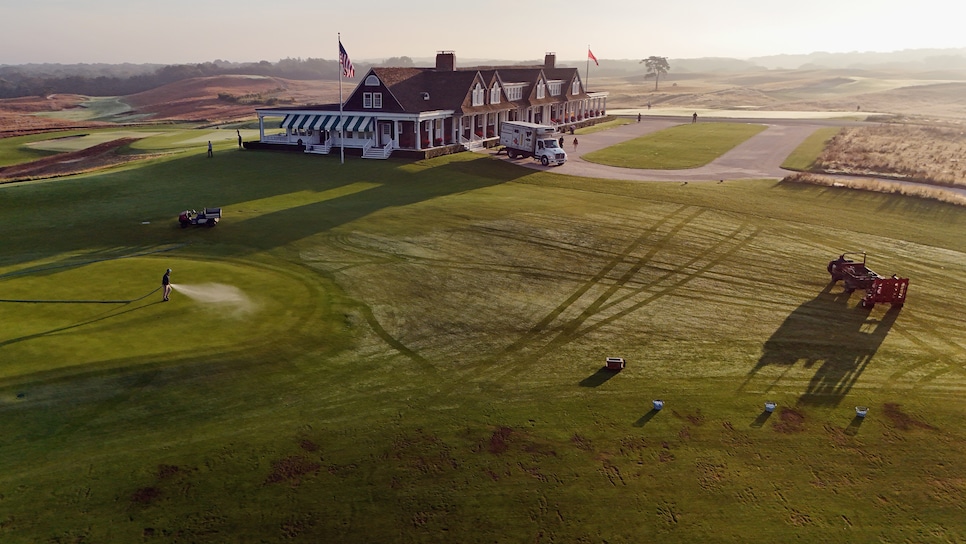
Photo: Bruce Bennett
The USGA will be walking the tightrope again this week, though it appears with a greater margin for error. Fairways are wider, but the rough will be more penal and without the graduated cut that Davis preferred to offer players who just missed the short grass. Green speeds will probably be kept in check.
Davis is confident that the championship will be properly tough enough. Because it’s Shinnecock.
“I think Jeff Hall and John Bodenhamer are going to do an awesome job, but there will be critics,” Davis said. “A lot depends on the wind. With a wider area off the tee, if the wind doesn’t blow, scores are generally going to be good. And that’s OK. And if it blows and maybe it blows significantly, scores are going to be high. And that’s OK, too. One or the other doesn’t indicate that they didn’t get it right. I think one certainty is that Shinnecock will have its moments against the field no matter what.”