A golf writer travels the length of New Zealand’s North Island in a journey more than 20 years in the making.
For Australians, one of New Zealand’s best attributes is the twin sensations of familiarity and mystery the country evokes. Normally a paradoxical union, those usually conflicting feelings materialise thanks to our knowledge of everything to do with our neighbour, yet also through the nation’s physical contrasts with our own.
I’ve long been an unabashed fan of the South Island. The mesmerising mountains and fiords have surely been responsible for more than a few strained necks over time, such is the circular nature of the jaw-dropping views. Yet for some reason, the South is all I’d ever seen. Despite living my entire life within a few hours’ flying time of Auckland and the North Island, I’d never been there – for either work or a holiday – before my visit late last summer. I’d soon discover the contrasts.
Upon checking in for my first night on the North Island, the woman running the modest motel in Upper Hutt, north of Wellington, expressed surprise when I said I was visiting the northern half of the country for the first time. When I mentioned that I’d visited the South Island several times, just not the North, she sighed and said, “Ah, the South Island is so much more beautiful.”
It has long been the characterisation for tourists of the two main islands, although beauty truly does lie in the eye of the beholder. In a top-to-tail journey up and down its expanse, I’d encounter ample scenic wonders on the North Island – just a different brand compared to those of the stunning South Island.

AN UNEXPECTED JOURNEY
The invitation first came in 2004, about the time Cape Kidnappers opened. Its sister course, the enthralling Kauri Cliffs, had already been welcoming golfers for a couple of years. Together, they represented two sterling reasons to visit the North Island – ideally as ‘tent pole’ courses to prop up a lengthier golf itinerary. I’d been offered the chance to see both properties during that time in something of an open invitation. For reasons that still befuddle me, it took more than 20 years to accept.
Not that I’d ever forgotten; I simply couldn’t concoct circumstances in my favour before this year. So when the opportunity finally arose, I made sure to compile a packed itinerary, beginning in the Kiwi capital.
Upper Hutt drew my attention thanks to Royal Wellington Golf Club, which began life at Miramar in 1895 before moving to its current site at Heretaunga 11 years later. It immediately struck me as an escape location, as there’s a genuine sense of ‘getting out of town’ at the gorgeous site beside the Hutt River, 40 minutes’ drive north of the city. The golf course is set in an arboretum environment, with spectacular and fulsome trees framing rather than intruding on the holes.
It’s a mostly flat layout but one rich in character and with the overall challenge enriched by strong par 3s. The greens feature distinct shelves and sections, with pin positions frequently dictating the approach strategy as well as the difficulty of the hole on any given day. The holes closest to the river are more open and so are susceptible to breezes whipping up and down the watercourse.
The club once had a reputation for stuffiness, but no longer. Royal Wellington today is as friendly a club as you’ll find, welcoming visitors most days each week. Any newcomers with a nose for history should take some time soaking in the history of the memento-filled clubhouse, while the club is preparing to host the Women’s Asia-Pacific Amateur next February after hosting the men’s edition in 2017.
Further north of the city – and flush against the North Island’s west coast – is the exceptional Paraparaumu Beach Golf Club, with its rumpled, Scottish-links feel. Long highly regarded in Kiwi golf circles, the club enjoyed prominence in January 2002 when Tiger Woods played in the New Zealand Open there at the behest of caddie Steve Williams (and thanks to a hefty financial outlay from a consortium of private investors).
The course rolls across a compact site – many tees are just a few paces off the previous green and houses line the boundary on most sides – while the dunescape is certainly reminiscent of the best links courses in the UK. Think Royal Lytham without the gorse. Several perched greens, many of which are small and feature steep runoffs, highlight the need for pinpoint iron play, which is no easy task in any breeze. Meanwhile, revetted-face pot bunkers litter the landscape to complete the links picture.
Paraparaumu is narrow in parts and is a strategic layout that demands precise iron play plus the ability to flight shots through the wind. No wonder Craig Parry put Tiger and the rest of that field to the sword there in ’02. How tough is it for those without a tour card? Let’s just say that “Par” appears twice in Paraparaumu, which is about as frequently as pars appeared on my scorecard.
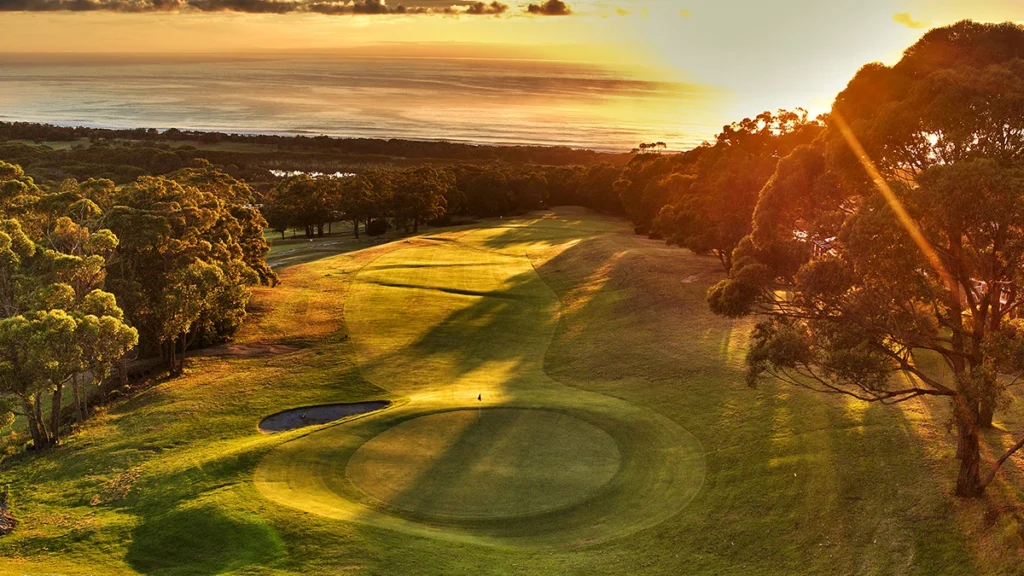
I’d spent two decades obsessing about Cape Kidnappers Golf Course. A combination of the imagery and location plus Tom Doak’s design nous had me salivating as I made my way across the North Island towards the east coast. Touring Kidnappers feels like you’re playing golf on the edge of the world – almost like a fantasy course from those wild calendars filled with impossible yet dazzling hole designs. Famously, it is possible to miss dry land at the iconic 15th hole, where the hole’s name, Pirate’s Plank, is true to form. The fairway tapers throughout the par 5 and a shot curving left of the green risks plummeting into the Pacific a hundred or so metres below.
Doak has never been afraid of colouring outside the lines and the dramatic terrain at Cape Kidnappers dared him to do so. Holes curve through or along valleys, across ravines and flirt with the edge of civilisation. Even the few flat fairways, such as the 10th, have life breathed into them via interesting green contours. Cape Kidnappers is not merely an amazing site with some window dressing; the 18 holes themselves are brilliant. Drawing down an imaginary curtain to block out the views would still make for an unforgettable experience.
I liked the little touches, too. Scorecards are available in metres or yards, the entirely wooden rakes complement the bunkering and the service is exceptional, while the adjoining Rosewood lodge is a must-stay. It’s obscenely good, with an unbeatable menu, more flawless service and accommodation that is difficult to leave. Come for the golf but stay for the degustation menu in the restaurant. Each item is like the holes on the golf course – you want to savour them all.
Difficult as it was to leave Kidnappers, the inland drive to Kinloch Golf Club ranked among my favourites on the North Island. In a picturesque setting near Lake Taupo, the front nine traverses an open plain that’s benched against a steep hillside and bordered on one side by a small forest, while the back nine is similar but offers more views of the lake. There’s a touch of Whistling Straits to the bunkers with frayed, ill-defined edges merging with the wispy rough around them in a striking colour contrast.
Mini-undulations abound at Kinloch, as Jack Nicklaus’ fairways and green complexes are intended to test golfers’ skills on uneven lies. Before I teed off, director of golf Tom Long assured me, “The only flat lie you’ll get is on each tee.” He was not wrong.
Not far from Kinloch is Wairakei Golf + Sanctuary, which completes a superb Taupo double. Part golf course, part nature preserve, Wairakei is indicative of the way resort courses were designed and built 55 years ago. While a modern renovation would do wonders for the layout, there remains an enduring charm to the John Harris/Peter Thomson/Mike Wolveridge design.
Superficially, it appears to be a nature sanctuary first and a golf course second, but after 18 holes you see the twin purposes at play. They blend seamlessly, a point made abundantly clear as I toured the oft-photographed 14th hole. Six deer munching on the rough beside the fairway of a hole with an elevated, U-shaped green was the only reminder required that it’s an ideal pairing.
GOLF APLENTY
Part of New Zealand’s golf appeal lies in its hidden rural gems – those honesty-box courses tucked away in the hills or outside small country towns. The possibility of an unexpected discovery is very real when driving across either island. For every Kauri is a Kawerau; for every Muriwai is a Mangawhai.
One region that doesn’t get the recognition it deserves in New Zealand golf is the Bay of Plenty. The area bounded by the body of water of the same name is known for lavish doses of sunshine and mild winters. It’s desirable from a climatic and lifestyle perspective, but also for golfers.
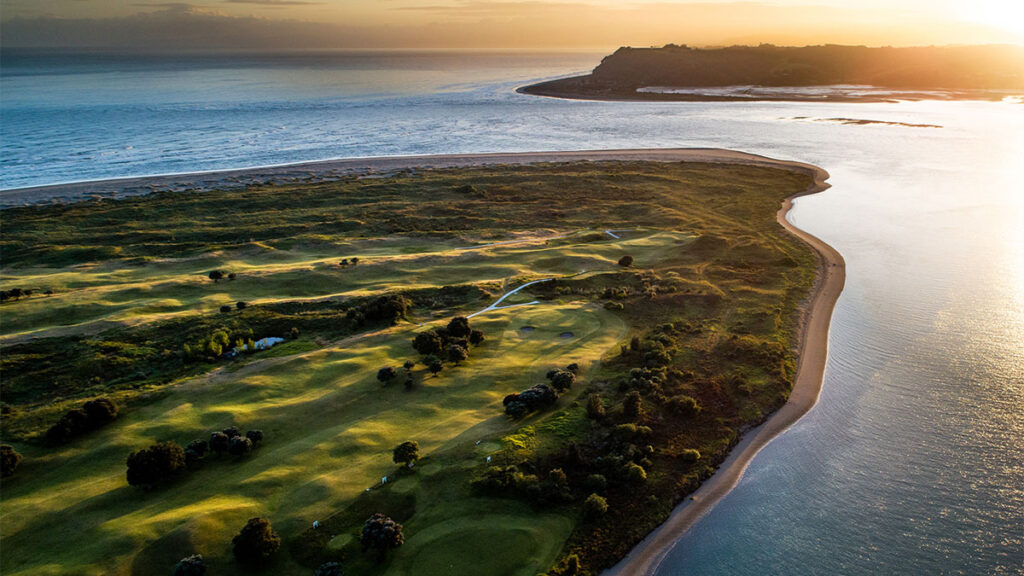
Ohope Beach Golf Links gets the lion’s share of the spotlight thanks to its jaw-dropping, peninsular location. Laid out across rippled land with endless humps and hollows, Ohope offers a true links experience with the bay on one side and Ohiwa Harbour on the other. Just along the coast, Whakatane Golf Club is similar in style with more trees and less-dramatic contours. This dunescape course designed by Charles Redhead cleverly uses the natural shapes of the sandy land right beside the bay and overlooking Whale Island.
The mighty par-3 16th is usually the talking point after rounds. The 194-metre hole plays downhill to a green protected on all sides by bunkers and accepts only the best shots. Many a promising score has come unstuck in the sand there.
Heading west towards Hamilton, Tieke Golf Estate is a tremendous new-ish addition to the Waikato golf scene. In 2014, the sheep-maintained Lochiel Golf Club and The Narrows united to become Riverside Golf Club. Their merger combined with the new Waikato Expressway development paved the way for Tieke, which was designed by Brett Thomson and Phil Tataurangi and sits directly beside the Waikato River. The course opened in late 2021.
Despite the coastline being more than 50 kilometres away, Tieke is very much links-style in look and feel. That’s thanks to the sandy soils of what is a natural riverbed landscape as well as the 1,000-plus trees and shrubs that were removed in the construction process to expose that soil. There are no true bunkers, only waste bunkers (in which a 30-centimetre preferred lie is granted). Often, you’ll walk or drive right through the middle of one as the network of paths winds through the waste bunkers. Most holes play through mini-valleys where the edges slope towards the fairway, yet the thick fescue grasses will rarely allow a ball to kick all the way back onto the short grass.
About the only downside to playing golf at Tieke is the constant hum and screech of go-karts from the neighbouring Kartsport circuit that adds an unwanted soundtrack to a round.

AUCKLAND AND SURROUNDS
A pair of star courses highlight golf in New Zealand’s most populous city. Titirangi Golf Club is a must-play for anyone who relishes the chance to sample an Alister MacKenzie design. The only course in the country the good doctor toured during his storied 1926-1927 trip, Titirangi today is constantly being restored to maintain MacKenzie’s recommendations.
In its early days, Titirangi was rural, treeless and bisected by a mere cattle track. Now, it’s ringed by suburbia, covered in trees and that cattle path is a suburban road crossed multiple times during a round. The club has also spent the past dozen years removing selected trees and vegetation to better reveal the layout’s features.
Australian golfers in particular will recognise touches of Royal Melbourne in places, mainly via the bunkering, vegetation, modest length at 6,062 metres, general landforms and road crossings. Serious course-architecture aficionados can dive deeper into MacKenzie’s mind inside the clubhouse, where framed sketches of his original plans line the walls.
Across town, Royal Auckland & Grange Golf Club is an excellent, modern contrast to the yesteryear feel of Titirangi. The layout is a 27-hole foray designed by Chris Cochran from Nicklaus Design after the merger between the former Royal Auckland and Grange clubs. Which means that a combined 232 years of club history now finds its home on a six-year-old golf course.
Familiar Nicklaus design traits – bright, white bunker sand and undulating, segmented greens – are evident across the 27 holes, which are split into the Grange, Middlemore and Tamaki nines. Astute design highlights the land’s modest undulations, with oodles of built-in flexibility via six different tees and numerous holes where the teeing grounds alter angles. That combined with several challenging pin positions give a high degree of variety. Meanwhile, the surfaces benefit from the SubAir system made famous by Augusta National, guaranteeing the high-quality surfaces remain perfectly firm.
Royal Auckland & Grange screams ‘tournament venue’, and if the rumours are true, it may just get its wish. Whispers abound in New Zealand golf that the club will host the 2032 Presidents Cup, which would be the nation’s first staging of the biennial teams matches.
For golfers looking to venture right out of the city, heading north yields the best options. Before you do, though, aim for the west coast as abutting the Tasman Sea is the rugged and delightfully ragged layout at Muriwai Golf Club. It’s a layout distinctive for its black-sand bunkers and outstanding drainage, which sees Auckland golfers flock there each winter when city courses are holding rainwater.
Such an exposed site also favours good wind players, as it can howl at Muriwai – often several clubs’ worth. (The number of parasailers in view on the nearby beach is often your guide to wind strength.) The prevailing breeze comes up the coast from the south, which makes all the par 5s play downwind.
Recent removal of several Norfolk pines under superintendent Harry Middleton has placed the focus more on the ground features at Muriwai, which are extensive. Scattered across the course are coffin-style depressions caused by felled trees rotting and the land around them sinking, making for a different style of hazard. Having fewer pines has the happy side effect of better revealing the site’s rolling seaside land.
If ever a golf course could feel like a tale of two parts, it’s Omaha Beach Golf Club, a links-style (although predominantly kikuyu) course on the edge of Whangateau Harbour. The holes nearest the clubhouse sit on flat, low-lying, harbourside land, while holes four to 12 occupy terrain with more movement, even if most fairways are quite flat. Instead, the design scales the dunes for several elevated tees and to frame its green complexes. For instance, the fifth green is nestled into a bowl with a bunker to the left and two cypress trees to the right, the trunks of which are only a couple of paces off the green. A swamp lines the left side of holes nine to 11 before an uphill par 3 to close this section of the layout. Locals refer to the two sections and settings as being like the differing North and South islands.
No discussion of golf on the outskirts of Auckland can overlook Te Arai Links and its 36 holes of majesty lining the Pacific. The recent addition of the twin layouts has not only brought more world-class golf to New Zealand, it has also opened this stunning slice of land to all golfers, which is especially important since neighbouring Tara Iti Golf Club is the epitome of private. Te Arai’s North and South courses are publicly accessible on rotation, with one open to the public and the other reserved for members each day. Access swaps between the two courses daily, making an on-site overnight stay the logical plan.
Alas, time allowed me to play only the Tom Doak-designed North course and to walk parts of the Bill Coore-penned South. Learn from my mistake and make the whole Te Arai complex the fulcrum around which you build your next North Island journey. Spend several days there if time and finances allow – you won’t be disappointed. It was good enough to lure Rory McIlroy halfway across the world last December when he played Tara Iti and Te Arai South with Ryan Fox while staying for several days.
It’s land upon which almost anyone could design at least a three-star golf course, yet true design genius is still needed to coax the best out of top-tier sites. Such aptitude is at play right across the North course. Displayed on the ground is Doak’s bank of knowledge from the past 20-plus years, as he lets the topography and natural features take the spotlight. The contouring, especially on and around the greens, is compelling, nuanced and strategic no matter how many times you play it. Greens like that of the par-4 fourth hole are equal parts cerebral and crazy.
There are a few ‘tricks of the trade’ on show, as Doak hides safe ground from your eyes right across the North, like he did at Tara Iti. It’s very much a ‘look backwards’ course, as you often see more by peering over your shoulder along the way you came than facing ahead. For those hoping to compile a score, holes two to seven are the scorecard killers, mainly thanks to a series of tricky and lengthy par 4s. Get through them unscathed and your chances improve dramatically.

THE ‘WINTERLESS NORTH’
Continuing the way north, you soon cross into Northland Region, which feels tropical, even though its most northern point is only roughly level with Sydney for latitude. Kiwis often refer to it as “the winterless north”. It’s a vast, remote and enchanting part of the country, one that is ideal for golf courses. Among the first you’ll encounter on the eastern side is Waipu Golf Club, which hits you with panoramic views of Bream Bay on all 18 holes. Parts of the course are so close to the sea, you can hear the waves rolling in as you play.
The land is largely treeless so there’s little to protect shots from any wind. The overall camber tilts towards the sea – the highest parts provide the best views but the lower realms are closest to the water. Waipu is a quasi-links in the sense that the sandy land and beachside location feel linksy yet the kikuyu fairways don’t quite match a links setting. That kikuyu, by the way, is one of the course’s best defences, as there are deep, snarly clumps of it in parts off the fairway, along with sandy areas that yield potentially unpredictable lies. Completing the picture are the distinguishing bunkers, some of which feature steep grass faces. The club has spent money in recent years improving its fairway watering and bunkers, which explains why the newer ones appear different to the rest. The layout will reach a new level once the bunker renovations are complete, yet whichever way you loop through Northland, it’d be a mistake to skip playing Waipu now.
Switching coastlines, one of the best west-coast courses in New Zealand is found way up north at 90 Mile Beach Golf Links, which flanks the beach of the same name. Formerly known as Kaitaia Golf Club, the new moniker is something of a misnomer as the beach itself is not 90 miles long – it’s 55 miles, or 88 kilometres, in length. But it feels like it stretches on forever, which only adds to the aesthetics of playing there.
Golfers are starting to learn that 90 Mile Beach is a must-play stop “up north”. The terrain is similar to the Waipu course, but unlike Waipu, 90 Mile’s holes move through the natural valleys rather than across them. It’s also kikuyu, but a layout where couchgrass is gradually being incorporated into the fairways by Jason and Chris, the only two full-time greens staff.
Just how close you are to the beach as you play becomes more evident when you learn that marram grass was planted in places to stabilise the dunes separating the beach from the course. One site is behind the ninth green and another next to the fifth hole, where a few years ago the green was in danger of being lost to the encroaching beach. Now, a dell-style green location not only looks great but is far better for dune stability.
My Kiwi odyssey culminated at Kauri Cliffs, which was fitting because it was an invitation to see the course all those years ago that sparked my intrigue. Kauri Cliffs is the resort course that put New Zealand on the international golf map, and the late Julian Robertson’s first golf venture in the country deserves due credit.
Land that was once a sheep station yielded an exceptional layout that takes full advantage of its location next to the Bay of Islands. The ocean is in view on almost every hole, while several clifftop tees and greens accentuate the postcard setting. Between the islands dotting the horizon and the broad expanses of the Pacific Ocean laid out before you, Australians might detect a similarity to Queensland’s Hamilton Island course. Yet in reality Kauri is incomparable.
The rising and tumbling nature of the layout – indeed, of many fairways – adds immensely to the excursion. Several holes occupy ridgelines, while others scale the undulating terrain in roller-coaster fashion. Often during a round, your ball will hang against the ocean in the distance as it plummets back to earth. It’s an experience that never gets boring. Elsewhere are holes like the heart-thumping seventh, a par 3 where a tee shot hit wide to the right could plunge or kick into the sea way below.
The David Harman-designed layout is set to get even better when a major grass conversion takes place this October to December. A switch to couch will be like a fresh coat of paint for the course that started the global Kiwi golf fascination.
Golf fits New Zealand’s North Island like a key fits a lock. Dramatic coastal sites abound in a temperate climate – and there’s more to come. In the pipeline are a Kyle Phillips design near Muriwai known as Muriwai Downs and a Darius Oliver layout near Paraparaumu called Douglas Links, two spine-tingling prospects that will have golfers salivating, this one included. Such dynamic and desirable newcomers will ensure it won’t take me another 20 years to return.
Getting Around
Vivid Golf Tours is passionate about golf and believes New Zealand has a truly remarkable story to share, one that’s as much about people and place as it is about the game itself. Having played golf across New Zealand and around the world, the staff at Vivid have experienced the brilliance of the country’s top-tier courses, each one easily rivalling the best anywhere.
The North Island is rich with beautiful courses that are thoughtfully designed and in exceptional condition. With hundreds of hidden gems scattered from the top of the North Island all the way to Southland – not to mention the iconic names you already know – they’ll craft a golf itinerary that’s personal, memorable and uniquely Kiwi.
Vivid Golf Tours currently has two North Island tours covering some of the nation’s best courses, including Te Arai Links, Tieke and Wairakei, or they can design your own bespoke tour. Visit vividgolftours.com to learn more.