
Ben Hogan made just a single appearance at the Open Championship. Yet his triumph at Carnoustie in 1953 inspired many more Americans to compete in golf’s oldest major. That mightn’t have eventuated if not for an act of impulsiveness by the late Patrick McCarville.
Australian golf farewelled one of its loveable larrikins in Patrick McCarville earlier this year. The Irish-born renaissance man was a larger-than-life character – part journalist, actor, author and raconteur.
McCarville was a former contributor to Australian Golf Digest and an accomplished single-figure golfer. However a car accident badly broke his right arm. So he taught himself to play left-handed, lowered his handicap to 10 and never returned to playing right-handed.
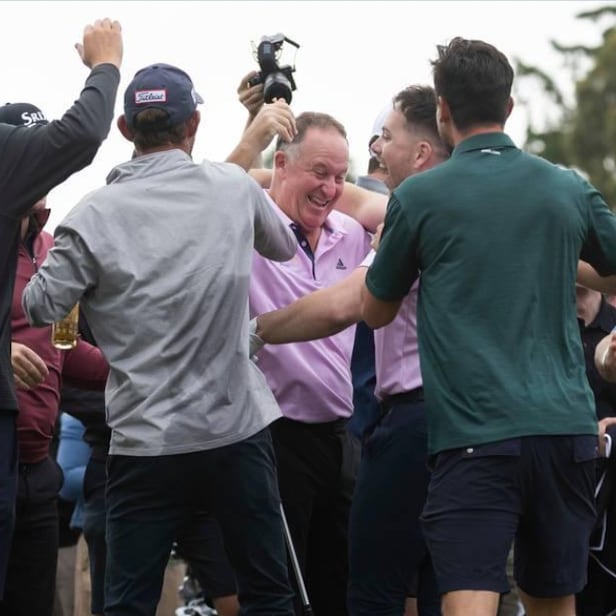
St Michael’s Golf Club in Sydney’s east hosted a memorial service to honour long-time member McCarville, which was MC’d by his dear friend, the Irish-Australian comic Paul Martell with whom they would argue about who would perform the other’s eulogy.
McCarville’s gregarious personality endeared him to the rich and famous. In late 1950s/early 1960s London, McCarville mixed with aspiring actors such as Richard Harris, Oliver Reed, Robert Shaw, Peter O’Toole and the Australian John Mellion of “Crocodile Dundee” fame. He later climbed Mount Kilimanjaro with the actor William Holden, interviewed Jack Nicholson for Australian Playboy and was Mick Jagger’s ‘vocal coach’ while making the movie “Ned Kelly” (1970) in the Snowy Mountains. (He even took Jagger for a steak dinner at Queanbeyan Leagues Club where the Rolling Stones frontman went unrecognised because of the long hair and beard he’d grown for the film.)
After working as a war correspondent for NBC during the evacuation of Aden and the Six-Day War in 1967, McCarville travelled to Sydney en route to Vietnam. It was Mellion who convinced McCarville to extend his stay Down Under and pursue an acting career. That led to roles in “My Name’s McGooley, What’s Yours?”, “The Young Doctors” (1981-82), “The Restless Years” and the “Mission: Impossible” TV series (1988). He combined both acting with writing for Grundy’s.
His pièce de résistance was the screenplay The Man Who Sued God. It was later turned into a film starring Billy Connolly as the protagonist whose insurance claim is declined after his fishing boat was destroyed by lightning.
In later years McCarville became widely known as the Australian ambassador of Jameson Irish Whiskey. “I drink for my country,” was one of his celebrated lines. Such was his passionate advocacy, it’s said that sales of Jameson would’ve gone through the roof if McCarville had’ve been the ambassador in every country.
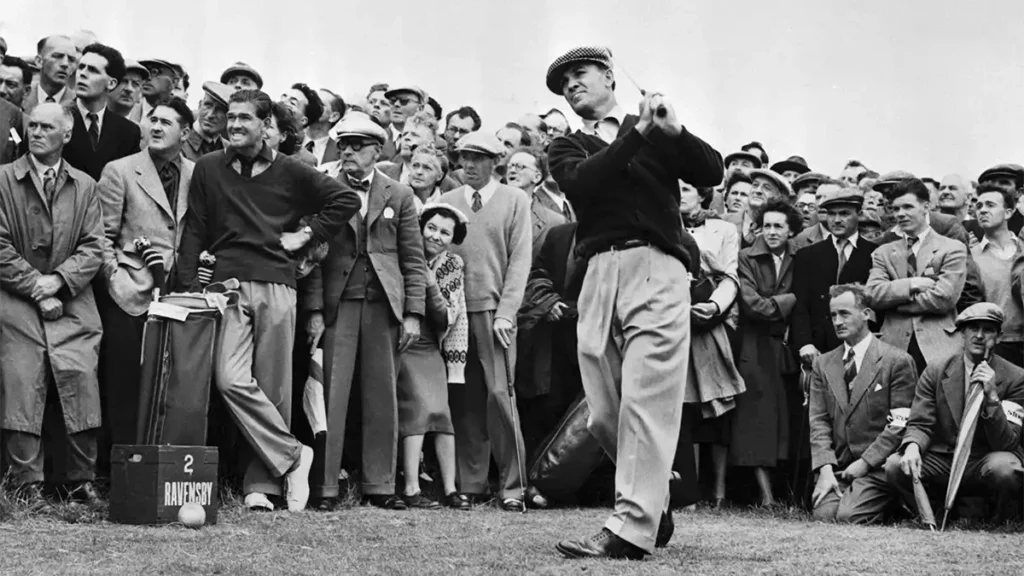
McCarville got into journalism through his brother-in-law Frank Johnstone, the head sportswriter for The Irish Times in Dublin. Johnstone married McCarville’s sister Marie and he took a 16-year-old Patrick under his wing when he went to cover the 1953 Open Championship in Scotland. Patrick was to be his ‘runner’ at Carnoustie where the great Ben Hogan was making his first – and what turned out to be his only – appearance in the Open Championship.
Having won the Masters and US Open earlier that year, Hogan was tied for fourth and two strokes from the lead at the halfway point. The Texan was battling ’flu and the weather was terrible on the Friday when competitors had to complete 36 holes.
Raining sideways and howling a gale, Johnstone gave young Patrick the instructions: “Now there’s your notepad. Go out, find him, get as close as possible.”
At one point Patrick ventured a hole ahead to get a better glimpse for when the Hogan party arrived on the tee. He vividly remembers Hogan turning to his caddie and saying: “This is the coldest place on earth. My feet are like blocks
of ice.”
Now Patrick’s sister Marie had given him a big, thick pair of grey, woollen, hand-knitted socks. And they were in his backpack. So young Patrick pulls out the socks, reaches through the gallery rope and hands them to Hogan’s caddie. Hogan and the caddie look back at this boy and thank him for the kind gesture. Then in front of everybody, Hogan sits down on his golf bag, takes off his old, saturated socks, throws them away and puts on Patrick’s woollen socks.
Hogan was able to recompose himself during the final round where he chipped in for birdie at the fifth hole, added another birdie at the sixth, and established a two-shot buffer by the 13th. He birdied the 18th for a four-under 68 to win the claret jug for his third major of 1953. His total of six-under 282 was four shots better than the quartet of Dai Rees, Antonio Cerda, Frank Stranahan and Australia’s Peter Thomson (who would win four of the next five Opens).
“I don’t know when I’ll be back,” Hogan said at the presentation ceremony. “But I’ll try to make it next year.”
Hogan never did return, and that ninth major would be his last. It wasn’t until 2000 that Tiger Woods would emulate Hogan’s feat of winning three majors in a calendar year.
After play finished, Patrick was in a bus queue to make the long journey back home via train and ferry where he would travel from Stranraer to Larne in Northern Ireland, then onto Dublin. He’s in the queue when a limousine drives past, stops, backs up and the window opens. It’s Ben Hogan in the back seat.
Hogan looks at Patrick, points at him, and asks: “Are you the kid who gave me those socks?”
“Yes, Mr Hogan,” replies Patrick.
With that, Hogan opens his kit bag and pulls out a cardigan – one of those expensive knitted sweaters. He reaches out, gives it to Patrick, and says: “Thank you, very much. You saved my life. The socks were wonderful.”
Then the window closes, the limousine drives off and Patrick remains in the queue. One can only imagine how much that woollen cardigan would be worth today given the significance of Hogan’s Carnoustie victory for American golf.
When McCarville told that story to Martell, his good friend asked: “Patrick, do you still have the cardigan?”
To which he replied: “No. I sold it on the train. I was f–king hungry!”
Irish by birth, Australian by choice, Patrick McCarville was one of a kind. His wife Lesley passed away two years ago, and he is survived by son Tom McCarville, daughter-in-law Lorinda and grandson Jack.
Photographs by getty images/bettmann