[Photo: nazar_ab]
There was an interesting moment during the final round of the Masters that brought Rule 10.2 into play – at least from the couch of some rules-savvy viewers. ICYMI, Cameron Young hit his drive on the ninth hole through the fairway and it came to rest under some branches. His caddie, Kyle Sterbinsky, appeared to help align him for his punch-out shot, and Young played without re-addressing the ball, which would appear to violate the rule on “advice and other help”.
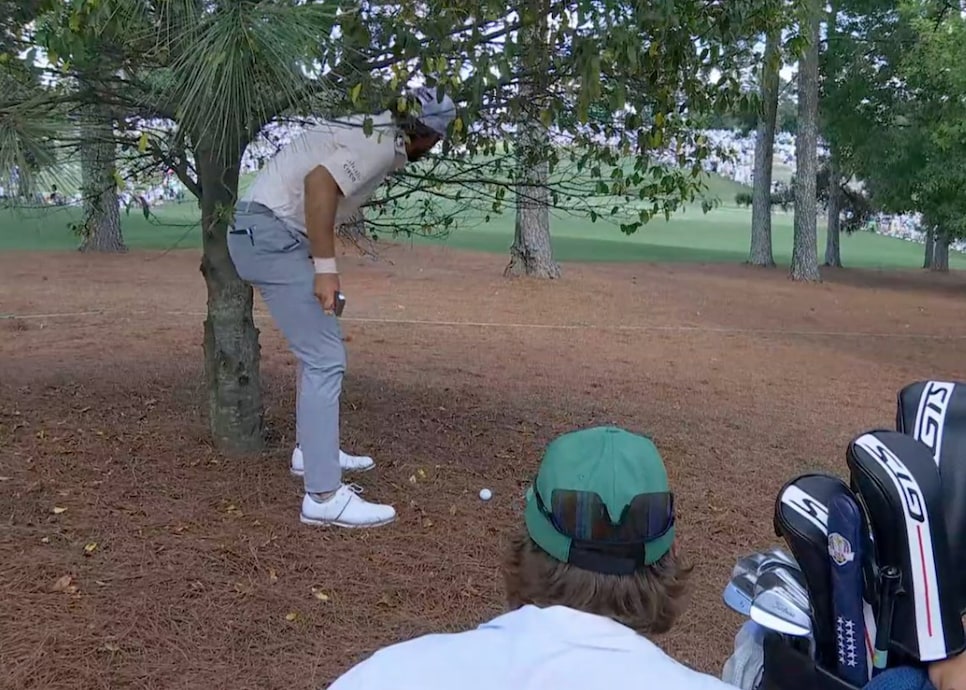
Here’s what Rule 10.2b(4) says in its entirety:
When a player begins taking a stance for the stroke (which means they have at least one foot in position for that stance) and until the stroke is made, there are limitations relating to when and why a player’s caddie may deliberately stand on or close to an extension of the line of play behind the ball (that is, the “restricted area”) as follows:
AIMING: The caddie must not stand in the restricted area to help the player with aiming. This help includes when the caddie moves away without saying anything but, by doing so, is giving a signal to the player that they are correctly aimed at the intended target. But there is no penalty if the player backs away before making the stroke and the caddie moves away from the restricted area before the player again begins to take a stance for the stroke.
HELP OTHER THAN AIMING: If the caddie is helping the player with something specific other than aiming (such as checking to see if the player’s club will hit a nearby tree during the backswing), the caddie may stand in the restricted area but only if the caddie moves away before the stroke is made and provided this positioning is not part of a regular routine.
There is no penalty if the caddie was inadvertently standing in the restricted area.
RELATED: 5 rules most golfers get wrong
There was some uncertainty as to what Young’s caddie was doing, so ultimately no penalty was called. And it’s this grey area that brings us to the rules dilemma about what constitutes the help of giving or getting advice.
To be clear, the definition in the Rules of Golf for “advice” is anything but grey. It’s “any verbal comment or action (such as showing what club was just used to make a stroke) that is intended to influence a player in choosing a club, making a stroke, deciding how to play during a hole or round”.
In the case of a golfer in your foursome saying your swing “looks quick”, it could be construed as giving advice if he or she is not just making an observation and is hoping you slow things down going forward. It’s a two-stroke penalty in strokeplay or loss of hole in matchplay. The penalty would be assessed on the hole being played or on the next hole if the advice is given/taken while waiting to tee off. For example, you get an impromptu golf lesson on a par 3 while the course is backed up.
Keep in mind, simply making an observation about someone’s swing doesn’t necessarily constitute giving advice. If a player swung and looked up at you and asked, “Did I keep my head down on that one?” you wouldn’t be giving advice if you simply confirmed what he did. Think of it as the difference in reporting the news versus taking an editorial stance on the news. Good: “You lifted your head up.” Bad: “You lifted your head up and that’s why you keep topping the ball. Try keeping it down on the next shot.”
Also, it’s important to understand that if you are playing a four-ball (best ball) or foursomes (alternate shot) format, you can give or receive advice to or from your teammate and can get advice from either of your caddies.
If you’re wondering how this rule of giving/receiving advice might be enforced, you could call a penalty on yourself or be forced to explain your intentions to a tournament committee or to the head pro at your local golf course if somebody spoke up – and they would make a ruling. It wouldn’t be enough for an opponent or fellow-competitor to insist you accept a penalty for giving/getting advice without you being able to explain/defend your intentions.
We’ll also acknowledge that advice is given or received in casual rounds and no one enforces the rule. “Hey, what club did you just hit?” You hear that one, a lot.
Bottom line: think about information you pass along before you actually say it or discreetly share it. Like showing another player in your foursome that isn’t your partner the club you just hit right before it’s his or her turn to play. That’s also a penalty.