Every year, golfers who play players irons (blades and compact cavities) are told the same thing: The tradeoff is real. You’re sacrificing distance and forgiveness for feel and workability. Accept it or go find a players-distance or game-improvement iron.
What recent robot testing reveals is that the tradeoff is more complicated than that, and a lot more interesting. For Golf Digest’s latest round of equipment testing, Golf Laboratories put 10 of the newest players 7-irons through the standard protocol: 36 shots per head, including six shots each at mid heel, center, and mid toe (three new impact locations this cycle), along with low heel, low center, and low toe. The same True Temper Dynamic Gold shaft, Titleist Pro V1 golf ball and delivery conditions were replicated for each iron.
The results revealed a field where the headline carry numbers barely separated the top five, dispersion was wide-ranging, and where two of the most recognizable brands in the game produced results that deserve a closer look before stepping into the hitting bay.
Carry and ball speed observations Carry vs. Dispersion: The Precision-Distance Tradeoff Each dot represents a single iron’s average carry (yards) and 95 percent shot dispersion area (sq. ft.) across 36 shots. Lower-left equals farther and tighter. Callaway Cobra Mizuno Ping PXG Wilson ← TIGHTER 95% Dispersion Area (sq. ft.) WIDER → Carry vs. dispersion scatter plot: PXG 0311T GEN8 (155.8 yds, 326 sqft), Cobra 3DP Tour (150.7, 227), Callaway Apex Ai 150 (149.5, 303), Mizuno Pro M-13 (148.8, 165), Cobra 3DP MB (147.1, 246), Ping i240 (146.8, 137), Mizuno Pro S-1 (146.5, 223), Wilson Staff Model (144.5, 372), Callaway X Forged (143.5, 279), Wilson Staff Model CB (136.6, 310). ← SHORTER Carry Distance (yards) LONGER →
The carry summary reveals eight of the 10 irons in this test clustered within nine yards of each other. The PXG 0311T Gen8 was the exception at one end, and the Wilson Staff Model CB was the exception at the other.
The PXG led the field with 155.8 yards of carry and a 1.34 smash factor, numbers that sit closer to a hot-faced distance iron than a players iron. It accomplished that through ball speed, not trajectory. Its 25.4-degree dynamic loft is the second-lowest reading in the test, which means it’s launching the ball in a stronger window than most of its competition. Whether that’s the right trade-off depends entirely on what you’re trying to do with a players iron.
At the other end, the Wilson Staff Model CB produced 136.6 yards of carry and a 29.3-degree dynamic loft, the highest in the field by 1.3 degrees. That extra loft is working against the CB in a direct, measurable way. More dynamic loft means more spin loft. The CB spun at 6,476 rpm, nearly 750 rpm above the field average and more than 1,200 rpm above the lowest-spinning iron in the test.
For the other eight irons, the Cobra 3DP Tour, Callaway Apex Ai 150 Forged, Mizuno Pro M-13 and Cobra 3DP MB sit bunched between 147 and 151 yards, with the Mizuno Pro S-1, Ping i240, Wilson Staff Model and Callaway X Forged rounding out the field within a few yards behind.
It’s a tight cluster. At this level, you’re likely not choosing between these irons based on carry. You’re choosing based on other metrics.
Dispersion observations Shot Dispersion Footprints: 95% Ellipse by Iron Ellipses drawn to scale relative to each other. Each represents the area containing 95% of shots under identical robot delivery conditions. Smaller ellipse = tighter iron. All ellipses rendered at the same scale. The ellipse shape encodes both total area and lateral width — a narrow, tall ellipse indicates distance variability but directional precision; a wide, squat ellipse indicates lateral scatter.
If carry is the boring finding in this test, then dispersion is where the story starts to get interesting.
The Ping i240 produced the tightest shot pattern in the field: a 95 percent dispersion area of 136.6 square feet, with a lateral width of just 4.6 inches. To put that in perspective: the next-tightest iron, Mizuno’s Pro M-13, had a lateral width of 6.4 inches. The widest iron in the test, the Wilson Staff Model, spread shots across 372 square feet and 12.6 inches of lateral width. That’s nearly three times Ping’s footprint from the exact same robot delivery.
The i240’s tightness comes at a price, however. It carries 146.8 yards, which puts it in the lower half of the distance rankings. But the more useful number may be its dispersion-relative-to-distance ratio, which trails only the Mizuno Pro M-13, the more interesting iron in this category.
The Mizuno Pro M-13 is the iron that may be doing the most with what it has. It sits fifth in carry at 148.8 yards while posting the second-best dispersion area in the test at 165 square feet. That combination puts it in a genuinely strong position on the carry-control tradeoff, farther than the Ping and tighter than nearly everyone else. If there’s an underrated iron in this test, the M-13 could be it.
The PXG 0311T Gen8 sits at the opposite end of that story. Its 17.7-inch lateral width is the worst in the field, nearly four times the Ping’s. It goes longer than anything else in the test, and scatters wider than anything else in the test. For a player who hits the center consistently, the PXG is a compelling argument. For everyone else, that lateral spread matters.
Spin and dynamic loft observations Spin Behavior: Rate, Dynamic Loft & Axis Bias Sorted lowest-to-highest spin. Spin rate is the primary driver of carry difference across this field. Dynamic loft shows how much loft each head presents at impact under identical robot delivery; spin axis indicates fade (+) or draw (−) tendency. Low spin (≤5,300 rpm) Mid spin (5,301–5,900 rpm) High spin (>5,900 rpm) Iron Spin Rate (rpm) Bar = relative spin volume Dyn. Loft Axis Carry
This is where the robotic testing gets instructive for anyone who thinks players irons are all built the same way.
Dynamic loft, which is the loft the face actually presents at impact under identical delivery conditions, ranged from 25.3 degrees on the Cobra 3DP Tour to 29.3 degrees on the Wilson Staff Model CB. That 4-degree spread directly explains most of the carry and spin differences in the test. Irons that present less loft at impact spin less and carry farther. Irons that present more loft tend to do the opposite.
The Cobra 3DP Tour sits at the low end of that spectrum at 25.3 degrees and 5,513 rpm. The PXG is just above it at 25.4 degrees and 5,244 rpm. Both are generating spin rates that start to look like distance irons, which is relevant context for anyone who expects a players iron to stop on the green the way it should.
With regards to spin axis, which determines whether a ball fades or draws, most of the field produced negative values, meaning a slight draw bias under the robot’s delivery. The Cobra 3DP Tour and Wilson Staff Model CB were the only two irons to flip positive, registering slight fade bias. Something in the head geometry is responding differently—most likely CG location or offset.
It’s something worth exploring before going through the fitting process.
Carry heat map Carry Distance Heat Map Robot-delivered impacts at six face zones: mid heel, center, and mid toe (upper row) and low heel, low center, and low toe (lower row). Values in yards of carry. Darker cell equals more distance. Carry scale: 117 yds (short) — 165 yds (long) Cell labels = carry in yards Toe misses hurt everyone: the Cobra 3DP Tour loses 14.4 yards toe-to-center, worst in the field. The Mizuno Pro S-1 is the most forgiving on toe strikes. Center strike at low is consistently the best-performing impact zone across all irons — typically 7–12 yards better than mid-center.
The heat map is where players irons tend to reveal themselves most honestly. A players iron that goes far on center but produces a wider delta on misses is telling you something about who it’s actually built for.
Across this field, the biggest single finding is that every iron goes meaningfully farther from the low-center zone than from mid-center, typically 7 to 12 yards. That’s consistent with how robot testing typically reflects strike location, and it reinforces the general rule: a player who hits the face higher on the blade is giving up real yardage.
The Mizuno Pro M-13 and Ping i240 both gained nearly 12 yards from their mid-center strike to their low-center strike, suggesting those heads are particularly sensitive to vertical strike location. The Cobra 3DP Tour hit its peak at low center at 162.5 yards, the best single-zone number in the test outside of PXG, but also produced the largest toe penalty of the field at 14.4 yards. The 3DP Tour is also rewarding a well-struck shot and a punishing one off the toe.
Compared to the irons mentioned above, the Mizuno Pro S-1 flips the script. Its toe penalty of just 9.7 yards is the best in the field, suggesting the S-1 is more forgiving on horizontal misses than its players-iron designation would imply. The tradeoff is a smaller low versus mid gain, which means the S-1 responds more evenly across the face. It’s a different design philosophy than M-13, within the same brand family.
Descent angle Descent Angle: How Steeply Each Iron Falls Steeper descent improves stopping power and holds greens from a distance. Shallower angles release more on landing, a useful shape for firm conditions, a liability on fast greens. Iron Descent angle (avg across 36 shots) Carry / Peak
Descent angle doesn’t get talked about much at the retail level, but it matters. A steeper descent means the ball hits the green, checks faster and holds more predictably. A shallower descent means the ball comes in flatter, releases more on landing and behaves less predictably on firm turf.
The range in this test was tight: 44.7 to 46.8 degrees, a spread of just 2.1 degrees. But at this level, small differences start to add up. The Wilson Staff Model CB and Mizuno Pro S-1 shared the steepest descent angle in the field at 46.8 degrees. The Cobra 3DP Tour was the shallowest at 44.7 degrees.
The Callaway irons and PXG cluster in the middle on descent angle, with the two Mizuno heads and Ping i240 showing slightly above-average steepness for their carry numbers. The M-13, in particular, carries 148.8 yards and descends at 45.7 degrees, a combination that offers both carry and a reasonably steep landing angle.
What the robot data tells us 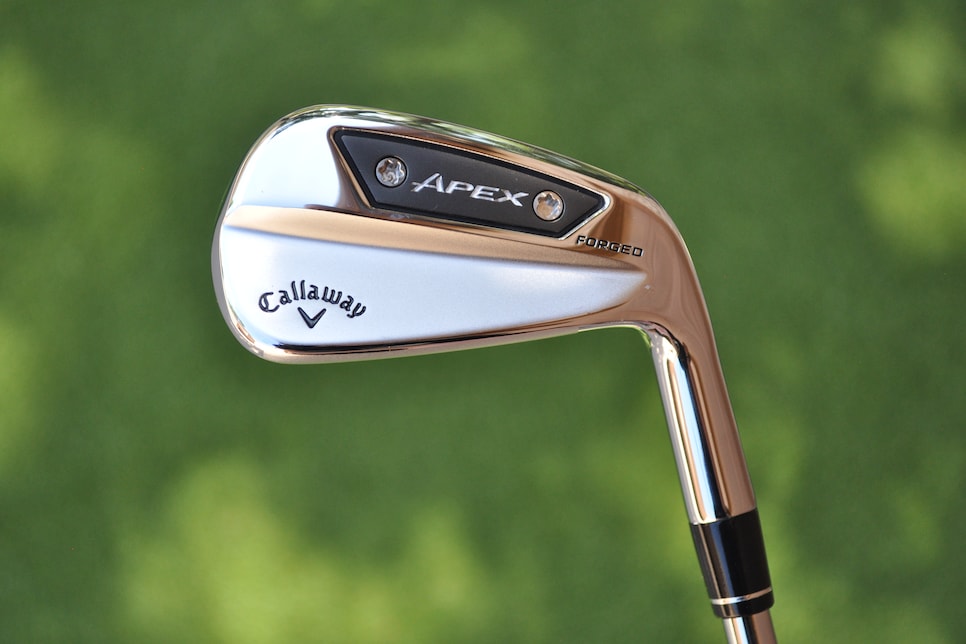
The most persistent assumption in the players iron category is that you’re always making a deal: give something up to get something. More feel and workability or more forgiveness and distance is the most common trade-off. The thing is, the robot doesn’t care about assumptions. It just records what happens.
What it recorded here is that the Ping i240 and Mizuno Pro M-13 are simultaneously among the tightest and most carry-efficient irons in the test, which is supposed to be a contradiction in this category. The PXG 0311T Gen8 is generating ball speeds that don’t feel like they belong in a players iron conversation by traditional definitions. And the Cobra 3DP Tour is the most spin-efficient head in the field, which is a nice-to-have for better players.
The results confirm the category is being quietly redefined from the inside. Interestingly enough, the irons that best illustrate the old tradeoff (distance or precision) are the ones at the bottom of the rankings.
This article was originally published on golfdigest.com