Just 10 months after a freak accident cost him vision in one eye, Jeffrey Guan is staging a remarkable return to pro golf.
Thursday, August 28, 2025 – mark it down on the calendar as the day Australian sport celebrates one of the more remarkable comeback stories in recent memory. Just 10 months after a pro-am partner’s ball struck him in the face, leaving him permanently blind in his left eye, Sydney golf sensation Jeffrey Guan has pencilled in a stunning return to the pro ranks this month.
Speaking exclusively to Australian Golf Digest, Guan confirmed his comeback plans have been rubber-stamped by the PGA Tour of Australasia and that he will return to the fairways at the Tailor-made Building Services NT PGA Championship at Palmerston Golf Course in the Top End, from August 28-31.
“The NT PGA is what we’re looking at right now,” reveals Guan, who is still adjusting to everyday life with vision impairment, let alone hitting golf balls for a living.
“I’m hopeful of getting starts in most of the events this season with my status carrying over, but the Northern Territory event is the focus for me right now. I’m excited, but I’m nervous because I don’t know how it’s going to go. I’ve got so many mixed feelings all at once right now. It’s going to be interesting.”
It’s an extraordinary development for 20-year-old Guan, whose meteoric rise through the amateur and professional ranks received global recognition 12 months ago when he was signed by Sportfive, the same sports management agency as golf superstar Jon Rahm. That move quickly led to a sponsor’s invitation to the 2024 Procore Championship in California’s Napa Valley. Guan suddenly found himself on top of the world, mixing it with the big boys on the PGA Tour.
Then, just a few days later, THWACK!
The Australian Golf Club member had just returned home to compete in a New South Wales Open qualifier at Catalina Club on the NSW South Coast when tragedy struck. A misfired shot from his amateur playing partner left him no time to react. The ball, a fairway wood hit with devastating force, shattered his orbital socket and inflicted catastrophic damage to his left eye. Guan was airlifted to hospital and underwent multiple surgeries, but the outcome was irreversible – his vision in that eye was lost. Just days after his dreams had begun to materialise, they were suddenly, brutally ripped away.
After a careful rehabilitation period, along with some huge fundraising efforts from family, friends and the wider golf community, Guan is ready to do the unthinkable: mix it with the world’s best golfers again.
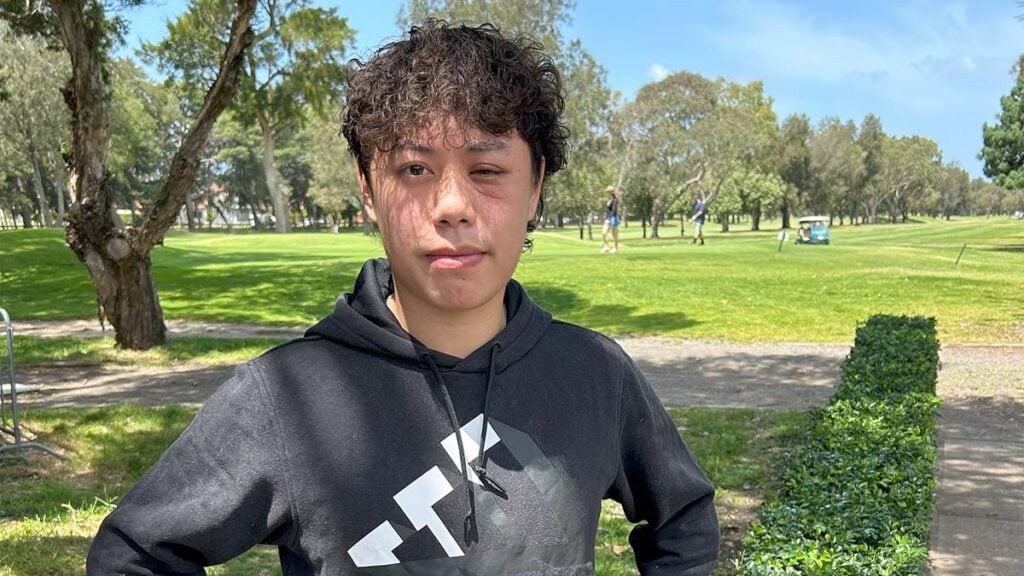
“Honestly, I thought there was no chance I was going to be playing this season,” Guan says. “In those first few weeks after the accident, I was just mentally not there – I couldn’t really process what had just happened. Even now, the whole thing is just so hard for me to explain. I genuinely thought that I was going to be out for, maybe, six to eight months, and then with everything changing, I was just so scared that I couldn’t even hit the golf ball. But, with so many improvements over that time, it just gave me a bit more confidence. Luckily, my swing is still in some sort of shape. Even though it might not be the most perfect swing, I still know what it feels like to hit a golf ball.”
Guan said the weeks before his comeback will be spent with his father, working on getting his course management and ‘numbers’ game on point.
“I rely a lot on my own yardage book that my dad and I have created, so making sure I have all that information ready to go again will be important,” he says. “When you haven’t played competitively for so long, you obviously lose a lot of your touch and also your swing speed. Getting these numbers up to date with how I’m swinging will be key.”
Guan has been training hard in the gym to regain his strength and flexibility, while he’s also been increasing his activity with swing coach Gary Barter at The Australian Golf Club.
“I haven’t played as many rounds as I would have liked – it’s still in the single digits [in total] – but I’m getting a few in when I can,” adds Guan, who fired a three-over par round off the members tees in his first official 18-hole round since the accident. He has since logged several under-par scores. Not bad for a bloke with one eye.
“The scores haven’t been anything amazing – nothing really low or too high, which I’m pretty happy about,” Guan admits. “Within all those rounds there were many shots where I could have done a lot better with the benefit of time, because the mis-hits were always going to happen after having that time away.”
Interestingly, the hardest challenge for Guan hasn’t been around the greens or on the tee. It’s been in the sand. So difficult has it been to judge his ball position in bunkers, Guan and Barter have introduced an ingenious prop from Bunnings to help Guan rediscover his magic touch.
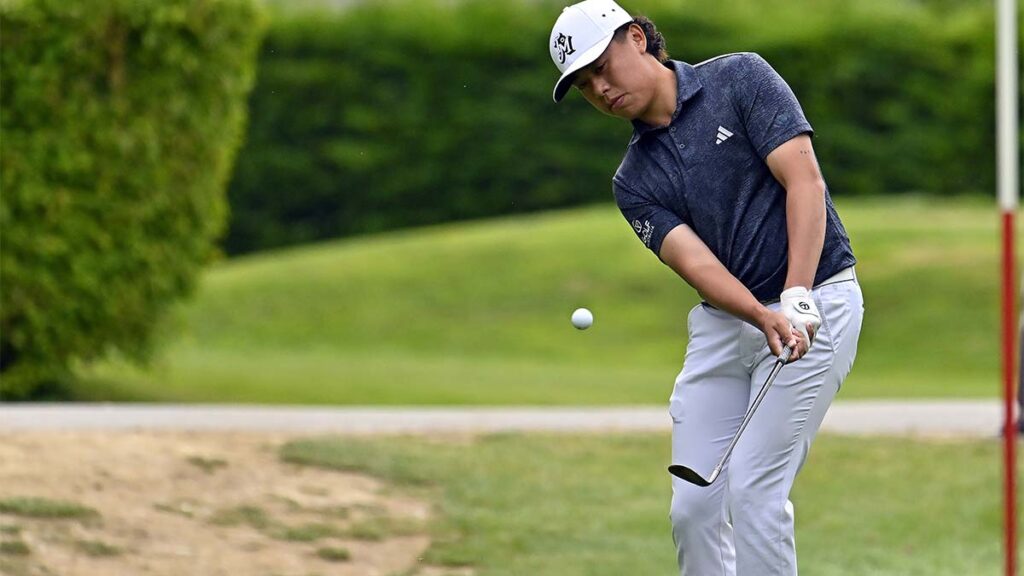
“It’s kind of hard for me in the bunkers because of my depth perception. At address, I can’t really tell whether the club is above the sand a lot or not enough,” Guan says. “I saw a tip on YouTube where I can put the club on the toe on my shoe to get a feeling of where I want the club to hover. But the other thing I’m working on with Gary is, I went to Bunnings and got a white piece of foam. Long story short, darker colours are much easier for me to see and because the bunker sand is so bright, there’s always a lot of glare and it’s hard for me to judge positioning. So, to help with that, I’m using a piece of white foam across the floor at home and I’m just hovering my club over that, then slightly touching it and then going back up, just to get a better sense of where my club’s at in those bright situations.”
For Guan, it’s all part of the trials and tribulations of overcoming the rough hand he’s been dealt. Of course, he needn’t turn too far in golf circles for inspiration. The great Tommy Armour lost sight in one eye due to a mustard gas explosion during World War I. He would go on to win the 1927 US Open, 1930 PGA and 1931 Open Championship. More recently, Augusta University golfer Marine Legentil was born blind in her left eye but has managed to make the uni’s division one team.
But Guan isn’t getting too far ahead of himself. He knows there’s a long road ahead to be truly competitive again at the sport’s highest level.
“It’s not going to be easy – I can never say this comeback is going to be easy, but as I keep practising and playing, I know I’ll get more and more of a feeling of where I can get to,” he says.
“I feel like all the messages, all the donations and the fundraisers for me and my family, I really appreciate all the support. I mean, everyone’s coming up to me at The Australian and asking how I’m doing. A lot of people might think, Oh, I don’t want to disturb him while he’s practising, but it really means a lot to me, just to know that I have a lot of people behind me.
“Mum and Dad have obviously been amazing. They know it’s always been my dream to play on tour and become a top-100 player in the world. That’s always been the dream of mine. I won’t give up on that. But I think with the targets I have currently, it’s all about retaining my card in my first year back.”
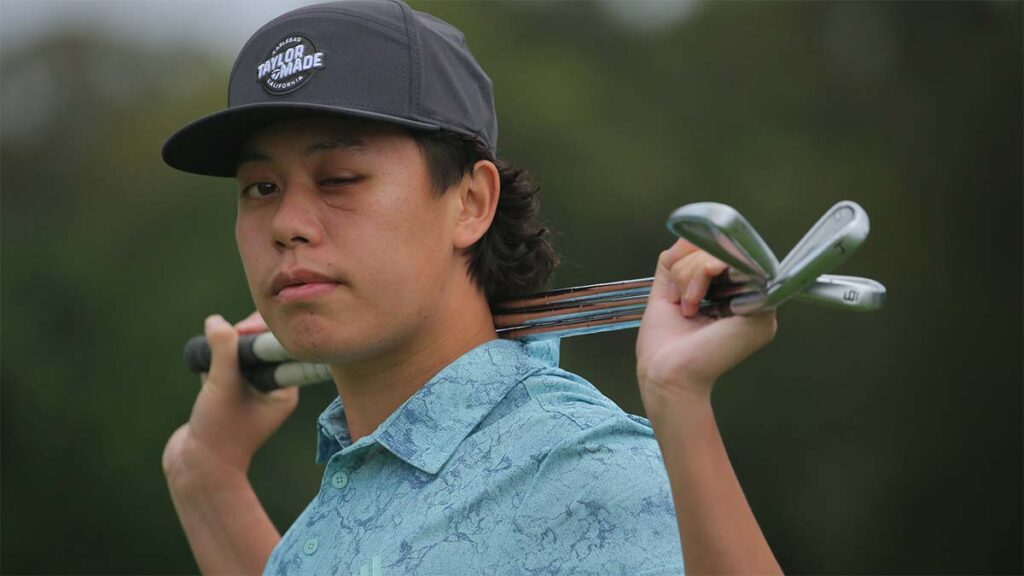
Quick 5 with Jeff Guan
Mum and Dad have been through everything with you on this emotional journey. How do they feel about the comeback?
“Their support has been incredible. I can never thank them enough. My dad’s obviously helping a lot with my statistics and my yardage book ahead of the big comeback. My whole system is based on what he worked out for me from when I was younger, and he’s helped me refine all that data over the years. Mum’s just been so supportive over my entire time in golf, not just in my recovery.”
With your vision impairment, do you feel like you’re going to need to develop a new stock shot – a failsafe swing you know you can repeat over and over again?
“Yes and no. I feel like some of those shots do require a lot of practice as well, but I guess that a lot of the time you don’t necessarily need something like that. Hitting a ‘stinger’, for example, you might use it a couple of times a round, so it could be useful. But if I was going to hit it off the tee, I feel like I’ll have too far in [to the green]. I’ll just probably play how the hole normally plays out. It’s a phrase that my dad used to say, ‘Safe and attack.’ You need to be safe with your score, but you’re still attacking at the same time. Give yourself more opportunities to make birdies. [The accident] won’t change things too much from how I played previously. I mean, I’m still going to try to play all the shots. Even if I’m hitting it bad, I’m still going to try to do my best to execute those shots that I originally planned before the round.”
Has your swing noticeably changed at all?
“To anyone that looks at a split screen of my before-and-after swings, they might say, ‘Oh, it looks kind of the same.’ But to me, I can definitely see a lot of changes. I don’t know if that’s just because I’ve seen my own swing quite a bit and I notice little things. I feel like I’m not moving as well onto my left side, but that could also be because I haven’t done too much in the gym and my left side’s just a bit weaker now. I know I used to swing it quite flat, but I’ve started hitting really high up on it, so my attack angle was quite high. So, that’s something I’m working on with my coach and we’re getting it back down again. But it’s honestly working so much better because with the higher attack angle, the ball kind of disperses in a wider range. I’m actually going to need a club fitting soon to make sure my old clubs are still working properly [laughs].”
Have you noticed any change in your yardages, having been out
for so long?
“Oh, 100 percent. I mean, when you don’t play golf for so long, for so many months, you obviously lose a lot of your touch but also your swing speed. But I’m working with my coach Gary Barter on regaining what I had [before the accident]. I’m seeing a physio and working on a program to help me get my flexibility back and most of my strength. I’m back at the gym now, so I’m slowly getting back to where I was before. I’m not there yet but, for example, during the first month I was back, I was swinging the driver at 103 miles per hour. Three months later, I’m swinging at about 113mph.”
What’s the dream, Jeff? I mean, coming back to play is remarkable enough. But what do you truly hope is still ahead for you?
“It’s always been my dream to play on the PGA Tour and become one of the top 100 players in the world. That’s always been the dream of mine and still is. But I think with the targets I have currently, it’s just retaining my card in the first year, and then hopefully I can build up momentum from that.”