Some kids will love the game no matter what. Others require a bit more finesse. Don’t worry if you’ve made mistakes. There’s always time to turn this cart around.
Illustrations by Ross MacDonald
How To Tell If Your Kid is Going To Be Any Good with Peter Morrice
Not taking the easy way out
With junior golfers, my first focus is on attitude. Physically, kids are ever-changing, so I’ll take a scrawny 10-year-old who wants to get better over the bigger, stronger kid who’s just going through the motions. My Three-Strike Challenge is always operating in the back of my mind. First, I ask them to show up with some time before a lesson or clinic to hit balls, chip, putt, etc. Some kids come an hour early. If they roll in just before we start – or late! – that’s strike one. Second, I’ll give them a challenge during the lesson that I know they’ll struggle with, like hitting a hook or pitching a ball that stops at a certain target. If they get mopey or try a few times and quit, strike two. Third, when the lesson is over, I’ll offer more golf, like getting them on the course for a few holes. I’m looking for their eyes to light up. If they just want to head home, that’s strike three. Now, a strike or two doesn’t mean they have no future in golf, but no strikes tell me they have something special.
– Mike Malaska, founder, Malaska Golf, Tempe, Arizona
Going with what feels natural
Kids don’t come with a lot of preconceptions or fears. They use their instincts to figure out how to hit the ball. They experiment and adapt. These are amazing lessons for all of us. One thing I’ve seen only a few kids do is grip a club for the first time with the lead hand low, the opposite of a traditional grip. Why does this matter? It proves they have grip strength in their lead hand, which is a big deal, and it also helps with a couple of critical things in the swing, like hinging the lead wrist for power and lining up the lead arm and the shaft at impact for a proper strike. I also see some juniors take a split grip, like a hockey grip. I love this, too, because it means the kid’s trying to really bash the ball or find a way to swing a club that’s too heavy for them. I never change a junior’s grip right away. I want to see why they do it – and if it works. Hitting the ball flush is what keeps kids in the game. We can always adjust later.
– Gavin Parker, director of instruction, Salisbury CC, Midlothian, Virginia
Acing this raw skills combine
Over the years I’ve developed a little skills combine that I run kids through. The first test is to mimic positions. I’ll swing back with the club pointing way off-line at the top, for example, and ask them to copy me; then I’ll do it with the club perfectly on plane. If they can match my positions, I know they have control of their arm structure and where the club is. Next, I tell them to create as loud a swish as they can with the club. I’m not worried about what it looks like, just the natural speed. Then, I’ll have them make one-handed swings with their trail hand. If they can make contact with decent speed, that’s proof of good hand-eye co-ordination. Finally – and this is the fun one – I’ll see if they can pick a ball off the ground with a wedge. To do it, they must manage the angle of the face and the shaft and apply force on the ground to flip the ball up. It’s a simple task that reveals a lot. These moves tell me if they can manage a club in their hands.
– Christoff Els, director of instruction, Montclair and Millburn Indoor Golf Clubs, New Jersey
Becoming their own motivator
Juniors are almost always introduced to golf by a parent, a friend or a coach. I want to see if they quickly start pushing themselves. That’s a sign that their passion is genuine, not borrowed. When it is, they don’t need to be rewarded. Golf is their ice cream. Most kids are notoriously ready to move on to the next thing, whether it’s going from the practice green to the range or from a 5-iron to the driver. When a kid says to me, “One more ball. I gotta hit a good one,” that’s special. Once I see inner drive, I look for emotional toughness. Golf can be demoralising, so the junior who hits one in a bunker and wants to go hit the bunker shot, that kid is different. Great golfers don’t check out. If they have that kind of grit at an early age, they’ll be able to handle the adversity that’s always around the corner in golf.
– Renee Skidmore, teaching professional, Atlantic GC, Bridgehampton, New York
Paying attention to the game at large
There are obvious physical gifts that can forecast a junior golfer’s success, but engagement level is just as important. One sign I look for is how big a fan they are of professional golf. As a kid, I was obsessed with Adam Scott; I tried to swing like him, act like him, everything. Juniors are great imitators, as my old boss, Jim McLean, used to say. When I see a kid on the range trying to swing like a certain tour player or pretending to putt against Scottie Scheffler to win the Masters, that gets my attention. I’ll ask juniors if they watched the tour event over the weekend. Some will say, “No” or “A little bit,” but sometimes a kid will say, “Yeah, Jordan Spieth finished T-19. I was so mad.” When they’re fans like that, it usually means their investment in their own game is higher.
– Ryan Hager, director of instruction, Plainfield CC, Edison, New Jersey
Thinking in extremes
It might sound counter-intuitive, but one thing I like to see in juniors is impatience. I’ll take kids to the putting green and after a few instructions, one kid will sometimes peel off and just start rolling putts. That’s independence and curiosity – two great traits in a golfer. Experimenting is another. I might ask how you would hit the lowest possible shot to some target. When kids say they’d putt it because the ball never gets off the ground, that’s pretty good. Highest shot? Put it on a tee and use a wedge – that’s critical thinking. I also like to see self-exploration, like if a kid is hitting it off the heel, he or she might ask what would happen if they hit it off the toe. Kids who think in extremes understand the middle faster.
– Paxton O’Connor, director of instruction, Desert Mountain Club, Scottsdale, Arizona
Outsource the instruction
Sean Foley, Golf Digest 50 Best Teacher
My dad took me to the range when I was a kid. I hit one teed-up 3-wood pure, and I’ve been chasing that dopamine rush my entire life. My dad never tried to teach me anything but the values of the game. For technique, he set me up with incredible instructors throughout my life, all with different methodologies to help me become a well-rounded golfer. Every parent, no matter how qualified he or she may be, can struggle to teach their child golf. Tiger Woods and I were on the phone once, and I asked him how Sam and Charlie were getting on. He goes, “Sam’s great, but Charlie, I just can’t get him to listen to me on the golf course. I’m trying to help him with his short game and putting, and he just simply will not do it.” As their stellar performances in the PNC Championship the past few years attest, Charlie and Tiger have obviously figured out a way to work together, but even Tiger experienced how hard it can be to be your child’s teacher. Outsourcing at least some of your child’s instruction can take the pressure off and help children fall in love with the game in their own way. – with Keely Levins
Make every association pleasant
Trillium Rose, Golf Digest 50 Best Teacher
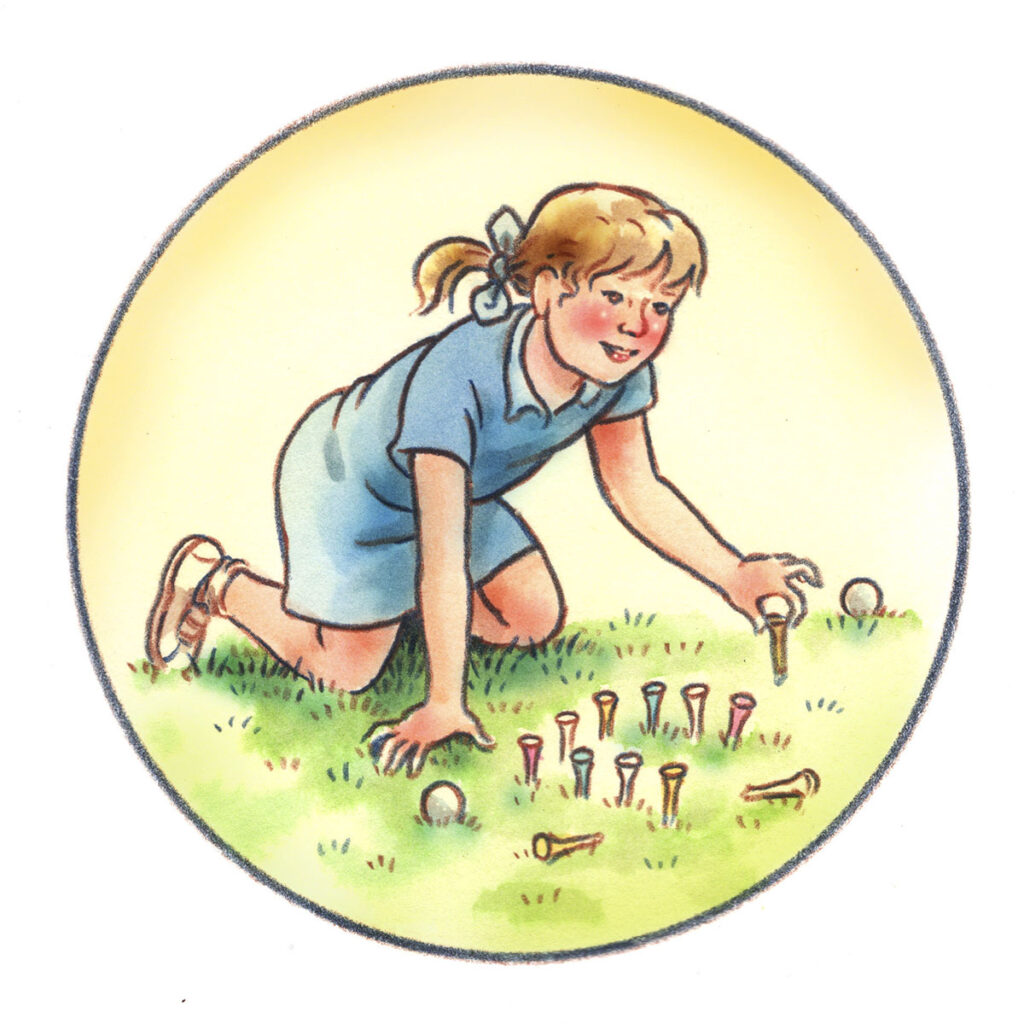
I coached a 5-year-old who asked to bump our sessions from 30 minutes to an hour. He’s one of those kids who’s loved golf from the start. My 6-year-old is not one of those kids. Helping her love golf has been a test for my husband and me. We’ve learned to let her do whatever she wants at the range if she isn’t bothering anyone else. She wants to take all the tees and build a fort? Great. She wants to hit one? Great. She wants to sit in the cart and drink lemonade while I hit balls? Great. I want every association she has with the game to be pleasant. She likes activities with other kids, so we signed her up for group lessons. We dropped her off like we drop her at soccer. We prayed she’d like it, but you can’t let your kid see that, because that’s pressure. It’s not fair to them, and it could backfire on you. This summer, we took her out on the course with a friend. The other kid’s mum and I grabbed a cart and kept an eye on pace of play while the kids hit it, ran after it and hit it again. I rarely talk about technique with my daughter. If one day she wants to learn more about the swing, she knows I’ll be right here for her. – with Keely Levins

Don’t make it about hitting perfect shots
Davis Love III, Hall of Famer
Atlanta Country Club recently posted a photo on Instagram of the renovation of the sixth hole, and I immediately thought: those rocks are the best place to look for golf balls on the whole golf course. That was my association with that hole because my dad, who was the pro there, would take us out on Mondays when the course was closed. When we got to No.6, my brother Mark and I would get bunker rakes and gather balls from under the rocks. Dad made golf fun for everybody – that was his mission in life. We’d take a fishing rod with us and stop playing to go fish. Mark (who caddied for me and co-founded our golf-architecture firm) also fell in love with golf as a by-product of those casual outings. When I first introduced my son to the game, I let him drive the cart, and play in the bunkers with the rake. My granddaughter, well, at first her favourite thing to do was ride in the cart and fill divots with sand. She also liked to look for mushrooms. She’d set up to the little mushrooms like they were golf balls and swing at them to make them explode. In all those introductions to golf, hitting perfect shots was never the focus. The result is generations of people who love the game. – with Keely Levins

The Best Games To Play With A Young Child By Madelaine MacClurg
It can be intimidating to take your child out to the range or the course. What if you’re too tough on them? What if you distract or slow down other groups? What if your child inherits your incurable slice?
Remember that his or her attention span is shorter. A session as short as 20 minutes might be perfect. How to spend that time? Brian Burgwyn, a US Kids Master Kids Coach, says gamify our practice. “Sometimes, the best way to practise is where they don’t realise that they’re practising.”
A classic game to play with your kid on the practice green is noughts-and-crosses because it teaches aim, speed control and strategy. All you need is something to mark the boxes with, like tees, string or chalk, and you’re in business. Depending on skill level, hit putts from five or 10 feet from “the board” and see who can get three in a row first. You can also incorporate a rule where players can knock their opponents out of their boxes. This helps players develop their aim, distance control and strategic thinking. As your child’s skills improve, build up to longer-distance putts. You can also use this game with chipping.
“Bowling” is another fun game for the putting green. Anthony Rodriguez, senior program director at the First Tee of Metropolitan New York, loves this game for juniors because it teaches kids how to account for stroke and distance while also developing speed control. To set this one up, place 10 tees upside down in a triangular bowling-pin formation and spaced so a golf ball can’t quite fit between them. Drop two balls about eight feet away and try to knock down as many pins as possible. Score this like you would a traditional game of bowling.
You don’t always have to set up elaborate drills to keep your kid engaged. Burgwyn says making golf fun can be as simple as challenging your kid to hit a shot high, or left, or wherever! Sometimes you don’t even need golf balls.
Dona Lerner, a US Kids Master Kids Coach, says that hitting pine cones in the backyard is a great way to simulate the sensation of swinging through something. She also endorses enlivening bunker practice by swapping out golf balls for giant marshmallows. On really hot days, Burgwyn switches regular range balls for water balloons.
Like many golf parents, you might be wondering if there’s a “right time” to take your kid to the course. Many junior golf coaches we spoke with agree: any time! If your goal is to grow a child’s love of the game, he or she must first feel comfortable on the course.
Instead of droning on about technique or strategy, make it fast-paced by having your child partner with you in a parent-child ambrose format. You can start around the green to boost the child’s confidence and work back as the child improves. Not only will the kids learn valuable playing skills, an ambrose is also a great opportunity to collaborate with them on the course.
When your junior is ready to play on his or her own, scale the course to his or her skill level. Start at about 70 metres away from the flag with minimal to no obstructions or hazards. The first time out, call a 70-metre hole a par 5. Once the child can consistently make par, change it to a par 4 and then a par 3. As your junior’s game progresses, use the Longleaf Tee System as a guide to figure out how long each hole should be for your child.
The Longleaf Tee System is a joint initiative from the American Society of Golf Course Architects and the US Kids Golf Foundation that’s designed to create a fun and fair course for every player. How does it work? Essentially, you allow driving distance to decide the distance any golfer plays. For example, a child who carries the ball with their drive 100 metres would play par 4s between 146 metres and 214 metres. This allows the child the opportunity to use every club in the bag and develop a well-rounded golf game. If you want to get granular, you can refer to charts on the Longleaf website to set specific tees on your home course.
Scaling the course doesn’t only apply to distances but also expectations. Because golf is often a recurring-cost sport, Lerner explains that many parents feel like they need to see their child improving at a certain pace to justify the money they’re spending.
“You can’t measure the success of your investment every time your kid touches a golf club,” Lerner reminds.
Minimising expectations will reduce the pressure kids feel on the course and make their experience more enjoyable. That’s all you want for your child – to love golf, too.
Fewer clubs that fit right is better
Jonathan Wall, Golf Digest managing editor (equipment)
An old set collecting dust in the garage feels like a perfect opportunity to retro-fit and save a few bucks. As a father of three, I’ll cop to considering a similar strategy for my kiddos. Cut-down clubs worked for Jack Nicklaus! But the consensus in the golf equipment world is never. It can make a shaft so stiff it’s virtually unplayable and a kid miserable. You don’t need to spend much. Marty Jertson, Ping’s vice-president of fitting and performance, suggests starting with a handful of junior-specific clubs – driver, fairway wood, 7-iron, wedge, putter should do – and letting creativity lead the way. “There’s a lot of skill development that happens if you give them a limited set,” Jertson says. “Let them learn how to manipulate the face. Make them earn more clubs.” Also, woods should have at least 15 degrees of loft. “Getting the ball into the air is magic,” says Dan Van Horn, US Kids Golf’s founder. “To help them achieve that, use a tee often and make sure they have proper clubs.”
It doesn’t have to look like your golf
Brittany Lincicome, eight-time LPGA Tour winner
Even though you love playing 18 holes, delay taking your kids out for a full round. My dad took my brothers and me to the range to teach us how to hold the club and swing it. The main purpose of those outings was to spend time together. Once we were making contact, Dad took us to a par-3 course under the lights. The longest hole was 80-something yards. The focus was on having fun and being together and not slowing any other groups down. We spent a few years there before going to a full-sized course. I loved those nights under the lights. Now that I’m a mum, I send my daughter, Emery, to First Tee clinics because I know their focus is the same as my dad’s: have fun and enjoy being with good people. Emery reminds me of myself the way she goes out there and just tries to hit it as far as she can. I’m going to keep doing what my dad did: let my kids play multiple sports and have golf be a normal part of that rotation. Hopefully, it’ll be something we can enjoy together for a long time. – with Keely Levins
How to Reward a Kid the Right Way By Drew Powell
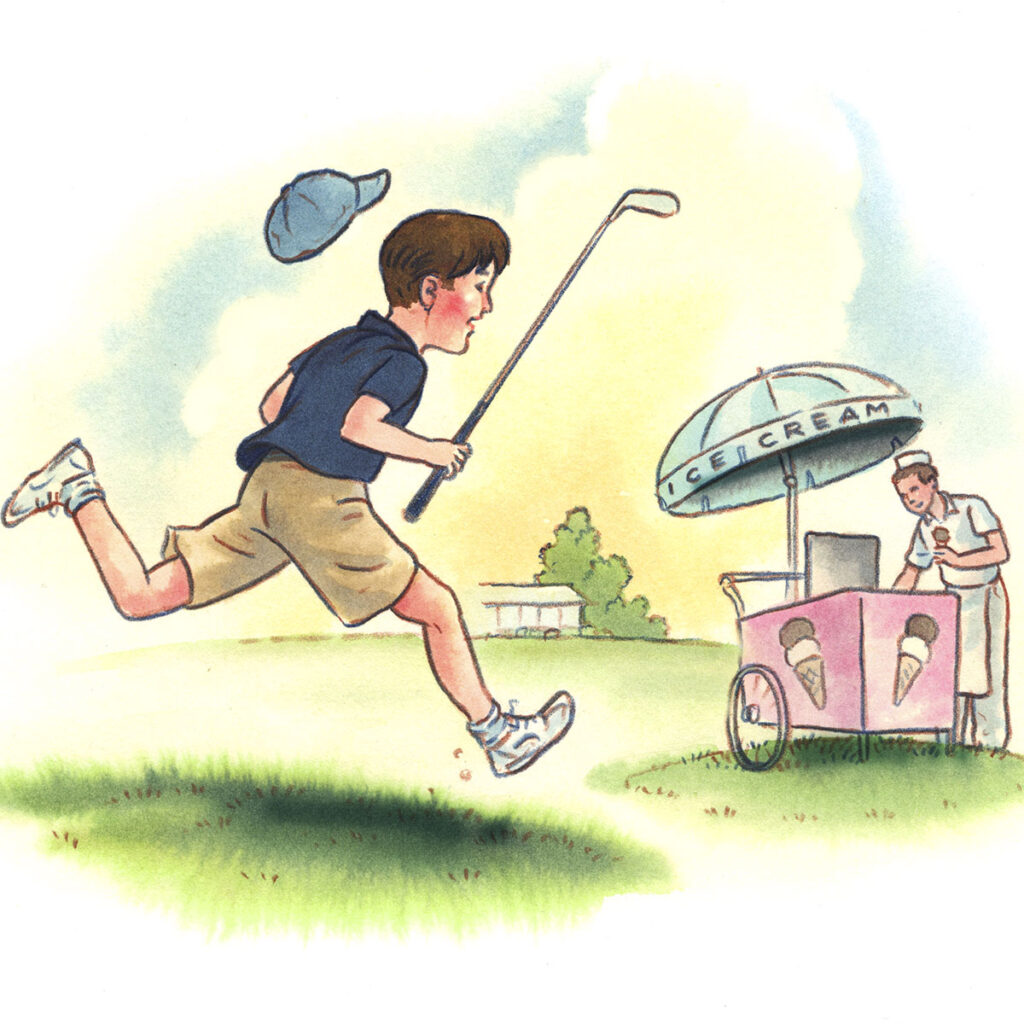
You’ve heard about the kid in a candy store, but what about the junior golfer in an ice cream shop? Sweden’s Ludvig Aberg says it was enjoying the frozen delight with his dad after rounds of golf that helped spark his love for the game. Fellow countrywoman and World Golf Hall of Famer Annika Sorenstam recalls enjoying plenty of ice cream at the golf course growing up, the memory of
which today still “brings a smile to my face”, she says.
Perks to incentivise a child to practise or play can create fun associations. Sport psychologists agree, however, that not all rewards are created equal, and understanding how to properly motivate a junior golfer can be the difference between burnout and lifelong enjoyment.
Dr Beth Brown played collegiate golf before earning her doctorate in sport psychology. She has devoted her professional career to youth development, notably at The First Tee and now as the senior athlete development specialist at the USGA. Coincidentally, when she was growing up in eastern Oklahoma, Brown’s dad owned an ice-cream shop, and she recalls teams and families regularly flooding in to celebrate a win.
Brown coined this the “Dairy Queen Syndrome” because the ice-cream reward was almost always contingent upon the team winning. “When those incentives are based solely on outcome, which become extrinsic motivators, they produce some short-term results in kids but do long-term damage because they lose that fun, that joy, that reason they’re playing,” Brown says.
Dr Albert Petitpas, a former psychology professor at Springfield College and one of America’s leading authorities on sport-based youth development, agrees that extrinsic rewards like these are lousy motivators. “They put all the emphasis on outcomes and not the process of how you get there,” says Petitpas, who helped develop the foundation and training program of The First Tee.
Placing too much emphasis on outcome can cause juniors to tie their identity as golfers to their identity as people, says Pia Nilsson, one of Golf Digest’s Legends of Golf Instruction. “If I can’t feel good with who I am, independent of my outcomes, then it’s going to backfire,” says Nilsson, who along with Lynn Marriott founded VISION54, a popular performance school in Arizona.
Self-determination theory was formed in the 1980s and is a widely accepted framework for understanding human motivation. When people are self-determined, it means they are intrinsically motivated to do an activity because they are driven by enjoyment and interest. This creates long-term satisfaction. However, the theory holds that to achieve a sense of self-determination, people must feel that they are in control during the activity.
When parents offer their kids rewards for shooting a certain score, they erode this autonomy. “If rewards are used to consistently control the young person’s behaviour, there’s no more self-determination,” Brown says. “There’s limited autonomy. Their behaviour is being controlled by the adult.”
What’s a good way to help a child find joy in golf without constantly dangling rewards over them? Petitpas says one answer is intermittent reinforcement, which is giving a reward at irregular intervals. At The First Tee, Petitpas encouraged creative games that would get juniors less focused on outcomes and more on the process. If Petitpas noticed a junior was swinging out of balance, for example, he would tell the child to hold the finish so that he could take a picture of the sole of the child’s shoe. When
Petitpas showed the junior the photograph, this served as the external reward. “If they can get some success experiences, that develops their belief that Maybe I can do this,” Petitpas says. “Then comes the self-efficacy and then comes the addiction to golf.”
Instead of rewarding juniors only when they succeed, Brown says to also reward them for accomplishing process-based goals, like trying their best, keeping a positive attitude or being a good teammate. Equally important is to not offer these rewards every time to tap into the power of intermittent reinforcement.
When utilised properly, rewards can be a powerful tool for creating a fun and communal atmosphere that will help juniors fall in love with the game. “Joy could come from having fun training sessions and then eating ice cream or a cinnamon roll together,” Nilsson says. “That could be part of making it fun, along with being with friends and being social and not always being compared because of your outcome and rankings.”
Fun: a simple goal espoused by Sorenstam, Nilsson, Petitpas, Brown and parents everywhere. But how do you know you’ve done it right?
“When you take the kids home, you want them to say, ‘When can we go back, Mummy?’ That’s the biggest success,” Sorenstam says.
Stick to your parental values
Annika Sorenstam, Hall of Famer
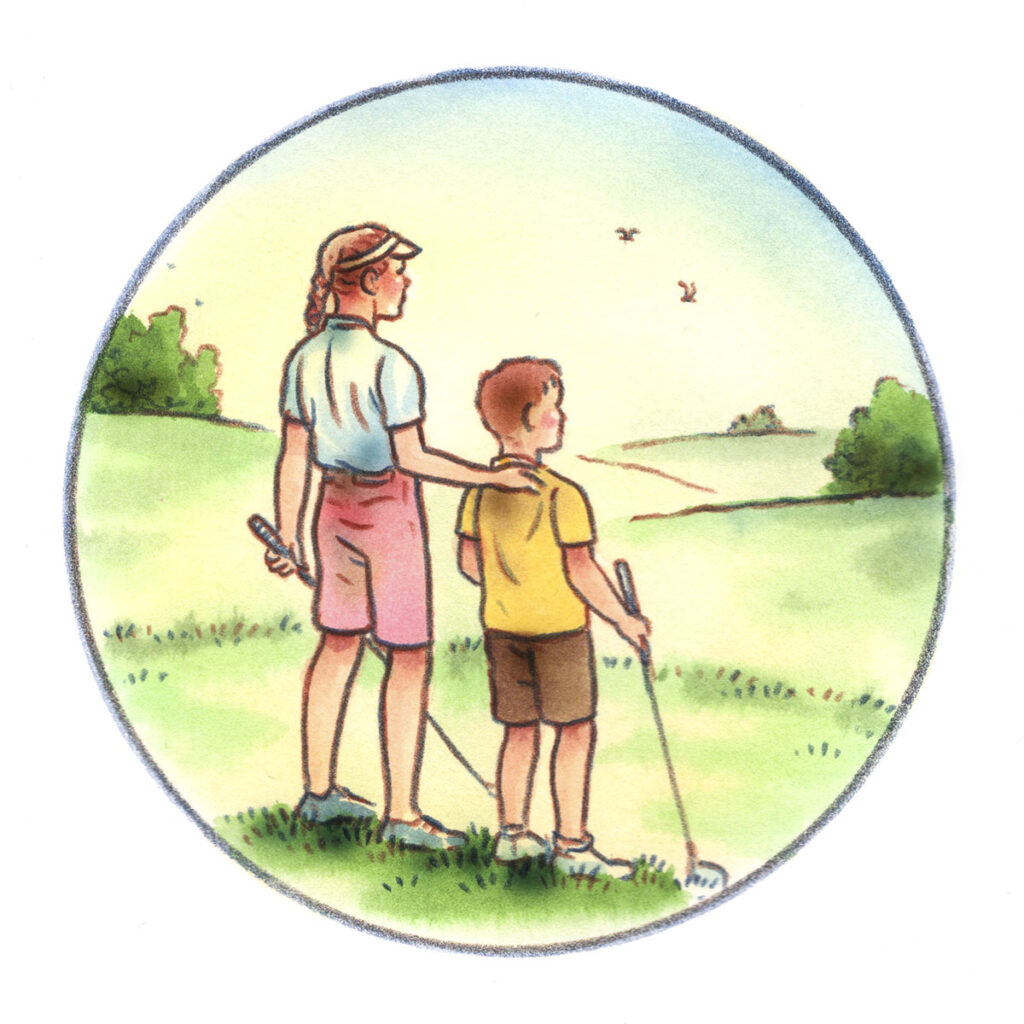
My husband, Mike, and I introduced our kids, Ava and Will, to golf when they were young, but they didn’t like it. “What a bummer,” we said to each other. My parents introduced my sister and me to golf the same way they introduced us to everything: here’s a soccer ball; go kick it if you like. Here’s a golf club; we can go to the driving range if you like. We tried a lot of things as a family until we figured out what we really loved to do. Mike and I know that our job is to introduce our kids to everything so that they can hopefully find that thing they’re excited about when they wake up in the morning. In 2015, I was going to the Drive, Chip & Putt event at Augusta National. It was held during Easter, so Mike and I decided to go as a family. Ava and Will had so many questions about what the kids were doing and how they got there. They asked if they could do it. I said, “Yes, but these kids have practised very much to qualify to get here, so you need to practise, too.” We signed them up for the next year’s qualifying, and they practised every day before and after school for two months. Now, Ava is a social golfer, and Will plays all the time. – with Keely Levins
A few years away is OK
Dave Schnider, CEO of Fujikura Golf
I introduced my son casually to golf by taking him on the course with me a few times, but at age 5 it was clear that he didn’t want to play. He was getting frustrated. I wasn’t having fun, either, so I took a step back. For four years, he didn’t touch a club. He played other sports, and I played golf with my friends. He showed interest in golf again when he was 9, so I signed him up for PGA Junior League. He kind of liked playing with the other kids but was still more competitive in other sports. Fast-forward to high school and he decides he’s done with basketball and soccer – now he wants to play golf. He absolutely dove into the game. Now he’s 16 years old and is a plus-handicapper with plans to play college golf. – with Keely Levins
Wait until they ask to play
David Leadbetter, Golf Digest Legend of Golf Instruction
Seve Ballesteros once told me how he’d keep his kids from the course when they were enjoying it. He wanted them to beg him to go to the golf course. When our daughter, Hally, didn’t want to play golf as a young child, we knew we had to let her do other things. For her to gain that love affair with the game, she needed the space to come to golf on her own terms, if she’d come to it at all. My wife was 15 when she started to play golf and went on to compete on the LPGA Tour. Hally was casually around golf just by being in our family, but she really loved horseback riding. When Hally was 12 or 13, she said she wanted to play golf. We remained calm and supported her by getting her equipment and coaching. When Hally got into it, she really got into it. She had a good college and amateur career and turned pro. Quickly, she decided to get into the media side. Now there’s no denying how much she loves the game. – with Keely Levins

Handling common frustrations By Sam Weinman
When your kid loves golf, the toughest days are when they also kind of hate it. Water balls, tears, occasional sprints to the carpark – there’s enough trauma available in golf for a parent to wish for something simpler. The best argument for having your kid stick it out might be how the game can help kids navigate everything else in life.
David Yeager’s best-seller, 10 to 25: The Science of Motivating Young People, isn’t specifically about golf. The University of Texas psychology professor’s book is a deeply researched exploration into the developing adolescent brain, how it responds to challenges and stress, and why certain messages resonate with kids more than others. For a book that isn’t about golf, a lot of it feels like it’s about golf.
“I am never playing again!”
Among Yeager’s central tenets is that with kids, parents should adapt a “mentor mindset”, which falls between two common extremes. Consider a familiar scenario, an 11-year-old unravelling in an early golf competition. The parent who only disciplines a child is setting too high a standard with insufficient support – what Yeager calls an enforcer mindset. A parent who wants to swoop in and save the child, or worse, decides not to let them compete in the first place, is guilty of a protector mindset – all support and no standard.
The mentor mindset is built around an equal measure of high support and high standards, which means giving young golfers a chance to develop skills while reinforcing their ability to cope with what the game can throw at them. Yeager’s refrain is that kids seek “status” from adults more than we realise.
“Choosing to be in this important competitive environment is impressive. It’s a high-status thing,” Yeager says of the message he advocates sending kids. “If you’re going to compete where it’s uncertain how you’ll do, that takes courage.”
“I’m soooo nervous”
Yeager forces parents to reconsider the assumption that stress is only detrimental. As Yeager notes, stress – from a racing heart to sweaty palms – is simply the body activating for performance. The tricky part is how we perceive it.
Yeager’s research elaborates on the difference between a “challenge-type stress response” and a “threat-type stress response”. When a golfer has butterflies on the first tee, the “challenge-type stress response” is to accept those nerves as a natural sensation before playing, and the body responds favourably. The “threat-type stress response” is when we believe something is wrong, and the body starts to panic even more. One of the worst things a parent can do is encourage kids not to be nervous, which is telling them to suppress an emotion they can’t control.
“For the kid, the implication is, ‘Well, I am stressed, so that must mean I’m not talented,’ or ‘I am stressed; therefore I didn’t prepare,’” Yeager writes.
“But I don’t want to hit balls!”
Parents and children can often be at odds around “It’s-good-for-you” tasks like homework or cleaning a room. With golf, this argument can often be about practice.
One misconception is that a truly dedicated golfer never needs to be coaxed because motivation always comes from within. Yeager says that’s not realistic. Golf is hard, and practice can be tedious. Rather than expecting a child to want to pound balls on the range, a mentor mindset helps the player see why it could help and appeals to their sense of reward.
“The message the parent is providing can be, ‘ It’s high-status for you to put in the preparation that other people were going to shortcut or half-ass,’” Yeager says. “For you to be the kind of person who’s chosen to push yourself now and get better, when other people wouldn’t, ties into status and respect.”
“Stop telling me what to do!”
Yeager’s kids are more into baseball, where he fights the tendency to tell his son what to do at every step of his pitching motion. However well-intentioned, a parent’s desire to overload their kid with knowledge usually comes at the expense of the athlete developing his or her own instincts. When a young player is pulling every tee shot left, a knowledgeable parent might note it’s because their kid is rising out of the backswing and coming over the top. Rather than tell the player the solution outright, Yeager advises asking players enough questions so they can diagnose and fix the problem themselves.
“You want to practise in an environment where you’re coaching them, but you’re coaching in a way where they know how to critique their own mechanics and form,” Yeager says. “The logic is that players need to play the game in their heads, but if, as a parent, you’re telling the kid how to play the game, then you are owning the mental effort.”
It doesn’t have to be expensive
Ben Griffin, PGA Tour player
Golf has a reputation for being expensive, but you can raise a kid who loves golf on a budget. My parents introduced me to golf at our country club, and I was one of those kids who loved it right away. Golf was a fun way to spend time with my dad, and I was pretty good at it. When we left the club due to financial reasons when I was 12, my parents kept my love of the game alive by figuring out how to get me access to golf without having to overspend. There was a Golf Galaxy store in a shopping centre my mum would go to, so she’d drop me off there, and I’d hit balls and putt while she shopped. They found a public golf course with a chipping and putting green and would drop me off on their way to work in the summer and pick me up on the way home. They were creative and made sure I was surrounded by good people. Golf can be very affordable if you get a little creative in your approach. – with Keely Levins
Show them how to act, nothing more
Ryan Palmer, four-time PGA Tour winner
Too many parents have too much riding on their kids’ golf. They base their social lives around it and get satisfaction out of their kids playing well. My dad was really only concerned with my behaviour. He’d unceremoniously take me off a golf course if I let my temper get the best of me. Our son, Mason, wasn’t into golf as a kid, so we never pushed. When we did play, the only expectation was he follow proper etiquette and be respectful. When he was 13, he said he was done with hockey and wanted to get back into golf. It was a bit of a shock. Of course, I was happy to help, but I can’t make him good. I can’t make him practise. He knows that part is on him. I help him when he asks, but he has his own coaches he works with. I’m here to encourage and teach him how to act, like my dad did with me. – with Keely Levins
Leave while everyone is having fun
Erika Larkin, Golf Digest 50 Best Teacher
The advice I give all golf parents is something that worked for me when I learned how to play with my family: leave while everyone is having fun. If you wait until your child gets tired, the attitude towards golf sours. If your child is smiling when he or she leaves the golf course, that child will want to come back. You can also create this positive association by letting golf be the reward for something the child has earned. In the same way that you’d reward your child for getting through a doctor’s appointment or celebrating something at school with a new toy or a special treat, reward the child with golf. That way, golf is in the same category as treats: it’s a desirable, special thing. – with Keely Levins