[Photo: Ben Jared]
Tell me if you have heard this story before: A player known for close calls not getting over the line breaks out and wins the Players Championship on the back of an impressive Ryder Cup debut as a captain’s pick.
Sound familiar?
No, we’re not talking about Scottie Scheffler in 2022. We are, of course, talking about Cameron Young in 2026.
Back in 2022, Young was named PGA Tour rookie of the year. That season he finished runner-up not once, not twice, not three times … no, not even four. How about five times in 25 starts. As quickly as he became a name in the game, the former Wake Forest All-American’s name came with the somewhat harsh label of a bridesmaid.
Fast forward four years, and Young now has the biggest title of his career to date, his second PGA Tour win in his last 11 starts, while also boasting of being the standout player for the US Ryder Cup team at Bethpage last September.
So what changed for Young? How did the 28-year-old evolve from the near-miss man to lifting the golden boy trophy at TPC Sawgrass? I have crawled through all the data and analysed Young’s game over his five years on tour and to me there are four elements to his evolution into an elite player.
From the moment Young came on the PGA Tour, he was known as a bomber capable of top-tier speed off the tee and able to launch drive after drive 300 plus yards on the fly. He seemed built for the modern style of play on tour yet he had a glaring weakness: his putting.
Young ranked 158th out of 193 players on tour in strokes gained putting in 2023. That year he lost more than a shot per tournament, minus 0.287 shots per round on the greens. In the biggest moments in contention, he found it hard to convert chances and save crucial pars late over the weekend.
However, that changed in a big way in 2025. Thanks to a new Scotty Cameron mallet and a slight tweak in his set-up, Young made a gigantic leap with his short game. In 12 months, he went from 145th on tour in SG putting to seventh.
All this said, his new secret weapon wasn’t the putter. Rather, it was the person handing it to him.
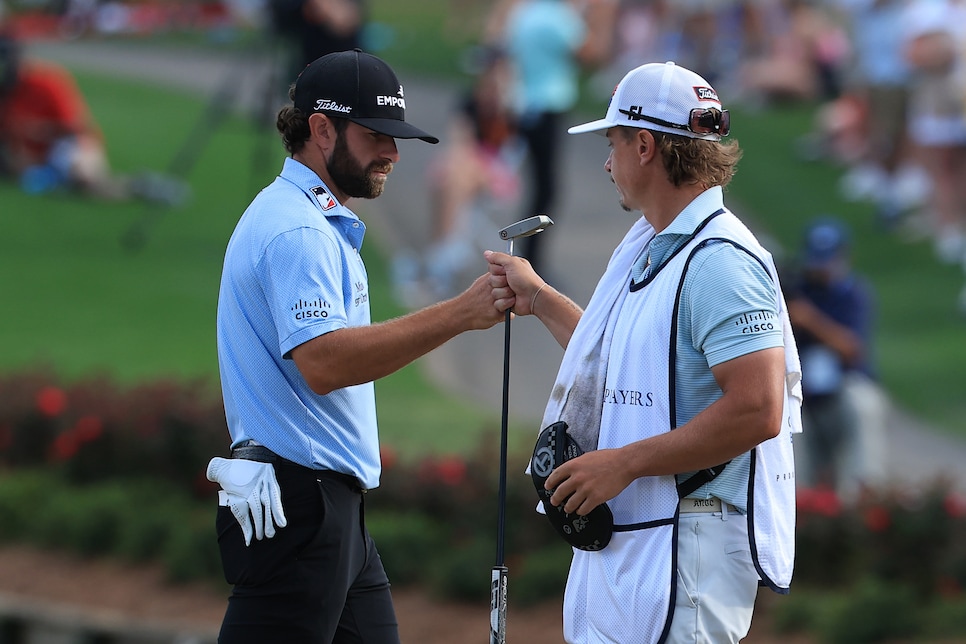
Putts like the one Cameron Young made on the 17th hole at TPC Sawgrass in the final round of the Players Championship seem to have been falling more since good friend and former college teammate Kyle Sterbinsky started to caddie for him in 2025.
David Cannon
Kyle Sterbinsky, a former teammate of Young’s at Wake Forest, began caddying for his friend at the RBC Canadian Open in June. Credited by his boss as being one of the best green readers he knows Sterbinsky had a clear and almost immediate impact on Young’s putting.
“I knew he would be [a great fit] before he started caddieing. He is a very good golfer in his own right,” Young said on Sunday in his post-victory press conference at TPC Sawgrass. “He is one of my closest friends. He is great at reading greens. He has a great mind for golf. So I knew he would be a good fit before I hired him.”
In the 10 months since he has been on the bag, Young is the third-best putter in the game according to DataGolf, now gaining 0.74 shots per round. Just a season earlier, he had been losing minus 0.23 shots per round on the greens.
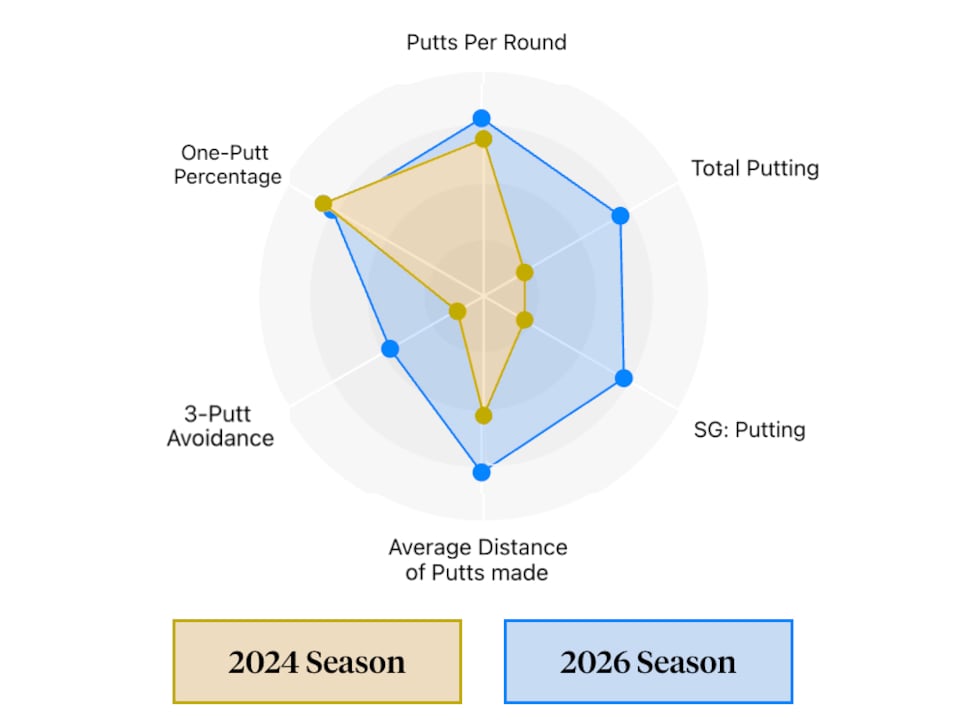
That is a difference of almost a shot per round. And that has a lot to do with Young’s recent tour success. No better example than the 71st hole at the Players Championship, when Young rolled in a tricky, downhill 10-foot putt to tie the lead. It’s a putt that seemed like it would have burned the edge of the cup; this time it disappeared. One hole later, Young was lifting the trophy.
https://twitter.com/PGATOUR/status/2033300018057126303
2. His approach play
The term “streaky” is often used to describe certain golfers. Young’s approach play was indeed streaky for a long time. He seemed able to get on runs when he could knock down flags and capitalise on his power off the tee. Yet sometimes in the same tournament or even the same round, he would blow up. His approach play was letting him down.
In 2025, Young ranked 129th in strokes gained approach, losing minus 0.124 shots per round and 141st in proximity to the hole, hitting his approaches to just outside 38 feet on average.
So far in 2026, it has been a different story. Young ranks inside the top 25 in SG approach, gaining nearly half a shot per round with his iron play and is third in proximity to the hole.
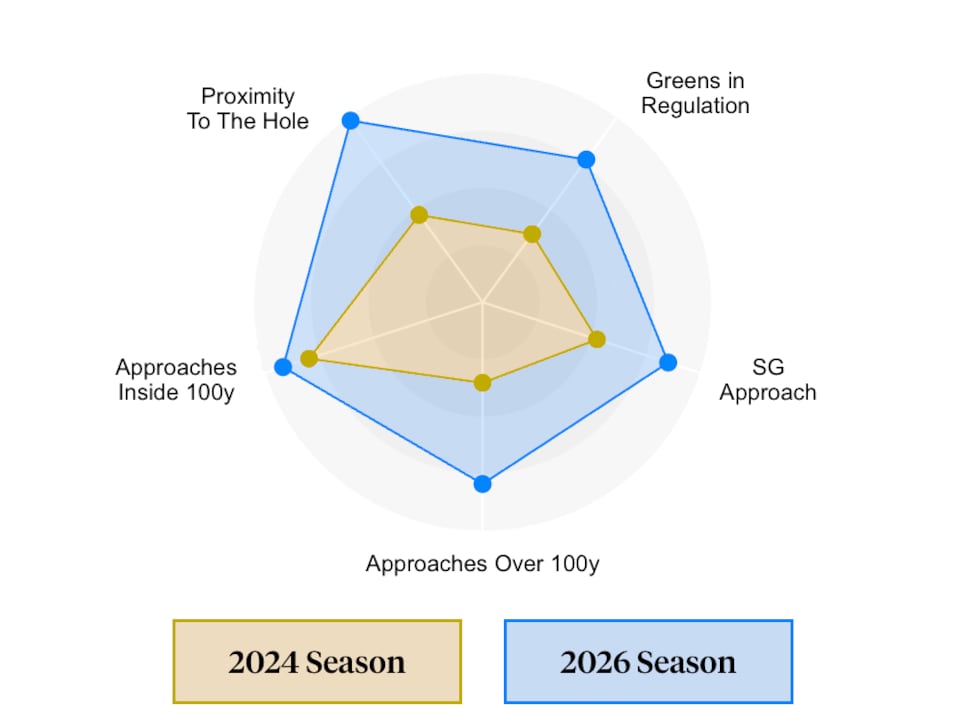
Combine that with an improved ability to hole those putts and you can see how Young’s scores have improved.
3. His Driving
It might seem odd to suggest that Young’s game has gotten better through his driving; he has always been one of the longest and most powerful players on the PGA Tour. But it is not distance he needed to improve.
In 2025, the data showed that Young was one of the wildest players off the tee. Yes, he averaged more than 313 yards and nearly a third of his drives travelled longer than 320 yards, but his misses were bad. Scratch that, they were very bad.
Young’s driving accuracy was just 53.9 percent, good enough to rank 167th out of 180 players on tour last season. He did not just miss one way. He missed 16.6 percent of tee shots left and 16.8 percent of tee shots right. He had a control issue.
However, you guessed it, he seems to have combated the issue in 2026.
While his driving average has decreased by five yards he has traded that for accuracy. He is hitting 63 per cent of fairways, nearly 10 per cent more than he was just a season ago and currently ranks inside the top five in SG off the tee.

Once again, it showed at TPC Sawgrass. Standing on the 18th tee in the final round, tied for the lead, Young stared down the narrow strip of fairway and became calm. Despite it playing as the hardest hole for the week and the second hardest fairway to hit on Sunday, Young pulled driver and executed the perfect combination of length and accuracy, hitting his ball 375 yards and finding the fairway. It turned out to be the longest drive ever recorded on the 18th hole at TPC Sawgrass.
The longest drive on record on No. 18 @TPCSawgrass.
Cameron Young will have just 98 yards left into the 470-yard par 4. https://t.co/c90Lb22xun pic.twitter.com/28wHXE06Uf
— PGA TOUR (@PGATOUR) March 15, 2026
Matt Fitzpatrick, tied with Young for the lead and statistically the most accurate driver in the field during the 2026 Players, was up next. But he would miss the fairway for the fourth straight day, eventually making a bogey. Young won the biggest title of his life, because and not in spite of his driver.
4. The Ryder Cup
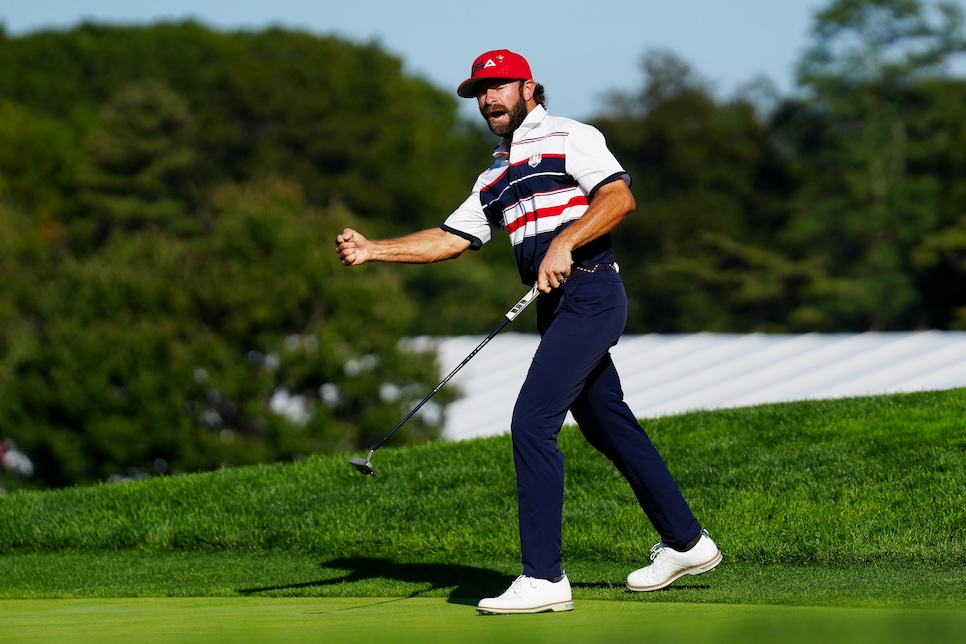
Strokes gained measures many aspects of a player’s game, but it can’t measure confidence. Making his Ryder Cup debut last September at Bethpage, playing in his home state, Young was the best player on the American side. That’s not a take; there’s data to back it up.
Mike Stobe
Young went 3-1-0, playing in four of the five sessions. No American player won more points.
Young’s cumulative strokes gained total for the week was +5.06, a shot and a half better than any other American and second only to Tommy Fleetwood overall.
Young’s approach play gained 3.84 shots over his four matches. He was the best American in that category, too, and second only to Fleetwood for the week.

And in his last act, on the final hole at Bethpage Black, Young found the middle of the fairway, hit his approach shot to 12 feet and holed the birdie putt to beat Justin Rose and kick start a near-historic comeback from the Americans.
Driving, approach play and putting. It works at Ryder Cups and it works on the PGA Tour. And it’s why Cameron Young will no longer be known as the bridesmaid but rather the Players champion.