
[Photos: Cliff Endsley]
WHAT YOU NEED TO KNOW: Callaway’s latest line of game and super-game-improvement irons – Quantum Max, Quantum Max OS and Quantum Max Fast – share a host of common technologies yet are geared towards specifically different audiences. The Max is more of a traditional game-improvement club, the Max OS is a noticeably oversized super-game-improvement model and the Max Fast is a lightweight version aimed at slower swing speeds.
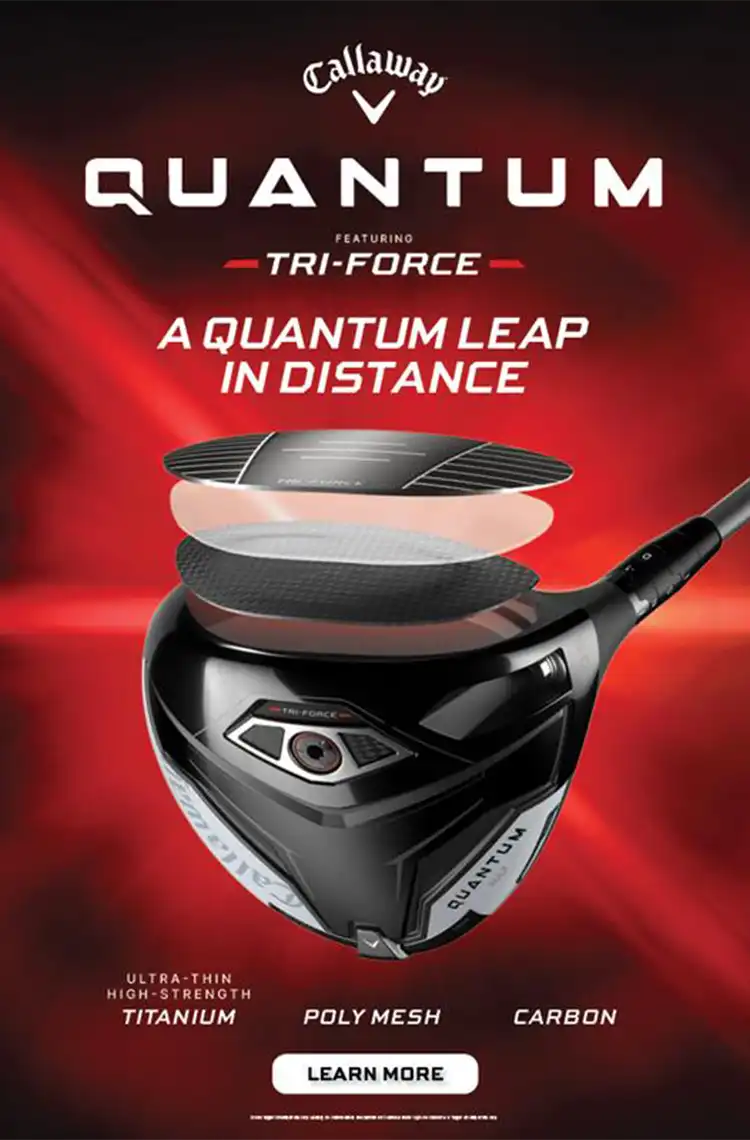
RELATED: Callaway Quantum drivers – what you need to know
PRICE & AVAILABILITY: The Quantum Max, Max OS and Max Fast cost $269.99 ($NZ319.99) per iron in steel and $299.99 ($NZ349.99) per club in graphite. Available at retail across Australia and New Zealand from February 13.
3 Cool Things
1. Bigger is better: Mid to high-handicappers need reassurance at address. Callaway returns to its roots with these irons by producing large clubheads with plenty of offset, generous toplines and slightly weaker lofts than recent offerings – all in an effort to ease getting the ball in the air.

“Callaway’s always been known for approachable irons, irons that are easy to hit, that have a ton of forgiveness, that kind of have that approachable sort of profile at address,” said Zack Oakly, senior manager, product strategy and category management for Callaway. “It’s confidence-inspiring. So, you’re going to notice that these irons have gotten back to that. Big cavities, easy to hit.”
2. The need for speed: Confidence is great but everyone wants the ball to go far, even in irons. To that end Callaway reimagined one of its hallmark iron technologies, the 360-degree undercut, in an effort to bolster ball speed. More deflection occurs thanks to a deeper face cup that extends further towards the trailing edge of the sole.
“We have an undercut that runs all the way around the perimeter,” says Brian Willliams, vice-president of R&D for Callaway. “It gives us a more active face with more deflection and you can really see the span of that deflection on the sole. It allows us to store and return a lot of energy through this face, which is helping us deliver speed, consistency off centre and helping players to hit to a consistent number more often.”
Also assisting speed is a weight bar that allows the centre of gravity to remain low and forward without inhibiting flexure on the sole flange, keeping speed up on shots hit low on the face.

3. Digging it out of the dirt: Many mid to high-handicappers have a steep delivery with their iron swings, making turf interaction a key design component in irons. For the Quantum line, Callaway employed a progressive tri-sole that boasts a leading-edge chamfer that sits higher off the ground. This accommodates the typical hands-forward iron address position and not only alleviates leading edge dig but raises the likely impact location on the face for more speed and higher launch.
Still, it’s not a one-sole-fits-all proposition. “Each Tri-Sole is uniquely designed, different parts of the sole are measured and obsessed over,” Williams said. “So, every product model and every loft, a unique design, you’re going to see it in a very pronounced way from heel to toe. It’s all about turf interaction, keeping the leading edge from grabbing or digging. Allowing golfers to get in and out of the turf with speed.”