
Callaway’s driver lineup has undergone some noticeable changes in the last three cycles, culminating with a multi-material, three-layer face design on Quantum that combines titanium, poly mesh and carbon fibre for the first time.
With AI still playing a key role in tuning specific areas of the face, it’s fair to wonder if the latest face technology found on Quantum is worth the upgrade, especially for golfers currently playing Paradym Ai Smoke or Elyte.
For the latest round of Golf Digest’s equipment comparison series, the last three years of Callaway drivers were put on the Golf Laboratories swing robot to showcase how they’ve evolved. The robot hit 54 shots per club at 95 mph across nine distinct face zones—six shots per zone—to capture how each driver performs on your best shots (geometric centre) and worst shots (heel and toe).
In some instances, the newest driver isn’t automatically the best. But understanding why is critically important when you’re in the hitting bay testing a multitude of different offerings. Our latest round of testing also shines a light on whether there’s a direct correlation between spin consistency and shot dispersion. In this test, they tell very different stories.
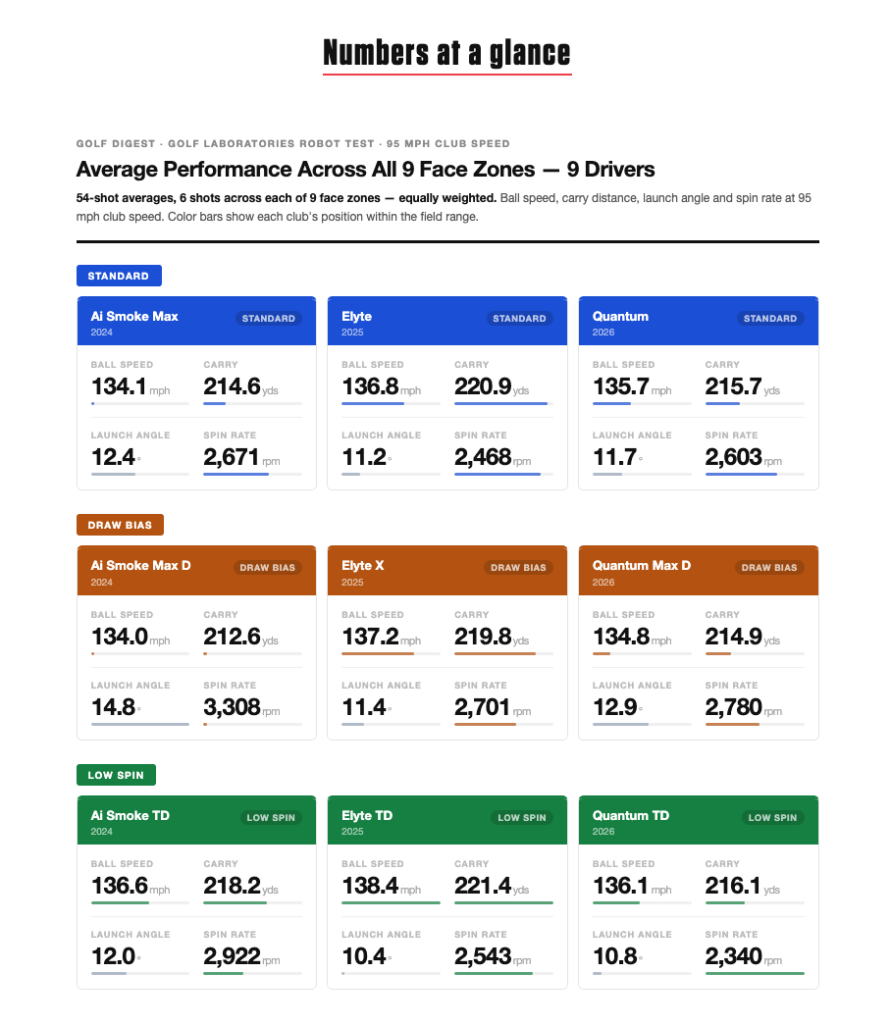
Before diving into specific metrics, it’s worth establishing where each model sits on the four numbers golfers care about most: ball speed, carry, launch angle and spin rate. These are the baselines against which everything else gets measured.
The Elyte family leads in ball speed and carry across all three tiers. The TD, standard and X occupy the top three spots in both categories, with Elyte TD’s 138.4 mph ball speed the highest in the test; its 221.4-yard carry also edges the Elyte standard (220.9) and Elyte X (219.8).
The Quantum line trends higher in the launch angle department. The Quantum Max D leads the entire test at 14.8 degrees, and even the standard Quantum (11.7 degrees) and Quantum TD (10.8 degrees) sit on the higher end of their respective tiers.
Quantum TD’s spin rate of 2,340 RPM is the lowest reading in the entire test. That’s 263 RPM below the Quantum standard, 203 RPM below the Elyte TD, and 582 RPM below the Ai Smoke TD.
For a player who already launches it high and carries it long, that number will look attractive. However, for a player who needs spin, it’s a flag worth noting before pulling the trigger.

Simply looking at the overall carry number doesn’t always tell the whole story. With the swing robot impacting nine locations on the face, we can get a better idea of where golfers around 95 mph could see improved performance on common misses, using a face heat map.
The data confirms the Elyte family continues to lead the way in distance. All three models occupy the top three spots in both centre carry and nine-zone average. If distance is the priority, then Elyte remains a strong option.
The draw-bias heads have a high-face problem, which makes sense considering more mass is generally concentrated towards the heel to induce a draw shape. The Ai Smoke Max D and Quantum Max D post the two worst high-face carry profiles in the test, bleeding nearly 18.5 yards from centre when contact moves up the face. Look at the heat map and the top row goes red fast. That’s a real-world issue for the player who tends to hit it high on the face under pressure.
The tradeoff is the low face. Flip the map over, and those same draw-bias heads post the two best low-face averages in the test, losing only 5-7 yards from centre. Every other club loses 11-16. The geometry is doing something intentional, trading high-face carry for low-face carry. Whether that works for you depends entirely on where your misses live.
Two other things the heat map reveals that a spec sheet never would: the Ai Smoke Max D is the only driver in the test where the heel carries farther than the toe, a structural quirk of the draw-bias CG position. And the Quantum TD is the only club where a mishit zone actually beats centre carry. The mid toe, at 224.6 yards, edges the centre strike by 1.5 yards, a byproduct of its ultra-low spin baseline finding a slightly better launch window just off-centre.
The low heel remains the universal kill zone. Six of nine clubs post their worst number there. Very few drivers have been able to solve this zone since we started conducting robotic testing.
For those unfamiliar with our SDEI (Spin Degradation Index) metric, it calculates the average absolute spin change across all eight off-centre zones compared to a geometric centre baseline. It’s essentially a spin consistency score. The lower the number, the better.
The Triple Diamond tier is the standout story. Its average SDEI of 190 RPM beats the draw-bias tier (262 RPM) and standard tier (288 RPM), meaning Callaway’s player-oriented heads are also the most face-stable when it comes to consistent spins. That’s counterintuitive. You’d expect a low-spin player’s head to punish mishits. The data says the opposite.
The Elyte TD’s 120 RPM SDEI is in a class by itself. Its full spin range across all nine zones spans just 361 RPM, with every impact location producing between 2,412 and 2,773 RPM. The next closest club, the Elyte X, spans 453 RPM. The Elyte standard spans 1,083 RPM (three times wider).
The heat map splits the lineup into two camps. Standard heads and the low-spin tier bleed spin on high-face contact. Draw bias heads do the opposite, spinning up when contact moves high, with the Quantum Max D averaging an additional 476 RPM above center across its three high-face zones. Structurally, that makes sense: deeper, more rearward CG amplifies gear effect spin on high-face strikes. The problem is that those shots are already losing ball speed. Adding spin can exacerbate the issue.
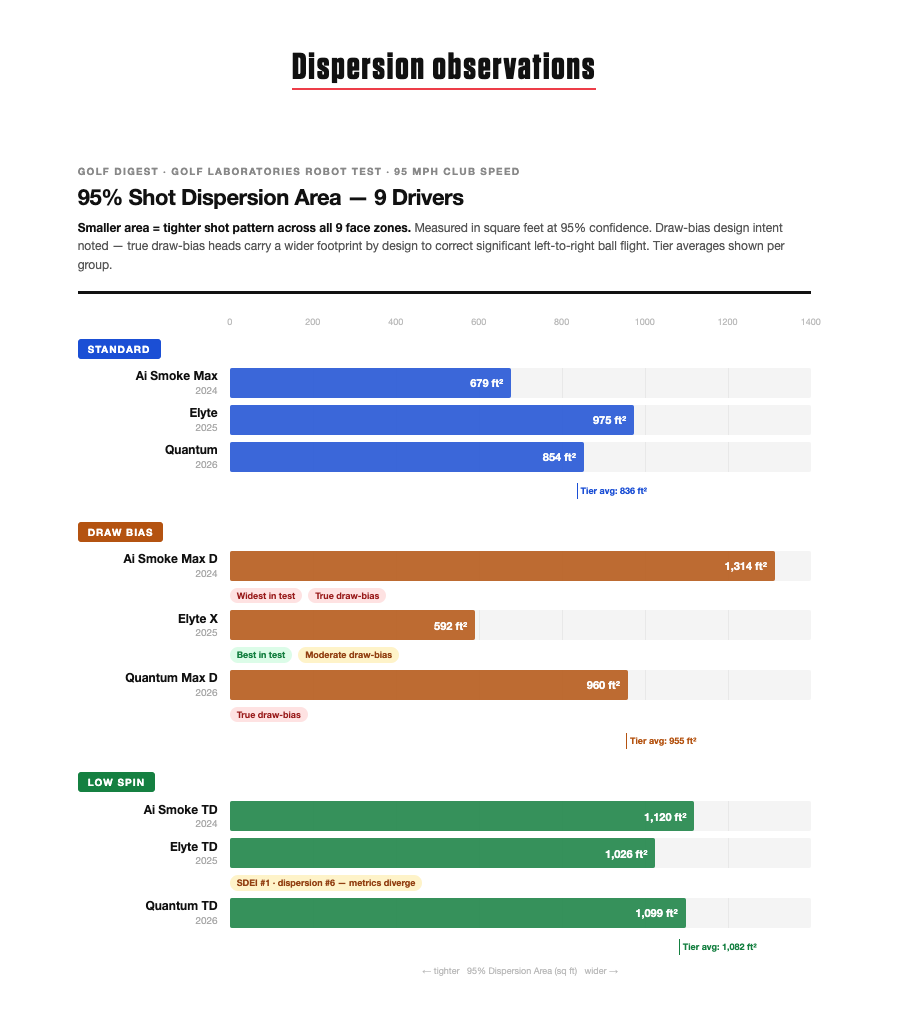
Not all dispersion numbers mean the same thing. The Ai Smoke Max D’s 1,314 sq ft looks alarming next to the Elyte X’s 592 sq ft. But those two clubs aren’t built for the same golfer or the same miss.
The Ai Smoke Max D is a true draw-bias head, engineered to correct significant left-to-right ball flight. A wider dispersion footprint is partly the point; it’s catching slices that a neutral head wouldn’t touch. The Elyte X sits closer to a standard head with a moderate draw bias dialled in. Comparing their dispersion numbers directly is like comparing a safety net to a tightrope. They are different tools for different jobs.
What the dispersion data is better suited to tell you is how each club behaves within its own design intent, and whether the shot scatter you’re getting is explained by spin instability or something else entirely.
Here’s where it gets interesting: SDEI and dispersion don’t move together. Spin consistency explains less than 9 per cent of the variance in shot scatter across these nine clubs. A club can hold spin beautifully across the face and still spray the ball. The Elyte TD is proof: 120 RPM SDEI, best in the test, paired with 1,026 sq ft of dispersion that ranks fifth-worst.
Spin stability and directional control are two separate problems, and we attempt to explain the divergence in the following.
The Quantum family sits in the middle of the dispersion leaderboard at 854 sq ft on the standard head, 960 sq ft on the Max D and 1,099 sq ft on the TD. Nothing that stands out as a best-in-test number, but nothing alarming either. The more interesting Quantum data point is the Max D at 960 sq ft, which is tighter than the Ai Smoke Max D by 354 sq ft despite both being draw-bias designs.
That gap likely traces back to the Tri-Force face construction doing a better job managing launch direction variance across zones, which is exactly the problem dispersion measures that SDEI doesn’t. The low-spin tier posts the worst dispersion average in the test at 1,082 sq ft, nearly 250 sq ft worse than the standard tier. For heads marketed toward better ball strikers, that’s a number worth chewing on.
The Elyte X remains the outlier in the best possible way at 592 sq ft in a draw-bias head, which typically carries a gear effect penalty that widens shot patterns. The Ai Smoke Max sits second at 679 sq ft. Neither leads any single metric outright. They do, however, keep producing clean results across the board.

Run the numbers across all nine clubs and the relationship between SDEI and dispersion is essentially flat. As mentioned above, the statistical correlation between the two metrics is -0.30, meaning spin consistency explains less than 9 per cent of the variance in shot scatter.
In layman’s terms, a club that holds spin beautifully across the face can still spray the ball. And one that spins inconsistently can still produce a tight pattern.
The Elyte TD is the proof. Its SDEI of 120 was best in the test. However, the club’s dispersion of 1,026 sq ft was fifth-worst.
Three factors explain the gap, none of which appear in the spin data.
Let’s start with gear effect sidespin. The SDEI metric measures only spin rate. It’s completely blind to the sidespin generated when the ball strikes away from the CG, and it’s that sidespin that moves the ball left and right.
There’s also launch direction variability. Face angle at impact changes subtly across contact points, even on a robot swing. Heel strikes deliver slightly closed; toe strikes deliver slightly open. Those directional differences widen the dispersion ellipse without touching the spin numbers.
The other thing to consider is dynamic loft variation. High-face strikes present more loft than low-face strikes. Different lofts mean different aerodynamic behaviour in flight, affecting both distance and lateral landing position. Again, nothing in the spin data.
The Ai Smoke Max D makes the same point from the other direction. An SDEI of 227, third-best in the test, with a dispersion of 1,314 sq ft, which was worst in the test. Spin stays consistent, but shots don’t achieve a tight pattern.
The SDEI tells you about distance predictability and whether mishits carry a consistent number. Dispersion tells you about directional control—will it land somewhere near your target?
A club can ace one and fall short in the other. That’s why neither number alone tells the complete story.