I read the other day about fears of a high-rise in Manhattan that was on the verge of collapse because its upper floors were showing signs of sagging and that one of its primary beams was “compromised.” (Tell me about it. I pull a muscle stirring my oatmeal these days.) Seems developers were trying to add 11 stories to the already 22-story building that is more than a half-century old. My mind drifts to the 60-something guy I came across during the member-guest telling me about his speed-training regimen with medicine balls, resistance bands and some kind of green powder that I wasn’t sure whether he was drinking or using to prevent chafing. I took my time with my oatmeal, feeling about as vigorous as Henry Fonda in “On Golden Pond.”
There’s got to be a better way of making old things better, which is pretty much I’m guessing your reaction to my selection process at major championships over the last 13 years: A lot of words about nothing to do with the actual golf or competitors, a mixed-up calculation of nonsense and a choice as obviously wrong as engagement ring shopping on a first date. But being given to pleonasm and at the same time achieving universal error is not news for me, or as Peg used to tell Al Bundy, “That hasn’t stopped you before.”
Nevertheless, I press on with hope, like Joe Dean, whose recent past of delivering groceries to strangers and sleeping in his car gives new meaning to the term “scrambling.” Because the Open Championship is the most hopeful of majors, a major whose champions have saved their claret-jug clinching final rounds with shots from car parks and driving ranges thrives on such illogical optimism. And so do I. Which can only explain my Wordle starting word: qajaq. Or why I still own a tuxedo from 1987.
But I digress …
The Open Championship excites me for two main reasons. First, there’s its abject unpredictability not only from player to player but from shot to shot. An ultra-bouncy Birkdale this year means 3-irons can go 310 yards, but it also means wedge shots can ricochet like tee balls, coming to rest 40 yards after initial contact with the tarmac green. Second, its unlike-any-other-tournament entry list with players who sound like they wouldn’t even be allowed to carry bags at Augusta National or Shinnecock Hills. It sort of reads like the guest list for one of Queen Victoria’s state banquets. Alejandro de Castro Piera obviously could have been the viscount of Madrid, Neville Ruiter clearly served as the court composer for Princess Viktoria of Prussia and Baard Bjoernevik Skogen must surely have waltzed into Buckingham Palace with the flowing robes of a mystic and faith healer from the Varanger Peninsula. But, no, they are in fact teeing it up at Birkdale this week, alongside Scottie, Rory and Fitzy (both of them), which are not characters in a series of children’s books from beloved British writer Beatrix Pottter, but could be.
In short, winning the Open never seems obvious until it is. Like last year when Scottie Scheffler won. I, of course, predicted Patrick Cantlay to win. Cantlay, whom I still admire very much, is unfortunately as relevant to contending in major championships as Prince Harry is to contending for the monarchy. He missed the cut, unremarkably. I take full responsibility.
This year’s prediction for the Open looks at the last 10 Champion Golfers of the Year and searches for a clue. (Me, in need of a clue, now there’s a revelation.) What I found was that seven of the last 10 winners were ranked in the top 15 in the world and their median World Ranking was 6. That means this year’s winner if we’re going to make bold predictions (and we are) is coming from the top six in the world. What was also true is that seven of the last 10 winners recorded a win prior to claiming the claret jug. So, let’s put top six ranking and a win into my magic calculus. And when I say “magic” I don’t mean Copperfield, Blaine or Shin Lim. More like, Amazing Joe. Look him up; Houdini, he ain’t.
Then, I just got bored and decided greens-in-regulation rank and driving-distance position would be the deciding factors. Only twice in the last 10 years was a player not in the top 40 in GIR heading to the Open (a healthy median rank of 16), while the average rank in driving distance was a relatively meaningless 85th, hence, winners like Brian Harman, Cameron Smith and, yes, Jordan Spieth, he of the aforementioned driving-range bogey.
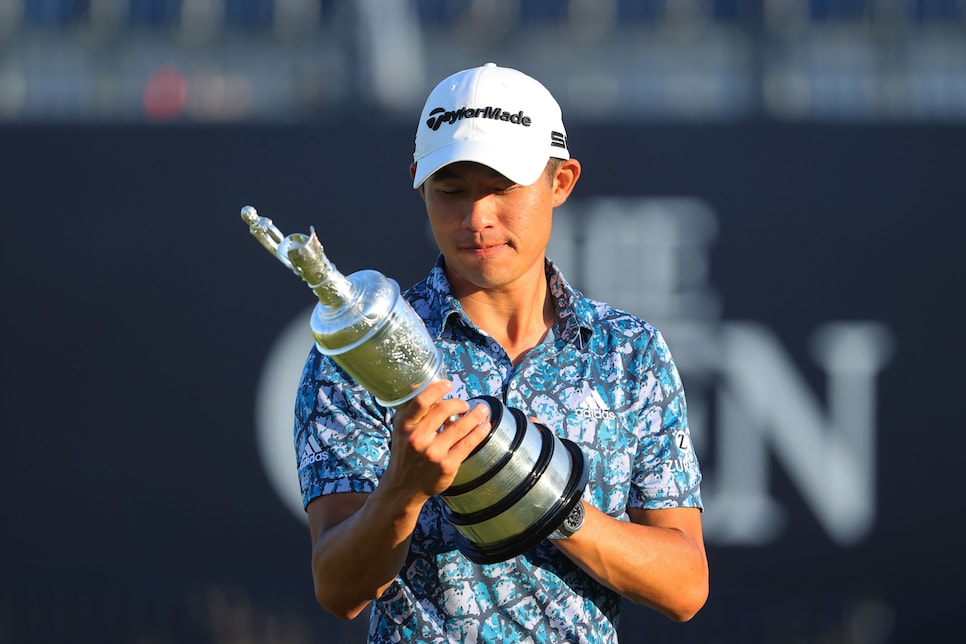
While Scheffler and Fitzy (the original, not the caddie) were in the mix, the player that had all the right numbers for me as I looked at Birkdale fortunately happens to be a guy who’s won the Open in the last 10 years. Collin Morikawa may not inspire the enthusiasm of Spiethian wiliness that won the last time at Birkdale or the heroic dominance of Scheffler or even the hometown favoritism of Fitzpatrick (either). But he is the kind of plodding brilliance of past Open champions at Royal Birkdale like Mark O’Meara, Ian Baker-Finch and Peter Thomson (twice). He currently ranks in the top 25 in more statistical categories than anyone not named Scheffler.
Andrew Redington
More importantly, Morikawa looks as oddly appropriate a winner as Birkdale’s clubhouse, a bizarro structure that seems equal parts cruise ship and Heathrow flight control tower homage. But he is the kind of stability my off-kilter predictions finally deserve. Unlike some things, he seems less inclined to collapse under the weight of added, er, floors.
Plus, his name seals it. Sounds like he might have been Queen Victoria’s Hong Kong emissary during the Second Opium War. Which is probably what you think I’m smoking. I am not. Yet.
This article was originally published on golfdigest.com