When we recently asked our audience what they wanted us to cover next in our Golf Digest YouTube series The Game Plan, the answer was clear: chipping strategies.
So I went to work – asking pros at the Masters, calling up coaches, digging through the Golf Digest archives, reading academic studies and even interrupting Edoardo Molinari’s Ryder Cup scouting trip to talk to him about it.
What I found was that everywhere I looked, the same big mistake kept showing up – and six common strategies pros use to avoid it.
The Mistake
The mistake is disaster shots: chips that don’t hit the green. Statistically, it’s one of the worst things you can do in golf – only hitting the ball out-of-bounds is worse. And it’s far more common than you’d think.
Short-game coach Chad Darby tested 400 golfers between a 6 and 16 handicap on 4,000 25-yard chip shots and found more than 40 percent finished long of the pin. So-called double-chip holes happen to scratch golfers once every two rounds, and they’re one of the leading causes of double-bogeys for higher handicappers.
Here are the six strategies pros use to avoid them.
Rule 1: Keep the ball low and the clubhead speed slow
We’ll keep the first rule brief because it’s a simple one. The first thing that kept showing up in my conversations with pros and teachers was that around the green, clubhead speed is the enemy. That’s what creates thins, chunks and other contact errors. The only time you need to use clubhead speed around the green is to hit high, aggressive flop shots (we’ll get to those), but you don’t want to hit those.
The goal of basic fairway chips and pitches is to stay basic. Ball low and clubhead speed slow. Don’t get fancy.
Rule 2: Putt whenever you can
The simplest way to follow Rule 1 is to putt from off the green whenever possible. You’re better putting from long range than chipping, as Lou Stagner proved with stats here.
A good goal for these shots is to finish inside 10 percent of the putt’s distance in feet, so a 70-foot putt should end between seven and 10 feet. That’s much closer than most golfers could chip it consistently, with the added upside that you’re not going to skull, chunk or ‘whiff’ a putt.
And if you think you’re above doing this, pros really do look for any excuse. I was once with Rory McIlroy when he tried putting out of a bunker because, with water long, he knew it was a great way to take disaster shots out of play.
Rule 3: When you can’t putt, putt with a different club
Sometimes the grass is too long or grainy to roll a putter through. That’s when you need more horsepower without picking up clubhead speed – which you do by making a putting stroke with a longer club. Stand closer, choke up, take your putting grip and make your putting stroke.
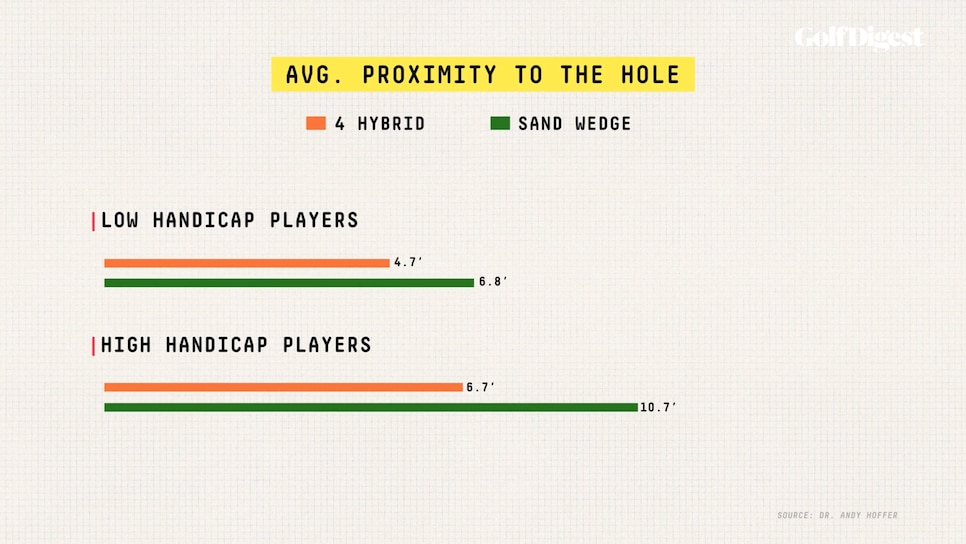
For most of us, that club should be a hybrid. A study by Dr Andy Hoffer at the most recent World Scientific Congress of Golf found that golfers from scratch to a 30 handicap chipped better in these situations with a hybrid than with their wedge – low handicappers about two feet closer, high handicappers almost four feet closer. And if you don’t think those margins matter, remember that on tour, the player leaving himself 4.5 feet gets up and down 20 percent more than the one leaving himself 6.5 feet.
You don’t need to use a hybrid, but you should reserve at least one longer club to putt with in these situations. Tiger uses a 4-iron. Justin Rose uses a fairway wood. Whatever you choose, simply making a putting stroke with one of these clubs gives the ball more pop before it begins to roll.
Rule 4: Aim for at least 50% roll on chips that have to carry rough
When you have to go over rough, you still want the ball to roll more than it flies. The pros’ stock chip is simple: stand closer, choke down, ball middle to back, weight forward, minimal wrist hinge. To change how much it flies versus rolls, don’t change technique – just change clubs. Jason Day says he’ll use a 60, a 56 or even an 8-iron for different effects, but the motion stays the same.
According to this old chart from Gary Player I found in the Golf Digest archives, the general landing zone is somewhere between one pace onto the green and 50 percent of the way to the hole. Only carry what you have to, and keep the technique the same if you can. Use different club selection to manage how much the ball rolls out.
Rule 5: When you’re short-sided, play to the middle
You’ve short-sided yourself, and not in the pretend-penalty kind of way. Treat it like being in the trees after a bad drive – it’s a recovery shot. Hit your higher-lofted wedge, open the face a little, play the ball further forward and add some wrist hinge as the situation gets more short-sided.
But tread carefully. The flop shot gets a lot of press, but pros see it as an absolute last resort. Edoardo Molinari explained that if you can’t consistently get chips inside seven feet – the range where pros have a 50 percent chance of making – there’s almost no upside in trying. Just hitting the green from these spots is priority No.1. For mid and high-handicappers, that alone is enough to gain shots on your handicap peer group.
Rule 6: Don’t chase ‘easier’ putts on slopes
When chipping into a slope, don’t aim short to leave yourself an uphill putt next. It seems to make sense, but it’s a bad idea. A 5-handicapper’s average proximity inside 25 yards is 14 feet – and aiming short to chase uphill putts only pushes your average further from the hole. You won’t make enough longer uphill putts to offset being worse overall, and you’ll mix in more three-putts. Tour pros make almost 10 percent more putts from five feet than from six. Being closer overall is better, even if it means a few scary downhill putts.
Your chipping strategy game plan
• Keep the ball low and the clubhead speed slow • Putt whenever you can • Putt with a hybrid or similar long club when you can’t • Aim for at least 50% roll on chips that have to carry rough • When short-sided, take your medicine • Don’t chase “easier” putts
Put it all together, and you’ll avoid disaster – and get up and down a little more.