Golf Digest senior writer Alex Myers is on a one-year mission to see how good he can get at golf through daily training, practice and playing. Read more from his “Late Scratch?” series here.
After countless hours practicing indoors this winter, I finally faced my first real putt in my opening round of the year. It was a 10-footer for par—in part, because my first real shot off grass was a shock to my simulator-based system—and it was absolutely tracking toward the hole. Until it stopped a few inches short.
There would be several more of those on the day as I never quite figured out the greens. It’s amazing how much different these country club putting surfaces were for an early April round, clearly slower than my PrimePutt mat that runs at a 10 on the stimpmeter.
So was all that practicing in my basement just a big waste of time? Quite the opposite. Here’s why putting inside can still be an effective—and, in some ways, superior—training method.
You can focus on your stroke instead of results
Like with hitting golf balls in a simulator, indoor putting practice can’t exactly replicate what you’ll face outside on the golf course. But with elements like slope, grain and spike marks stripped away, you can actually learn more about your stroke inside. Provided you’re aimed correctly, a miss on a perfectly flat surface means a mistroke, whereas there are a number of different reasons a putt doesn’t drop during a real round. You also won’t be distracted by trying to make a bunch of different putts to different holes.
Of course, you should be trying to make putts when you practice inside as well, but it’s not as important when you’re in your home. Plus, you can learn a lot more from your misses.
RELATED: How to flush more putts (Yes, putts)
“ I think we all have a thing or tendency that hurts our putting stroke and it might even be the same thing you do in your full swing,” putting coach Bill Smittle says. “And from time to time, you revert back to it.”
That’s certainly the case for me. With both my putting stroke and full swing, I tend to get my arms too far away from my body on the backstroke/backswing. It’s why I wrote about finding Bill’s “Turn the shoulders, don’t rock them” tip particularly helpful. On days that I’m feeling off while putting in my basement, it’s usually because I’ve reverted to doing that. So I know to practice—and maybe even exaggerate—turning my shoulders.
You can hone in this skill
I’ll never forget Bill declaring himself the “Start Line King” the first time we met. And the former 30-year head pro at Scarsdale Golf Club certainly backs up that title if you watch him putt. And it’s this skill that you can really concentrate on developing while indoors.
“I’m an aim small, miss small guy,” Smittle says. “If you can aim for a spot and consistently roll it over that spot, that’s going to help you when you get on the course.”
RELATED: The 7-iron speed rule you’re probably not following
Smittle also says improving your start line indoors will help you with your green reading once you get outside. One drill he suggests doing is placing a dime on top of a penny about a foot in front of your golf ball. The goal is to knock the dime off the penny without moving the penny like this:
Your browser does not support the video tag.
This will help you work on start line, but also make sure you’re getting topspin on the ball to help it roll end over end. Bill compares this to playing pool and hitting the top of the cue ball. And speaking of drills . . .
You can use training aids
The best part about practicing at home is the convenience. Being able to squeeze in a few minutes of work on the green mat whenever you get a chance helps you improve and maintain your stroke—especially during the long winter in the Northeast. The second best part, though, might be these helpful tools, which, obviously, you’re not allowed to bring with you on the course.
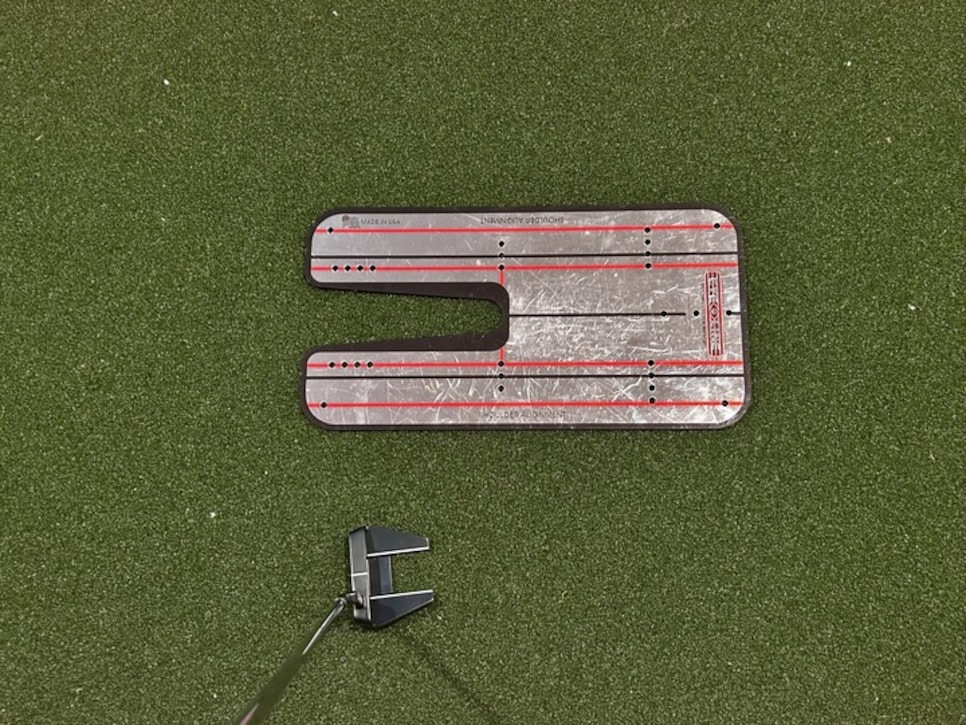
If you surveyed my basement, you’d think I’m almost to “Tin Cup” levels of training aid addiction. I’m not recommending that, but I have found certain ones very helpful (Check out Luke Kerr-Dineen’s rundown of training aids he likes). Like this simple putting mirror that lets me make sure I’m setting up with my shoulders square:
As I’ve written about before, I love Bill’s Smittle Stick—attached, below, on my putter shaft—which helps to make sure I’m bringing the putter back and forth in an arc.
Your browser does not support the video tag.
But to also help with that motion, I got a Phil Kenyon Visio putting mat that also helps with that visual. And I got a putter gate as well to make sure the ball is starting where it’s supposed to. Here’s a look at those two things in action:
Your browser does not support the video tag.
What I’ve noticed with the gate is that I tend to tick the left side, even on putts that feel good. It’s another result of my tendency to bring the putter too far outside going back (I’m still doing that slightly in the above video, but it’s getting better) and then pull across it. You have to be super precise to get it through that gate—which adjusts even tighter—and that’s the point. Make putts doing that and you know you’re striking them pure. Which leads to my final point . . .
You can build confidence
A few years ago, my in-laws got me a small putting mat for Christmas. It was only about five feet long and it had one of those silly fake bunkers and water hazards, but I swear it’s the best I ever putted from that distance. And when I faced a crucial five-footer late in the final round of that year’s HGGA Championship (AKA my annual golf trip), I thought about all the putts I’d made on that mat, knocked it in, and wound up winning our green jacket.
Fast forward a few years and now I have this really nice 15-foot matt from PrimePutt. And my hope is to become better than ever from the 6-to-10 foot range, something I learned I need to improve thanks to tracking my stats with Arccos Golf.
“ If you get world class at making 10 footers, controlling the speed and controlling the distance, you can convert a couple of more of those 6-to-10 footers per round, you’re gonna save a couple strokes.”Smittle says.
RELATED: The equipment upgrade most golfers overlook
Mario Guerra, the head pro at Quaker Ridge, one of Golf Digest’s Best in State for New York and my swing coach for this project agrees. Early in the winter, he challenged me to try to make 10 eight-footers in a row—something I finally did once after a couple months trying. Of course, it’s much easier doing that in indoor conditions, but the hope is that it increases your make rate outside as well.
Your browser does not support the video tag.
“If you can get it within that distance and you feel more comfortable, you know you’ve done some nice work this winter doing that,” Smittle adds. “And raising your confidence level goes a long way too.”
Now that the weather is better, I’ll do more putting practice outside, but that doesn’t mean I’ll abandon my basement. Those opening round putts may not have been dropping for me like they do down there, but they were tracking. And while I’ve still got plenty of work to be anywhere close to calling myself a “Start Line King,” these past few months have been a good, well, start.
RELATED: Get caught up on the entire ‘Late Scratch?’ series
This article was originally published on golfdigest.com