
The women’s game is booming, just not where most people expected it to be.
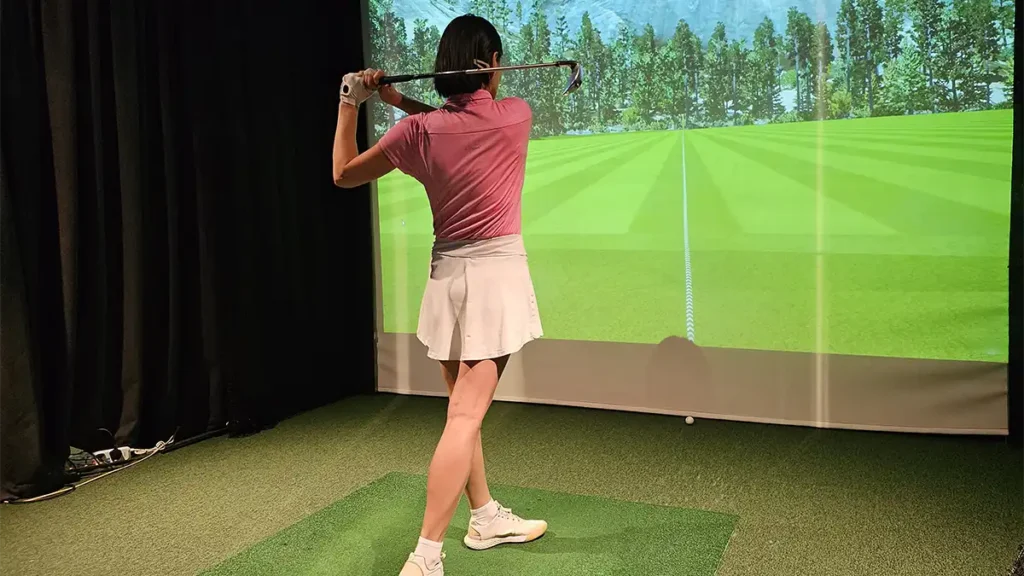
Picture a Tuesday morning at an indoor golf simulator somewhere in suburban Sydney. The bays are humming, the music is on and a group of women in their 30s are laughing their way through a nine-hole virtual round. Some of them are only weeks removed from picking up a club for the first time. There are no tee-times to worry about, no dress codes to decipher and no pressure to keep pace with a field of strangers. Just a group of friends, a screen full of lush fairways and something that looks unmistakably like fun.
Australian golf is growing. Participation is up 5.2 percent year-on-year and more than four million Australians played the game in some form last year, roughly one in every seven people. Since 2022, 1.3 million additional adults have taken it up. The numbers, on paper, are impressive. But here is the thing: focusing on those top-line figures alone means missing the far more interesting story unfolding beneath them.
The real growth in women’s golf is not happening on the 18th fairway of a traditional country club. It is happening in the simulator bay, at the driving range, in the six-week beginner clinic that runs on Wednesday mornings and finishes with a coffee. It is happening among women who never saw themselves as golfers, in environments designed specifically not to feel like golf, at least not the version of golf they were always warned about. The game is being rebuilt from the ground up and women are leading the way.
THE MISUNDERSTANDING
For a long time, club membership was the standard measure of golf’s health. More members meant more players, more green fees, more game. Growth was tied to the image of the weekend foursome teeing off at 7am, handicap cards in hand. It was a model almost entirely built around men.
Women make up only 17.7 percent of club membership nationally, with growth sitting at just 1.5 percent. On those numbers alone, it would be easy to assume little has changed. That assumption is wrong.
The reality is that women have been growing the game in an entirely different arena, one that golf’s governing bodies and club administrators are only now beginning to understand.
Social media has played a major part in that shift. Tamara Mason, Golf Australia’s head of women and girls engagement, has watched the conversation around women’s participation shift dramatically. The change, she says, has not come from within the sport. It has come from the women themselves.
“Social media is playing a huge role because women are happy to share their journeys, whether they’re amazing or just starting out,” Mason says. “They’re sharing their experiences of buying clothes or equipment, showing up to the driving range, going to a party or heading out with friends. They’re really enjoying that social space.”
Mason has spent years working at the intersection of participation and culture within Australian golf and says the shift has been driven not by the industry but by the women arriving in it.
WHERE IT’S ACTUALLY HAPPENING
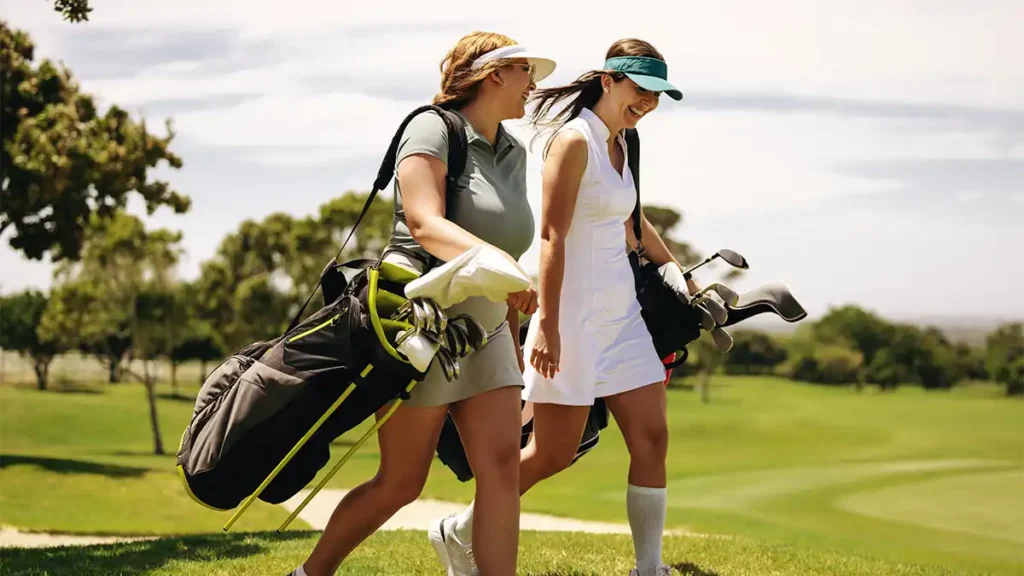
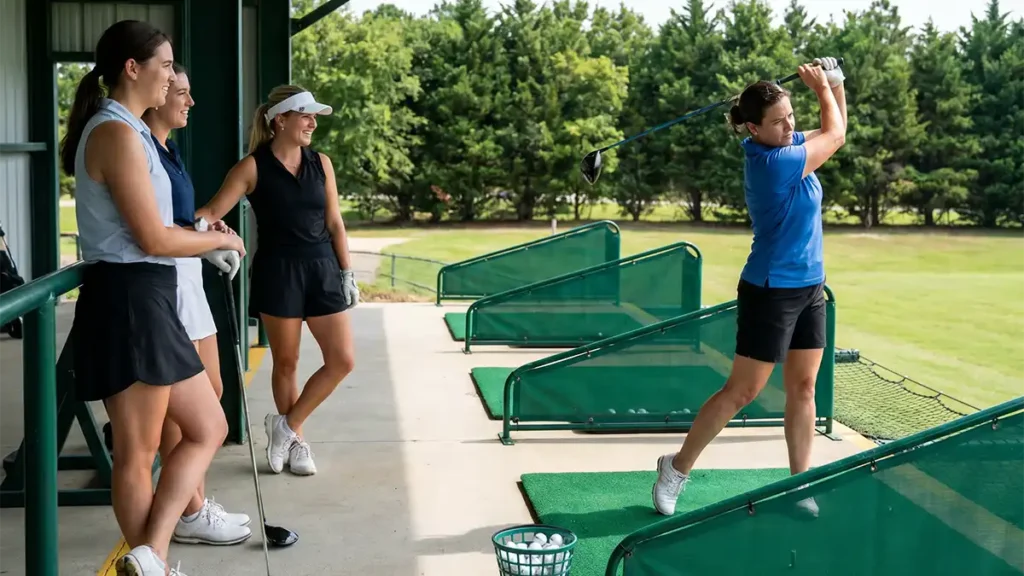
The driving range used to be a place you went to fix your swing before Saturday’s medal round. Now it is one of the primary entry points into the game, particularly for women. Off-course golf, which encompasses driving ranges, indoor simulators and mini-golf, now accounts for a remarkable slice of total participation. Women represent 50 percent of those players. That figure alone should recalibrate how the industry thinks about growth.
These environments are not a consolation prize for people who cannot get on a course. They are a genuine first experience with the sport and, increasingly, they are the experience that converts a curious observer into a committed golfer. Nearly 87.9 percent of participants in Golf Australia’s Get Into Golf beginner program are women, a number that speaks to both the demand that exists and the fact that women are seeking structured, welcoming pathways into the game rather than stumbling in through the traditional route of following a partner or joining a club on a whim.
Women are now experiencing the game at driving ranges and simulators with friends, in environments that prioritise flexibility, comfort and social connection over tradition or structure. Mason notes that this shift is reflected in participation, with women now representing 42 percent of all golfers nationally.
The formats driving this growth share a set of common characteristics. They are flexible. They are low-stakes. They reward participation over performance. They fit into the actual shape of a modern woman’s week in a way that a 7am Saturday tee-time simply cannot. These are not marginal considerations. They are the difference between a sport that a woman will try once and forget and one she will return to, tell her friends about and eventually invest in.
Janine Barney has seen this transformation up close. A former national-level hockey player who came to golf during her pregnancy about 30 years ago, Barney spent a decade running the award-winning Golf Fore Women program at Windaroo Lakes Golf Club, south of Brisbane, a program that in 2024 alone engaged more than 1,400 women through more than 150 clinics, leagues and events and drove a 33 percent increase in female club membership. She has since taken her philosophy into her own indoor simulator venue, The Golf Nest, in Brisbane’s bayside suburb of Cleveland.
Barney says her approach has always been centred on attracting, nurturing and retaining women in the game, supporting them from their first experience through to long-term participation. “That was always my focus: bring women in, support them through the process and then keep them in the game,” she says. Since opening her indoor centre, she has also noticed a growing number of younger women entering the sport for the first time.
The experience Barney has created is inclusive and social, music-filled, with food and laughter as standard. It is not just a nice environment. It is a fundamentally different proposition from the one golf has historically
offered women.
WHO IS WALKING IN
The data on who is now taking up golf in Australia is striking. Sixty percent of new golfers are women. The average new golfer is 11 years younger than the traditional club member. These are not incremental changes at the edges of an existing demographic. This is an entirely new audience, one that has not previously seen golf as something for them.
These are women who might have played team sport in their 20s and are now looking for something physical that fits around a career, a family or both. They are women who saw a friend post a video from the driving range and thought, That looks like fun. They are women in their 60s who have finally decided to try the thing their husbands have been doing on weekends for decades and who are discovering that they love it.
Mason says the rise of social media has helped normalise the idea of women entering the game, particularly through content created by everyday players rather than elite athletes. This visibility reduces the fear of judgement and makes the game feel more accessible to first-timers.
Barney, who describes herself as someone who came into golf late and had to fight hard for her place in a sport that was not especially welcoming to women at the time, finds the shift deeply satisfying. Early in her career, she was told by a club president to go home to the kitchen. During her PGA traineeship, people assumed she was there to watch someone else play. Members at the pro shop would ask to speak to a man instead. Those experiences shaped her determination to build something different.
“I was a hockey player before that and friends started asking me to teach them because they’d go out with their partners and end up frustrated. That’s when I realised there was a real need. I saw golf as the perfect transition for women coming out of other sports,” she says.
The women walking into Barney’s simulator venue today are, in many ways, the generation she always imagined would eventually arrive. Younger, motivated, unintimidated by the idea of learning something new in a social setting and often, she notes with some satisfaction, highly competitive.
WHY IT’S WORKING NOW
The question is not just where growth is happening but why it is happening now. Golf has had women players for as long as it has existed. The difference today is not the existence of interest. It is the existence of infrastructure designed to meet it.
The clubs seeing the strongest growth in female membership are not necessarily the ones with the best courses but those that have re-thought every touchpoint of the new-player experience, from websites and social media to signage, visibility and the way word of mouth builds after a positive first visit. Mason says the most effective clubs are those offering Get Into Golf clinics, where clarity and visibility matter as much as the program itself, particularly in helping new players feel oriented and comfortable from the outset.
Convenience is also central to that shift. Rather than being tied to fixed tee-times and formal structures, newer entry points such as driving ranges and indoor simulators allow women to participate around work, family and other commitments, without the pressure or rigidity of traditional club golf.
Barney has operationalised this understanding in her own programming. Her “Chip and Sip” events, which blend skill development with socialising, have been consistently oversubscribed. The secret, she says, is not complicated: when women feel safe enough to be bad at something, they are far more likely to keep trying until they get good at it.
WHAT HAPPENS NEXT
The pipeline question is where the conversation becomes both exciting and sobering. Women are entering golf in unprecedented numbers and through entirely new channels, but the sport’s long-term health depends on what happens next. Off-course participation needs to convert to something more sustained, whether that is club membership, regular course play or, at minimum, an ongoing relationship with the sport across its many formats.
The signs are encouraging. The Junior Girls Scholarship Program now involves 1,432 girls across 160 clubs nationally, up 20.2 percent year-on-year. MyGolf, the kids’ entry program, counts 13,542 girls among its 40,736 participants. The pipeline, at the youth level, is being built deliberately. At the adult entry level, clubs that are converting casual players into members are the ones offering stepping-stone options: three-month trials, six-to-12-week clinics, introductory memberships that allow access during off-peak times rather than demanding full commitment upfront.
At the elite level, Australia also has a strong international presence through players such as Grace Kim, Hannah Green, Minjee Lee and Steph Kyriacou, all competing and winning on the global stage. Mason says the challenge is that their visibility at home has not yet matched their performance abroad and that telling those stories is central to changing perception of the game. She adds that visibility of women in the sport has a direct impact on participation, pointing to spikes in sign-ups after major moments on the calendar, including a surge of 2,500 women joining in January and a second peak in March.
THE GAP
None of this is to suggest the job is done. Cost remains a genuine barrier. Equipment, green fees and club memberships add up quickly and for many women exploring golf for the first time, the financial ask comes before the emotional payoff has had a chance to take hold. Barney lends clubs to anyone who needs them and has delivered clinics through council partnerships for as little as $5. These approaches work, though they are not yet universal.
Perception, too, remains an obstacle. Despite everything that is changing at the margins, the dominant cultural image of golf in Australia is still stubbornly narrow. Some clubs retain rules that prevent women from playing seven days a week. Dress codes remain rigidly enforced in environments where flexibility would cost nothing and gain everything. The idea that golf is hard, expensive and only for a certain kind of person has not yet been fully displaced, even as the reality on the ground looks increasingly different.
THE BEGINNING OF THE STORY
Back in that Tuesday morning simulator bay, the women are now on the back nine. Nobody has kept a strict score. One of them, the one who started only three weeks ago, has just hit the longest drive of the session and the others erupt. She looks slightly stunned, then delighted, then like someone who might be back next week with a friend in tow.
That moment, the surprise, the laughter, the quiet realisation that this might actually be something, is where the future of the women’s game is being built. Not on the first tee of a Saturday medal, not in the handshake of a new full membership, but in the small, unglamorous, utterly ordinary experience of a woman discovering that golf is something she can do and something she wants to keep doing.
Mason says that, in the end, that is what matters most in a sport that has often measured success in the wrong places: when someone has a genuinely good experience and then goes on to share it with someone else.
By that measure, the women’s game is not just growing. It is only just getting started.
BY THE NUMBERS
- 87.9% of Get Into Golf program participants are women
- 60% of new golfers nationally are women
- 50% of off-course (range/simulator) participants are women
- 1,432 girls enrolled in the Junior Girls Scholarship Program, up 20.2%
- 4 million+ Australians played golf in some form last year
- Participation is up 5.2% year-on-year
Photographs by istock/satit_srhin, istock/Nadzeya Haroshka