Insights from a dream trip to the iconic Titleist Performance Institute in California.
I could not help but laugh as I checked into the hotel in Oceanside, California, ahead of two dream days of testing and gear fitting at the Titleist Performance Institute (TPI). It was not the view from my room across the Oceanside Pier, which ran out several hundred metres into the waves of the Pacific Ocean, that generated the laughter. Although the outlook was so spectacular it almost was comical. Instead, I chuckled at the fact that the exquisite Mission Pacific Beach Resort was located next door to “Top Gun House”.
For the uninitiated, it’s a quaint but non-descript Victorian cottage facing the water in Oceanside which became globally famous after Hollywood movie producers used it as the set for the home of Charlotte “Charlie” Blackwood in “Top Gun”, played by Kelly McGillis. Charlie was the love interest of main character Maverick, played by Tom Cruise. The cottage features heavily in “Top Gun”, alongside scenes of Maverick riding his motorcycle around the palm-lined Pacific St in Oceanside. Some 40 years later, tourists gather in droves to take photos of the urban piece of cinema history.
What I found funny was wondering if there was any connection I could use for my story between the house and my visit to Titleist’s renowned California testing facility. And there was; “Top Gun” was a timelessly entertaining movie about an elite aviation-training tournament where highly skilled pilots use specialised expertise and technology to squeeze out small performance gains while competing against each other. I am significantly less skilled than Maverick, but the good people at TPI were still willing to do everything it took to extract improvements from my golf game.
The mission was clear: spend two days at the TPI facility for Australian Golf Digest, starting with a physiological and golf-swing assessment with Dr Greg Rose and his colleague, swing coach Dave Phillips (an Australian, coincidentally), before the pair handed over the results to several equipment specialists at Titleist. Gurus of irons, wedges and putters would then use that information to make better observations of my game during a T-Series iron fitting, an SM11 wedge fitting and a Scotty Cameron putter fitting.
First up was the physical assessment with Rose and Phillips. Now, I had already heard of the revered Dr Rose. During my years reporting on the PGA Tour and other circuits, I have befriended many of the physios, chiropractors and strength-and-conditioning coaches who look after golfers. They are some of golf’s nicest people and the game’s quietest achievers. They had all spoken highly of Rose, who is essentially one of golf’s founding fathers of exercise science and high performance. He is equal parts a Doctor of Chiropractic, an engineer and the co-founder of TPI alongside Phillips, who coaches Jon Rahm among other
tour players.
Phillips, who grew up in Melbourne, was running one of the pioneering golf-specific fitness programs in US golf at Caves Valley Golf Club in Maryland. He had met and befriended Rose. In the early 2000s, Phillips took a young golfer (and eventual PGA Tour and LIV Golf pro) named Peter Uihlein to be assessed by Dr Rose. Peter brought along his father, Titleist chief executive Wally Uihlein, who was blown away by the work Rose and Phillips were doing. Uihlein even predicted that sector to be the future of golf. In 2003, TPI was created at Titleist’s 30-acre facility in Oceanside. Here, Rose and Phillips collate data from 3D motion-analysis systems to pinpoint how players generate speed while utilising physical screenings and exercises to identify weaknesses. Paired with equipment testing from Titleist, it accelerated golf’s transition into the modern era. Rose’s expertise in biomechanics and the human body have helped pioneer the analysis of rotational athletes, particularly using data captured by force plates. Rose also helped develop the Selective Functional Movement Assessment and founded OnBase University (baseball) and RacquetFit (tennis and racquet sports).
This is all to say I was a little nervous about the assessment, despite being a reasonably fit guy and regular golfer and tennis player. I’d watched a video of a previous TPI assessment that focused on star NFL quarterback Josh Allen and certainly felt inadequate. But Rose and Phillips’ sense of humour and passion for improvement put me at ease as I went through lunges, hip exercises, weights and other movements to gauge my strength and flexibility. The result was: despite playing to a handicap of 3, my major swing flaw was early extension. Meaning, my pelvis would fall towards the ball on the downswing, which closed an important alleyway for the club to travel through freely. I then had to cast the club around my knees and legs moments before impact. I managed, but it led to issues with strike consistency and loft. The pair concluded that to improve I would need to move my pelvis away from the ball on the downswing and slightly towards the target. I’ll come back to this point later.
After the physical, the afternoon on day one at TPI moved onto putting. I toured the Scotty Cameron Gallery and marvelled when I saw an executive’s office whose feature wall could only be described as a Sistine Chapel for Scotty Cameron putter covers. From major-championship themes to famous courses, there were hundreds of Scotty Cameron custom putter covers including several Australian-themed beauties. At the nearby Scotty Cameron Studio, I underwent a putter fitting. I had been using a centre-shafted, zero-torque putter that works for some but was all wrong for me. The centre shaft was moving my eyes further from the ball and leading to inconsistent strikes as well as influencing me to address the ball off the toe. After testing, the results were a blade style with a plumber’s neck, as well as a putting tip to stand closer to the ball, as means for improvement. I was recommended a Scotty Cameron Studio Style Squareback 2. I had never thought putters could be beautiful until this piece of art. The blade style encourages a more athletic and playful follow-through with a bit of toe release, and I’ve been putting much better since.

MIXED TO MATCH
Day two brought two significant equipment fittings: iron and wedges. The first thing that became obvious at TPI was that nobody seemed particularly interested in selling me distance. Instead, Titleist’s mantra was: predictability will lead to distance when a golfer wants to access it.
The TPI range (which can also be set up to have several golf holes) was intoxicating for a golf tragic. I was using the same turf that Adam Scott, Justin Thomas and Cameron Young hit off during equipment testing. Yet nobody cared that I wasn’t a tour professional; for those hours, my golf game was the assignment.
My T-Series iron fitting was conducted by Dino Antonucci, Titleist’s Korn Ferry Tour manager of clubs, and I went in fascinated by the prevalence of blended sets on tour. Antonucci explained that mixing models allows players to optimise ball flight throughout the bag.
“The three Ds that we have are distance control, dispersion control and then descent angle,” Antonucci said. The distinction between distance and distance control proved important.
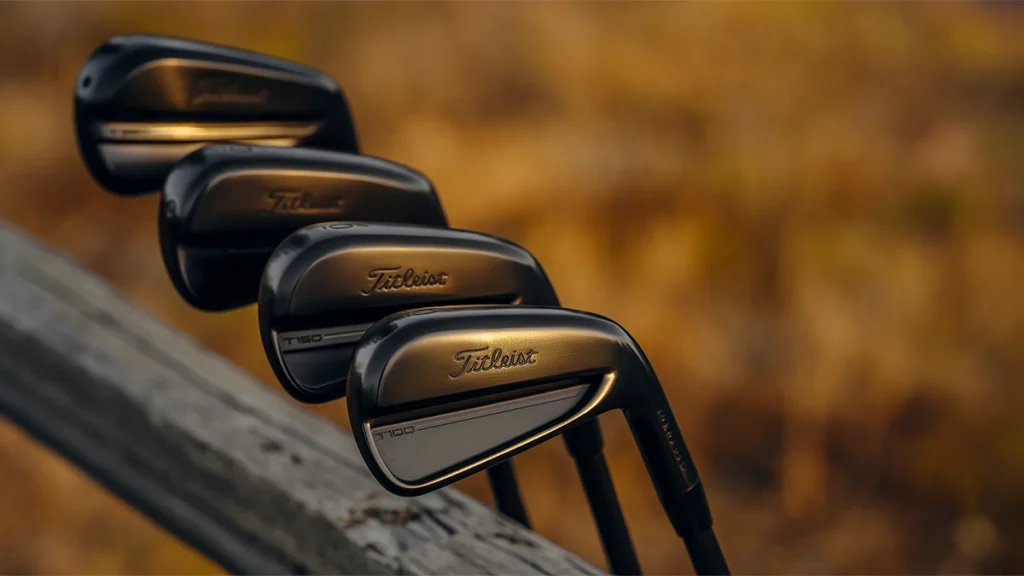
Antonucci had me hit balls with varying shafts on each of the T-250, T-150 and T-100 iron heads. My existing 7-iron had only 30 degrees of loft. For the 7-iron, the T-150 we tested was 32 degrees. Conventional thinking caused me to ask if more loft might risk surrendering metres. That wasn’t the case. Antonucci wasn’t interested in one isolated number, rather he watched launch, spin, dispersion and descent angle, while constantly asking what I saw and felt.
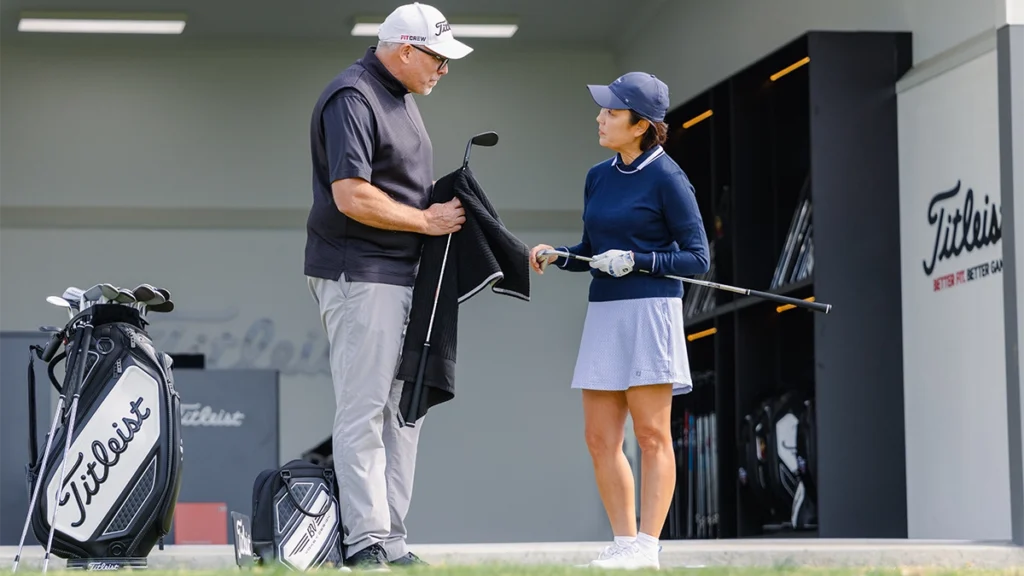
He also wanted my bad swings.
“When we’re all hitting the ball great, everything’s wonderful,” Antonucci said. “It’s when things are a little bit off that we want to be able to mitigate those misses.”
Eventually the numbers began pointing somewhere interesting. Despite the T-150 having more loft than my existing iron, I was launching it higher and carrying it further. My dispersion tightened. My descent angle improved. Antonucci identified me as a shallow swinger and explained that the additional height and spin actually complemented my delivery. Even better, the occasional rocket wasn’t the objective. Antonucci wanted extra distance to appear when I supplied the extra speed, rather than because the club unexpectedly produced a ‘jumper’.
The prescription became a blended set: T-150 from 5-iron through pitching wedge, with a T-250 4-iron providing additional assistance in the long irons. Antonucci determined that a slightly heavier shaft (115 grams, stiff) was producing my best numbers.
Moments later, it was time for the SM11 fitting with Vokey wedge fitting specialist Brandon Rheault. As a wedge admirer, this was special.
Rheault’s framework was wonderfully simple: contact, flight and spin. After establishing distance gapping, Rheault began handing me wedges without allowing me to inspect their soles. Bounce and grind were hidden. I knew the loft, but not precisely what I was hitting. There were 27 different options and we tested them without me knowing their lofts, bounces and grinds.
From straightforward pitches we progressed to increasingly uncomfortable shots, opening the face around the green before eventually heading into the bunker. Rheault watched the interaction between club and turf as closely as the golf ball itself. I chipped and pitched it well and noticed how much spin I was generating.
Again, the same characteristic emerged as my full swing: shallow. At one point, Rheault observed that he could barely find a divot from my shots. That immediately influenced the amount of bounce he wanted to put underneath me. The eventual wedge setup was wonderfully specific: SM11 44.10 F (pitching wedge), 50.08 F (gap wedge), 54.10 S (sand wedge) and 60.04 T (lob wedge), with the 60-degree one degree flat.
The 60 was particularly revealing. My bunker miss tends to be thin, and the low-bounce T Grind, with its narrow sole and sharper leading edge, allowed me to enter the sand more comfortably. My wedges felt like I’d used them for years, after maybe 60 balls, they were that comfortable.
What stayed with me from Oceanside was that these experts in different facets of golf regularly see Scott, Young, Cameron Smith, Jordan Spieth and others travel to TPI. Yet they seemed just as eager to help me improve my game. The watched the data, and my personal tendencies, before recommending equipment.
For someone obsessed with the game, a visit to TPI was a golf nerd’s dream. A must for any serious golfer. The marriage between what 3D motion analysis was indicating and how equipment could be optimised for my game has me playing some of my best golf. I’m ingraining the move of pushing my pelvis back against an imaginary wall. This, and the fact my equipment is producing more predictable flight and distance control, has me more obsessed with the game than I have ever been.
I may not be worthy of competing in Top Gun, but at least my ball flight is far more predictable.