
If you ever get the chance to sit in the bleachers behind the driving range at a professional tournament, you’re sure to be amazed with how high and far tour players hit the ball. Before you head off to the watch the event, do yourself a favor and close your eyes for a minute and just listen. The sound of a well-struck golf ball might be as memorable as what you see.When it comes to iron play, that sound is the product of the clubhead compressing the ball off the turf with a downward pinching blow. In addition to that desirable “pfffffffffff” sound, you’ll also see quite a large patch of turf hurling forward. A measurement of tour pros’ impact conditions by former player and now instructor Bobby Clampett found that the typical swing bottom of their shots occured four inches after the ball was struck. That’s not a typo. Four inches!Jason Guss, one of Golf Digest’s Best Teachers in Illinois, says amateurs struggle to create anything like those impact conditions for a couple of reasons. The first is, they don’t shift their weight into the lead foot properly during the downswing. Often, they’re still supporting their weight on the back foot. The second is, they don’t shift laterally toward the target to create room for the club to properly approach the ball from inside the target line. Without that “clearing out,” the club has to come down steeply from outside the target line leading to poor contact.While swing issues are often corrected on the range, these two faults also stem from a lack of lateral training in the gym, says Andrew Dulak, a Golf Digest Certified Fitness Trainer. Dulak trains golfers in the Pittsburgh area. Many gym-goers do the brunt of their training in the sagittal plane, meaning forward and backward motions. Things like arm curls, pull-ups and squats. Sagittal motion comes into play in the golf swing, too, but frontal-plane (lateral) movement is arguably more crucial to power generation and that iron compression you’re after.Dulak has three simple exercises for you to help train for the weight shift and side bending necessary to attack the ball from a good angle and path. He’s demonstrating them for right-handers, but be sure to do them in both directions for better muscle symmetry and injury avoidance.
Stick hip bumps
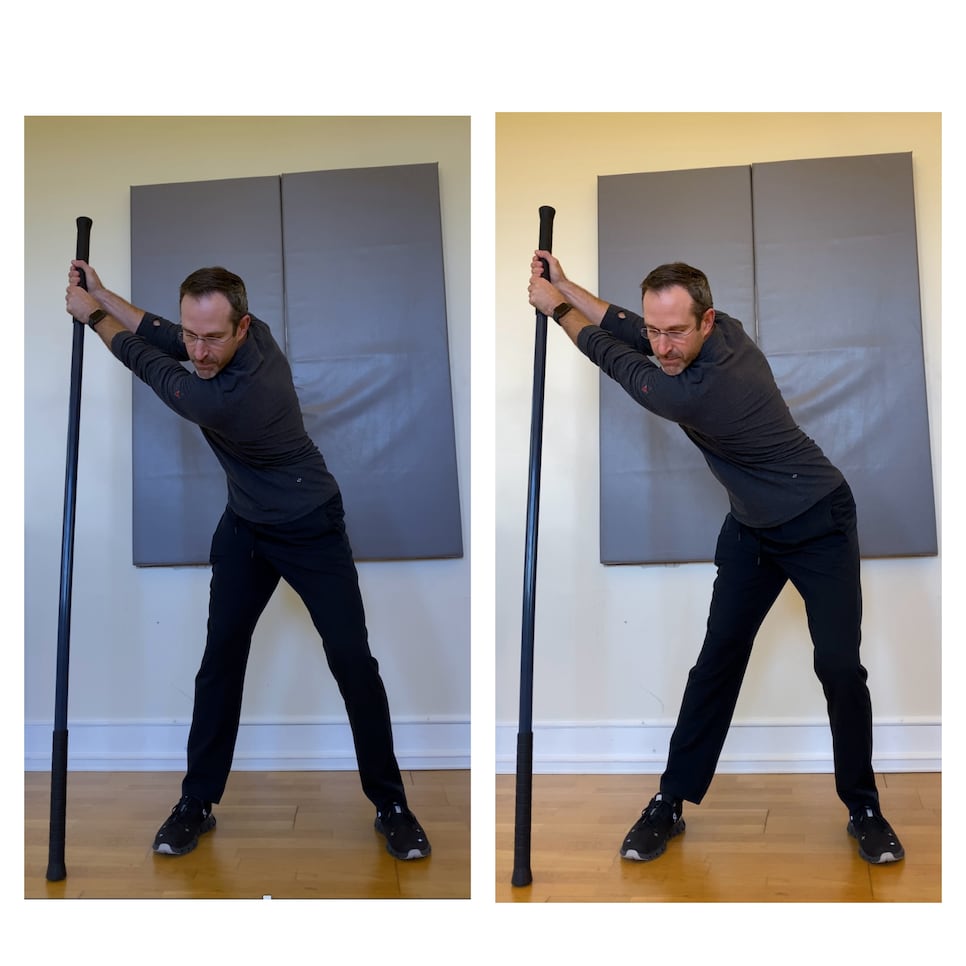
How to do it:
- Get into your backswing posture while holding a broomstick or long stick— trail hand high on the stick, lead hand lower.
- Keeping your upper body stable, push the stick away.
- As you do that, allow your lower body to shift toward your lead side, feeling a stretch along your lead-side lat muscle and trunk.
- Hold for a moment, then return to the start position.
- Repeat slowly, focusing on control and separation between the upper and lower body.
Coaching cue: “Imagine your hands and hips moving in opposite directions—hands trail side, hips lead side—to train true dissociation and mobility through your golf-swing sequence,” Dulak says.
Lateral lunges with hip bumps
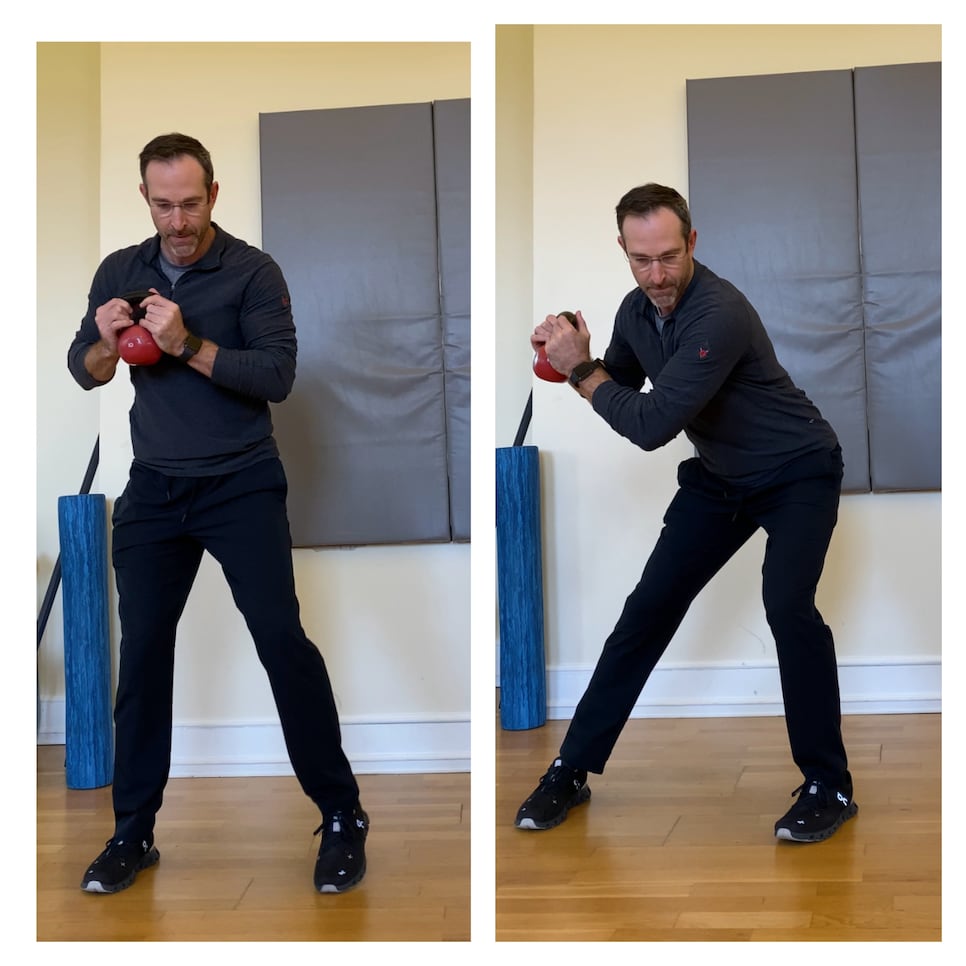
How to do it:
- Hold a light weight (dumbbell, medicine ball, kettlebell, etc.) on your trail side.
- From an athletic stance, step laterally toward your lead side.
- As you step, keep your hands back and pivot your hips toward your trail side—this keeps the hips closed during the lunge.
- You should feel your lead hip shift laterally (“bump”) while maintaining upper-body stability.
- Push back to the starting position and repeat smoothly.
Coaching cue: “Feel the hips glide laterally before rotation. It’s just like the hip bump that starts the downswing, getting weight to the lead side appropriately,” Dulak says.
Medicine-ball downswing slams
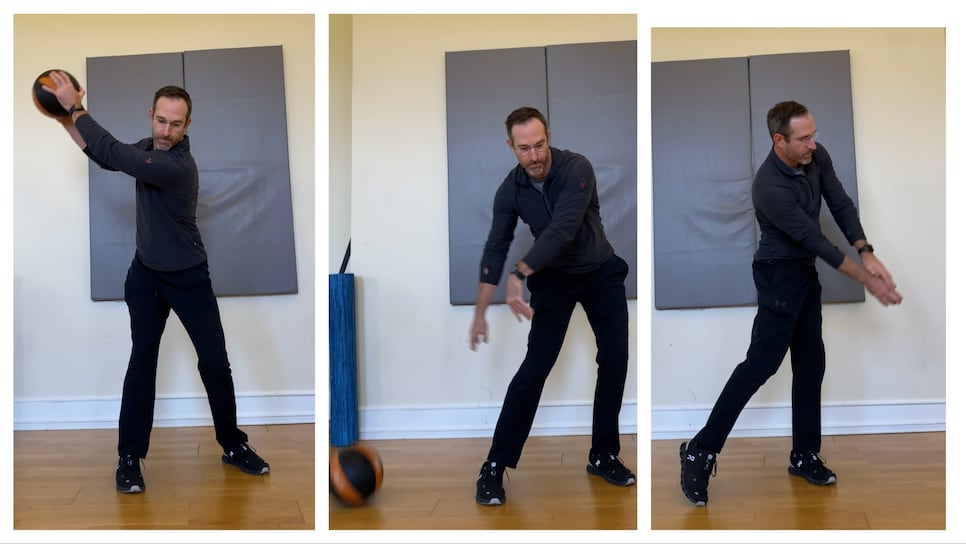
How to do it:
- Hold a light medicine ball (2-6 pounds) in a “top-of-backswing” pose—arms high and body loaded.
- Shift your lead hip toward the target (lead side).
- As the hips shift and rotate, pull the ball down and slam it into the ground just outside your trail foot.
- Allow your body to follow through naturally, rotating fully toward the target.
- Reset and repeat with rhythm and intent, focusing on smooth sequencing from the ground up.
Coaching cue: “Think, hips lead, hands follow. This teaches your body to start the downswing with the same kinematic sequence used in a powerful, efficient golf swing,” Dulak says.Click on this link if you’re interested in becoming a Golf Digest Certified Fitness Trainer.
This article was originally published on golfdigest.com