[Photo: Kate McShane]
Wind. It’s the word of the week at this year’s US Open. In fact, in the USGA’s pre-tournament press conference, chief championships officer John Bodenhamer used the word 27 times.
The wind was forecast to blow on Thursday and it did. Perhaps not as strongly late in the day as many expected, yet still enough to cause headaches for all who teed it up at Shinnecock.
Wind is part of the examination for an outdoor sport, of course, but how specifically did it impact play on Thursday?
Here are five examples:
1: The into-versus-with difference
Players were greeted with a northwest wind in the opening round, gusting from 20 to 30 mph throughout the day. That meant that the par-4 third hole played downwind and the fourth hole played into the wind. And that meant those two tee shots played vastly different. Take Scottie Scheffler for example. His drive on the third hole rolled out to 370 yards in the fairway, whilst his tee shot on the fourth hole, with the same club, travelled just 249 yards.
11 years younger. 14 yards longer.
Scottie Scheffler and Mason Howell both piped drives downwind on No. 3.
The vet: 370 | The kid: 384 pic.twitter.com/tm0pIaMymA
— U.S. Open (@usopengolf) June 18, 2026
2: The importance of ball flight
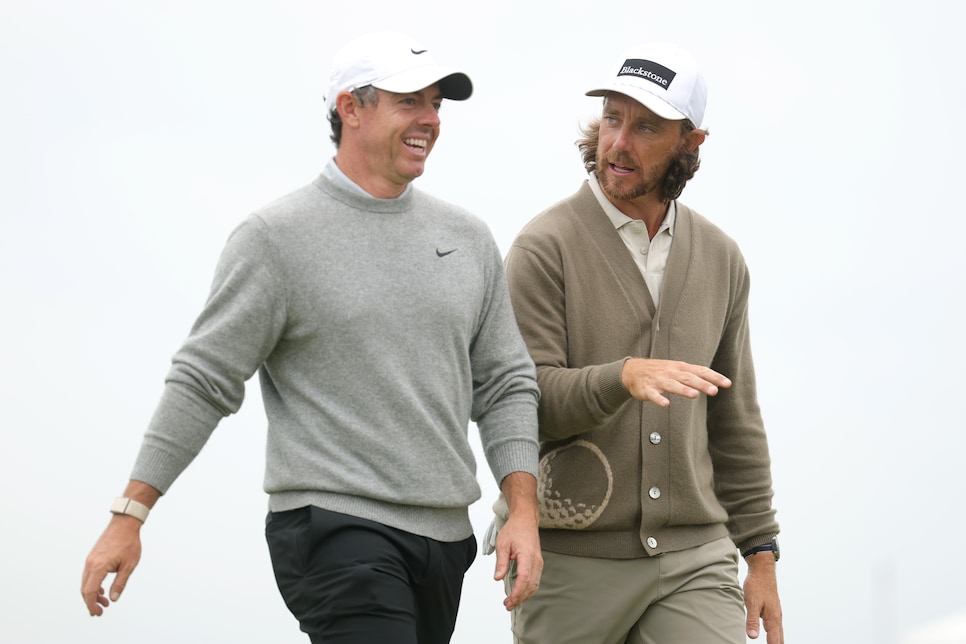
Rory McIlroy and Tommy Fleetwood are good friends, Ryder Cup teammates and played together during Round 1. However, they are not the same type of the player off the tee. McIlroy is one of the longest hitters in the game, second on the PGA Tour this year with a 326.8-yard average. Fleetwood on the other hand is three yards shorter than average off the tee this season and known more for his accuracy. Yet, on the 16th hole at Shinnecock, Fleetwood taught McIlroy a lesson off the tee.
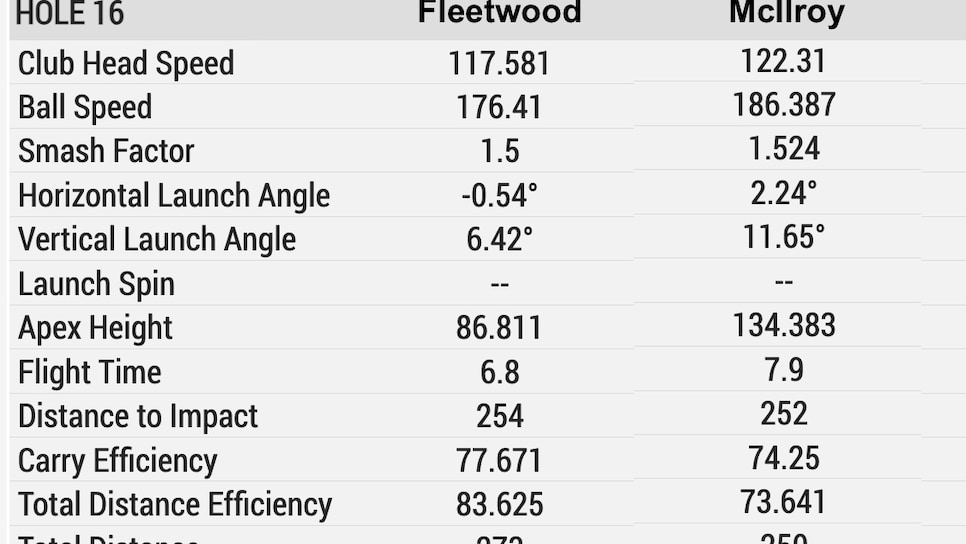
The 614-yard par 5 was playing nearly directly into the wind, with a deep pocket of bunkers guarding the left side of the fairway. To carry them was just 253 yards. Playing first, McIlroy launched a drive with a ball speed of 186.4 mph but caught the face of the bunker at 252 yards and rolled back into a terrible lie. He would go on to make bogey.
[Photo: Kate McShane]
Fleetwood, on other hand, sent his ball into the air at 176.4 mph yet carried the bunker and found the fairway beyond. He went on to make birdie.
On paper, that doesn’t make sense. However, watching both drives from behind the tee, it was easy to understand the difference. McIlroy hit his drive high, launching at 12 degrees with an apex of nearly 135 feet. It ballooned made it narrowed and whilst he cried for it to “go!” it didn’t.
Fleetwood’s drive was flighted. He launched at 6 degrees with an apex of 86 feet. It bore through the wind more efficiently and narrowing carried the bunkers.
 3: The seventh green
The seventh hole at Shinnecock is infamous. It was here, in the final round of the 2004 US Open, the USGA made a last-minute decision to water the green between groups in order to keep the hole playable. The redan-style green runs from front right to back left and is quick to repel any ball hit with the improper distance or shape.
Playing 180 yards into the wind today, it did exactly that.

[Photo: Cliff Hawkins]
Of the 156 players in the field, less than a third hit the green. I say hit the green but of course I mean “stayed” on the green. There were a lot of balls that landed on the green but didn’t stay. In total, 27 players “hit” the green but did not stay there.
Of the 74 players that missed the green so far, only 28 were able to save par.
4: 18th hole tee shot 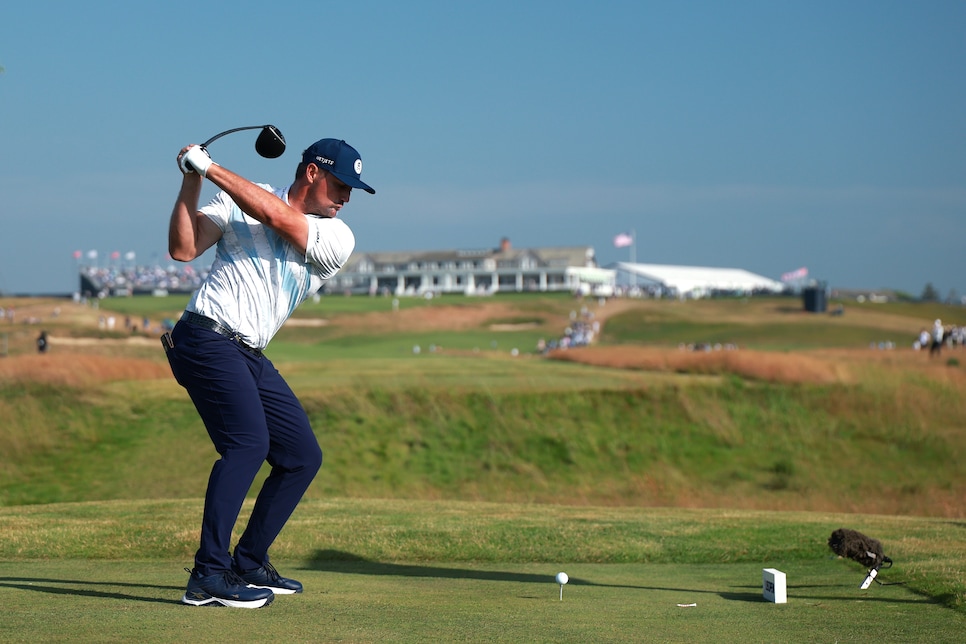
[Photo: Andrew Redington]
The closing hole at Shinnecock Hills is challenging yet forgiving. At its widest, the fairway is nearly 60 yards wide. The real challenge of the design comes in the approach and green contouring. But Thursday it played into the wind. Every player in the field hit driver yet none were able to reach 295 yards off the tee.
While the average drive on the PGA Tour this season is over 304 yards, the average drive on the 18th hole was 268 yards. Only one player, amateur Brandon Holtz, was able to card a birdie. He did so after a drive of just 250 yards.
5: Putting across the wind 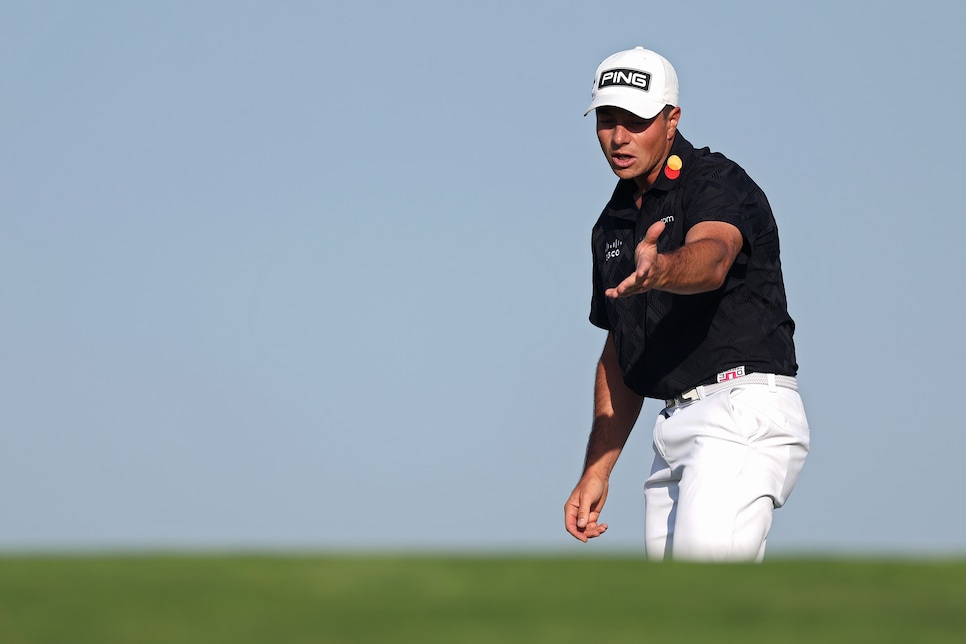
[Photo: Christian Petersen]
When you think of the challenge of wind in golf, it’s easy to fixate on tee shots or approach shots. Those are the shots that spend the most time in the air, so that makes sense. However, ask any of the players at Shinnecock this week and they tell you that putting becomes equally more challenging in wind.
Take the fifth hole for example. The 597-yard par 5 played down wind to a perched green with a right pin position. Players were, understandably, aiming for a spot left of the pin. Any miss to the right would likely lead to a ball rolling and rolling… and rolling away to a depression below the green surface.
The issue then became the putt. It may not have been a long putt, but it was now met with a hard, gusting wind across the line of the putt. Of all the holes on the course, it was the hardest to hole a putt inside 10 feet.
This season on the PGA Tour, players are holing out at a rate of 88 percent from inside 10 feet. On the fifth hole during the first round, players holed just 78 percent of putts from the same range. Sahith Theegala missed from three feet. Michael Brennan too. John Parry three-putted from 16 feet and players, considered to be among the best putters in the game, like Sam Burns, J.J. Spaun and Daniel Berger all missed from inside 10 feet on this green.