Finding the right flatstick is about fitting the golfer to a putter and not the other way around.
I have the Scotty Cameron Gallery, located in Encinitas, California, to thank for turning my putting around. Scotty Cameron, Titleist’s catalogue of putters, are a rare piece of golf equipment that have developed both a cult following and status as a collector’s item among golfers.
The fit-out of the Scotty Cameron Gallery reflects such passionate fandom. We walked past racks of merchandising and Scotty Cameron paraphernalia and into a fitting room where I proceed to try a variety of putters after answering several questions. What is your putting style? What do you currently use? And what is your typical miss on the greens?
Style, or I should say, inspiration/hope, is the ready, stand-up, athletic stance of Rickie Fowler. I always loved that he was upright and loose, approaching putts with a nonchalance as opposed to tilting over the ball dramatically and overthinking or over-rehearsing.
What I had been using was a centre-shafted, zero-torque putter that may work for some but was all wrong for me. The centre shaft had pushed my eyes too far inside the target line, which was leading to inconsistent toe strikes. The visual deception of the centre shaft also influenced me to address the ball off the toe.
I always liked that a longer putter prompts a golfer to stand up taller, so my Scotty Cameron fitting expert compromised and recommended a 37-inch shaft, down an inch on my previous flatstick.
After testing several makes from a pure blade to a mallet and several putters in between, my match was a blade style with a plumber’s neck. My Scotty Cameron fitter also suggested I stand closer to the ball for more consistent centre-face contact. I was recommended a Scotty Cameron Studio Style Squareback 2. Looking down at the blade-style portion of this putter encouraged a more relaxed and languid follow-through with a bit of toe release, while the Squareback style provided the balance and forgiveness of a mallet.
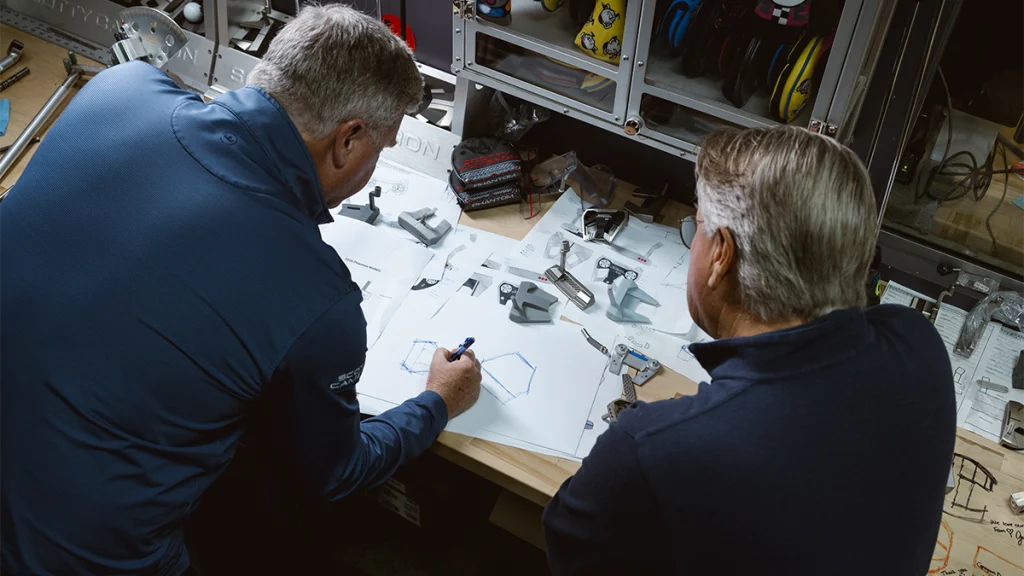
Afterwards and across town at the Scotty Cameron Studio, I sat down with Austie Rollinson, senior director of putter R&D for Scotty Cameron/Titleist. We spoke about the new line of putters, which includes the Scotty Cameron Phantom 9.2R, the Super Select Newport 2.5 Plus, the Long Design Phantom 11, the Super Select Newport 2.5 Plus, the Studio Style Squareback and the Phantom 11R OC.
▶ ▶ ▶
Australian Golf Digest: When a new line like the Phantom comes out, what’s the most joyous moment for you to release it to the golf industry?
Austie Rollinson: Well, I think there’s a certain amount of anxiety because you’ve been getting feedback and working on these for so long. It’s just seeing what the reaction is initially, I think. So we’re excited, but there’s also the anxiety of, OK, do we get it right? And with this one, I think we got it right.
▶ ▶ ▶
With the new Phantom line, you are a believer in fitting a golfer to a putter and not the other way around. There’s a lot more options in the necks and the shafts in the new Phantom range. Can you speak about that?
We try to have a variety of head shapes because the head shape is what players use to align. So having a variety of alignment features on it to find a shape that they align the best. And then the neck configuration is what a golfer is going to use to sense the face awareness as they swing the putter, to be able to deliver that face back to square after they set it initially.
And so in Phantom, we have a lot of different types of head shapes, but we also have a lot of neck configurations to make sure we have the right setup and the right feel for as many players out there as we can.
▶ ▶ ▶
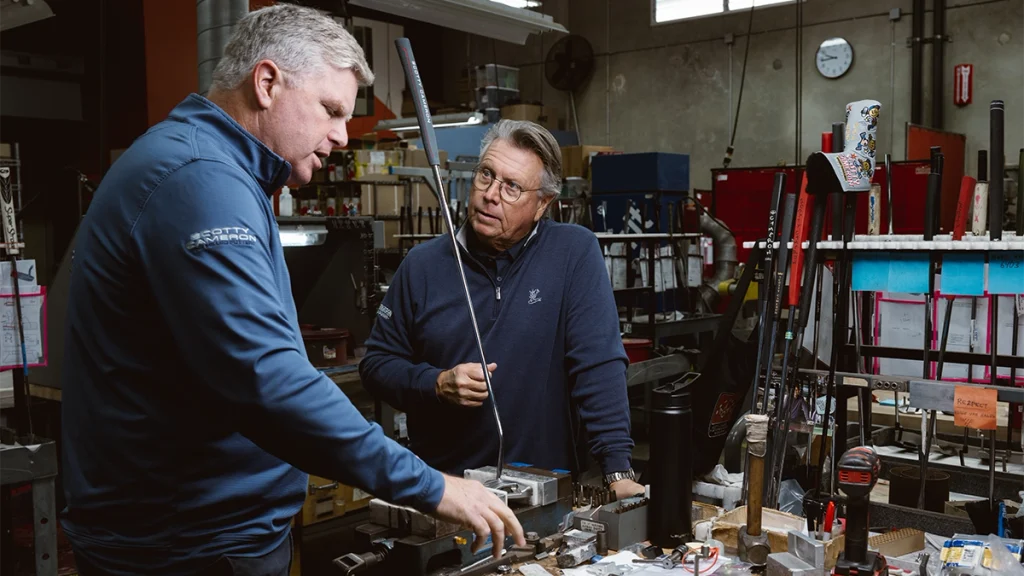
For the average golfer, when they’re selecting a putter, where should they begin?
With what they feel comfortable looking at because you’ve got to be confident standing over the ball. Then start hitting some putts with it. Do I like the sound and feel of it? Do I like the feel of it as it swings through my whole stroke? And not just short putts, but long putts as well.
▶ ▶ ▶
Why are more players gravitating towards a mallet?
Well, I think it’s confidence, especially when there’s a lot of pressure down the stretch, in having a putter where they’re sure they’re aimed correctly. If they’re a little inconsistent in their strike location, that they’re going to maintain their ball speed.
Some of it is trying to get blade type of characteristics into these mallets. I think that’s where you’ve seen a lot of these different hosel styles going into mallets; it’s to get the blade-like performance and some of those feels while still bringing the mallet alignment and forgiveness.
▶ ▶ ▶
What are some of the benefits that you’re seeing of low-torque putters?
It’s set up where that shaft axis, your hands are very high or your eyes are right over the ball, so that can help alignment and set up. Eliminating some of the torque that may cause the golfers to overreact or underreact and be inconsistent. By eliminating those, you get a very smooth sense or feel in the putterhead, and that can build confidence with them that they feel that they’re putting very well and being very consistent.