Most golfers are familiar with compression clothing and its benefits in terms of increasing blood circulation and its healing agents to areas where you feel pain/soreness, etc. What you might be less familiar with is literally the reverse of that concept.
RELATED: Five stretches you should do after every round
Health-care professionals and athletic trainers often use a treatment and/or training strategy commonly known as “BFR”, short for blood-flow restriction. Extreme pressure is applied between the heart and a joint, which limits the outgoing transportation of blood from the heart to that joint. Often combined with exercise, that limitation accelerates improvement in everything from post-operation rehab, treatment for osteoarthritis, strength training and fatigue recovery – even physical therapy for children with neurological disorders.
A simple explanation for how it works is that if you restrict blood flow to an area of the body, it can accelerate hypertrophy (the building of muscle mass) without needing to lift heavy weights. The restriction makes the muscle or muscles work harder without being challenged by big external loads. Think about how beneficial that might be for someone who is fatigued, injured or doesn’t have the strength or joint function to build muscle mass in a traditional way.
“It’s been around for a long time and it’s weirdly effective,” says Ben Shear, Golf Digest‘s chief fitness Adviser. Shear trains several professional golfers, including Ryder Cup captain Luke Donald, and is creator of Golf Digest‘s Fitness Trainer Certification. “For golfers, it’s great for a number of things including elbow tendinitis, shoulder problems, knee pain, really any joint issues.”
To be clear, exercising under restriction is one way to benefit from BFR, but not the only way, Shear says. A number of BFR devices have come on the market in recent years that allow for speedier recoveries from fatigue and soreness simply by wearing them. The compression they create helps with lymphatic drainage and delayed onset muscle soreness (DOMS).
Adds Golf Digest certified fitness trainer Justin Barr, “I can’t say enough positives on how beneficial BFR is when recovering from an injury or seeking to increase intensity of an exercise while maintaining low amounts of resistance. Also, BFR is now an acceptable modality in physical-therapy clinics and many insurance companies will now cover the cost.”
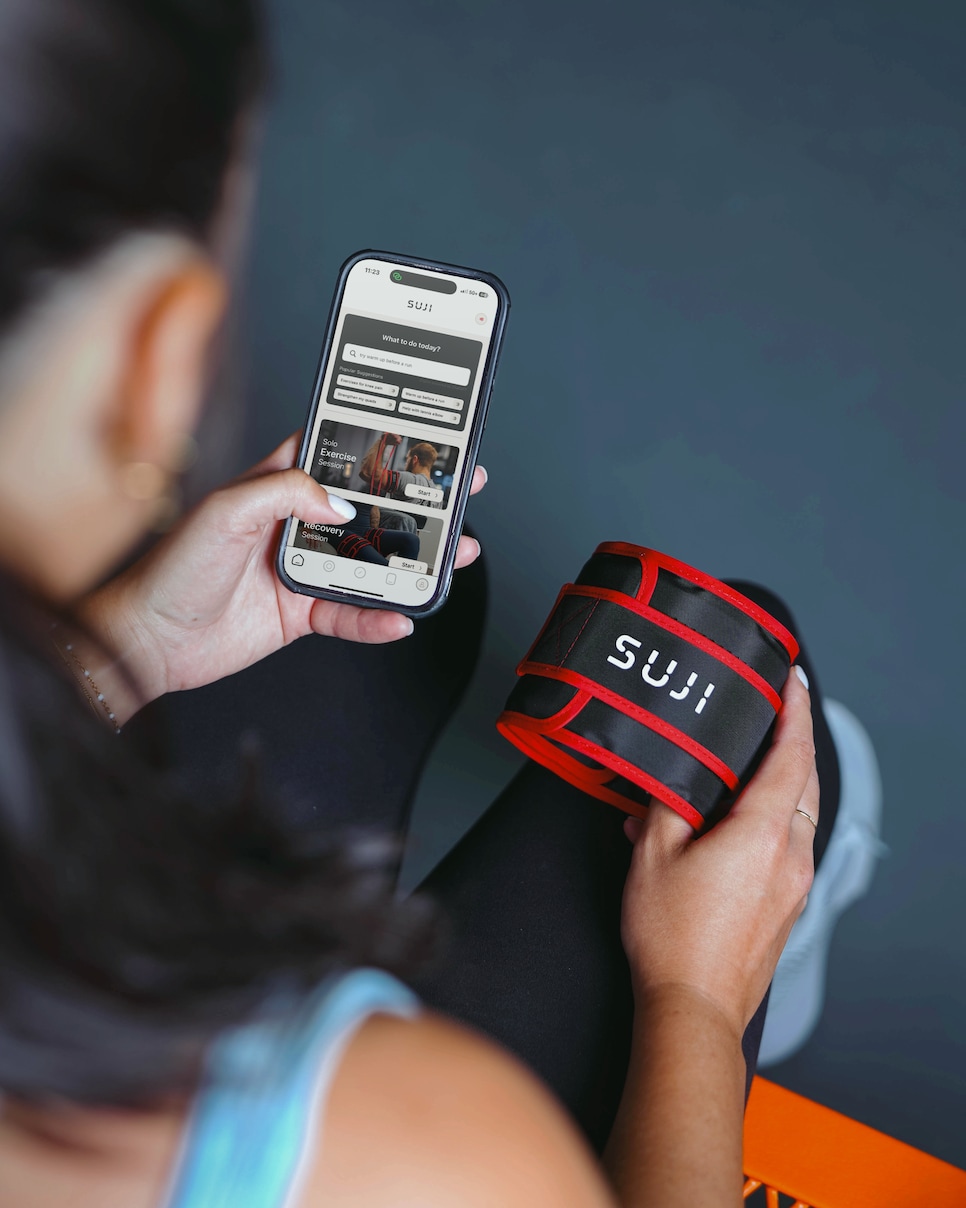
There also are now several products on the market, at various price points from $1,000-plus down to less than $150, that make it possible to use BFR therapy at home. They typically come with one or more “cuffs” that you can wrap around limbs for treatments or training. Many employ smartphone apps to operate, which is a key development since you no longer have to manually inflate the cuff and/or guess how much pressure is being applied, Shear says. The top-of-the-line products deliver the right amount, depending on your calibration and your goals, with a tap of a button.
An example of this new technology comes from the company Suji, which sells cuffs [below] for arms and legs (trysuji.com). They are endorsed by Justin Rose and other professional athletes and used by teams in the NFL, NBA and MLB. Shear has one in his training facility in Jupiter, Florida.
“If you’re just using it statically, you could do it every day,” he says. “In training with the cuffs, however, I would restrict use to a few times a week, and you have to take them off from time to time, because the occlusion (restriction) is very real.”
Other BFR products to consider are SmartCuffs 4.0 (smarttoolsplus.com), BStrong (bstrong.training) and Edge (edgemobilitysystem.com). There also are manually inflated bands that are considerably less expensive and can be found on shopping sites such as Amazon, but they are somewhat limited in what they can do.