Can McIlroy help make the Australian Open matter again?
He’s completed golf’s career Grand Slam and become one of the most influential figures in the sport. Now Rory McIlroy is back in Melbourne, chasing a second Stonehaven Cup and lending his weight to a tournament with ambitions well beyond one famous name. But can the Australian Open turn his star power into something lasting?
Rory McIlroy has never been short of opinions. Nor, for that matter, has he been short of people willing to challenge them.
One of his latest exchanges with fellow tour pro-turned-pundit, Kevin Kisner, was a case in point. After McIlroy travelled to India in October for the DP World Tour’s India Championship, Kisner, via the “Fore Play” podcast, questioned the Northern Irishman’s stated desire to grow the game internationally, suggesting the real motivation for his subcontinent sojourn was a lucrative appearance fee. McIlroy’s response was characteristically direct.
“Two things can be true at the same time,” he said, while questioning how Kisner could possibly know his motivations. It was a neat rebuttal, and one that speaks to a bigger question facing men’s professional golf: does a player’s willingness to take the game to new audiences become any less meaningful if he is well paid to do it?
McIlroy will arrive in Melbourne in December to complete a two-year commitment to the Capital.com Australian Open, having headlined last year’s championship at Royal Melbourne. The arrangement, pulled off by Golf Australia and backed by the Victorian Government, represents a significant investment in bringing one of the sport’s biggest names to Australia. The precise terms of his deal have not been disclosed publicly, but sources tell Australian Golf Digest the financial commitment runs into the millions.
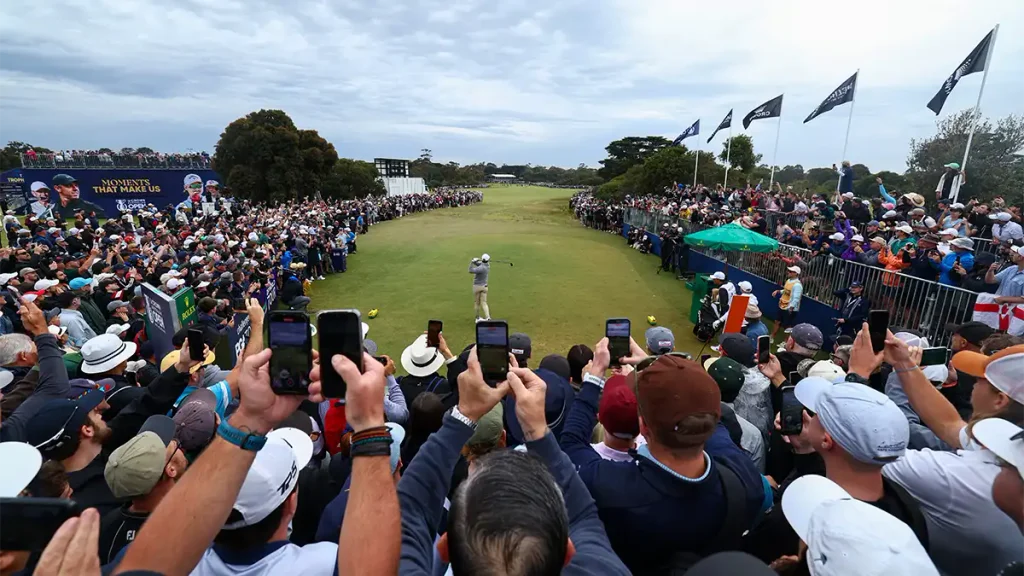
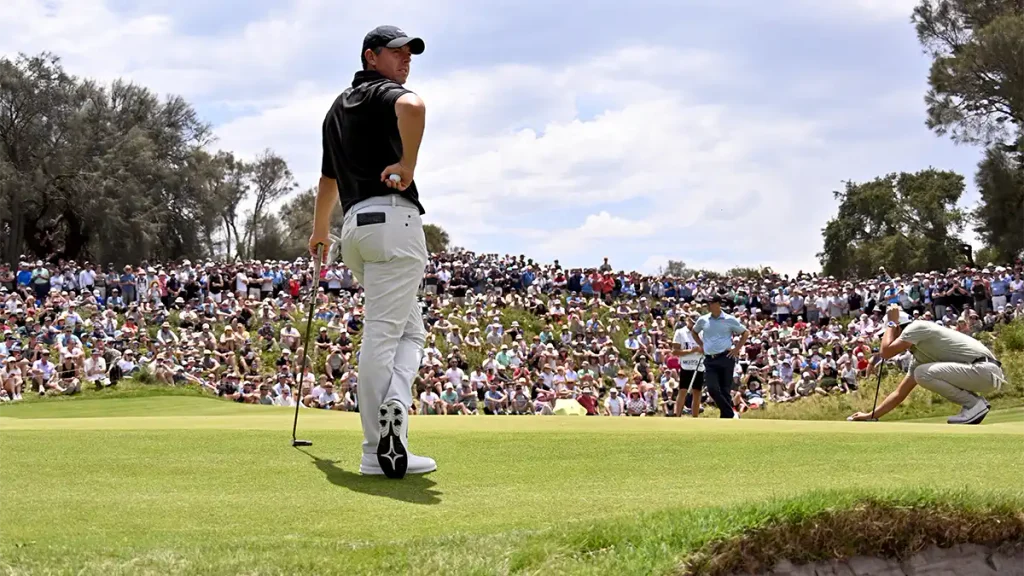
It is a lot of money to spend on one golfer not named Tiger Woods. It is also a lot of attention to attract. Last year, McIlroy’s return helped put the country’s marquee event back on the international golf radar. Record crowds flocked to Royal Melbourne, television viewers tuned in and, for a few days, a championship that has spent years trying to reclaim its place among the world’s most important had one of the biggest names in sport at its centre.
“Wherever Rory goes, he’s going to get offered appearance money,” said Australia’s former world No.16 Nick O’Hern via his “Talk Birdie To Me” podcast with Mark Allen.
Added Allen: “What Rory is doing for golf in this country is enormous! The money we’re spending getting him down here is absolutely worth every cent.”
Most in the game would agree it’s been a sound investment, much like getting Tiger down here was previously. However, now comes the important bit: making that Rory momentum really count.
McIlroy returns from December 3-6 for the 2026 edition, this time at Kingston Heath, the Melbourne Sandbelt course he rather publicly declared as his favourite in Australia last year. He will be joined by a field that includes Adam Scott, Cameron Smith, Sahith Theegala and reigning Champion Golfer of the Year Ryan Fox, with further international interest helping to strengthen the event’s appeal. But McIlroy remains the central attraction, the player whose presence gives the championship a global reach few others could ever match.
For all the attention surrounding his appearance, the Australian Open is not simply another overseas stop on the schedule for McIlroy. His relationship with the Stonehaven Cup stretches back to his teenage years, and his victory in 2013 arrived at a moment when he needed it most.
“Honestly, the Stonehaven Cup is one of the most meaningful trophies that I have,” he says. “I was at a bit of a crossroads in my career. I had a really tough 2013 and I’ve always said I wouldn’t have had the 2014 I had – winning two majors and getting to No.1 in the world – if I didn’t have the week in Australia that I had at the end of 2013. So, it’s always been a meaningful week for me.”
That is a considerable endorsement from a player whose trophy cabinet includes six major championships, two of those green jackets, and the coveted career Grand Slam. The Australian Open is not a major, but McIlroy has never suggested that its significance to him depends on its place in golf’s hierarchy.
His first connection to the championship came much earlier: “I qualified for it as a 16-year-old amateur back in 2005, down on the Mornington Peninsula (at Moonah Links). So, I’ve had a big affinity for this golf tournament for a long time.”
OPEN AND SHUT
That sense of history, sadly, hasn’t always been reflected by McIlroy’s PGA Tour brethren. National opens once formed the backbone of professional golf’s international calendar, offering fans in Australia, South Africa, Japan and elsewhere the chance to see the world’s best compete on their home soil. The Australian Open’s honour roll reads better than most, from Jack Nicklaus and Gary Player to Greg Norman, Peter Thomson and more recent superstars of the sport.
But the modern game has become increasingly concentrated around the United States, where the PGA Tour’s schedule, prizemoney and world-ranking incentives make it difficult for leading players to justify travelling elsewhere. Australia has felt that shift acutely and it was the core reason LIV Golf was able to be as successful outside the US for as long as it was. The challenge now for Aussie Open organisers is not simply getting a famous name to appear once; it is persuading enough of the world’s best to make the journey a regular part of their competitive lives, like it once was.
McIlroy believes the opportunity is there, particularly after last year’s event returning to Royal Melbourne.
“It was an important week for the Australian Open to get back to playing at Royal Melbourne, one of the best courses in the world,” McIlroy says. “The Melbourne Sandbelt has some of the best courses anywhere in the world and I think [this event] getting the exemptions into the Open Championship and the Masters Tournament was a big step forward and hopefully something that they can build on in the years to come.”
With three places in The Open and a ticket to the Masters now up for grabs, the Aussie Open at least has something more substantial to offer than a cheque and a trophy. It has a competitive purpose that can attract ambitious professionals from around the world. The next step is to build a field worthy of that opportunity. With the greatest of respect to two fine international players, Rasmus Neergaard-Petersen (2025 champion) and Ryggs Johnston (2024) weren’t the headliners the Australian Open needed at that pivotal moment. Their victories, while thoroughly deserved, reflected a tournament still struggling to attract the star power required to reclaim its place on the world stage. David-versus-Goliath fairytales can be heartwarming stuff, but this is an event that desperately needs a goliath holding the silverware on Sunday.
McIlroy agrees it needs to reclaim something it once had: a place in the plans of the best players, rather than a position on the periphery of their schedules.
“I certainly hope that more people make it Down Under and play,” he says. “I think what the PGA Tour are doing with their schedule from February through to August, there’s an opportunity there to get some of the biggest names in the world down to play the Australian Open. Obviously, that would be amazing for the tournament and it’s not like that hasn’t happened in the past. I mean, you look at the winners of the Australian Open over the years and it really is a ‘who’s who’ of the best players over the past 50 or 60 years.”
A change to the PGA Tour calendar, which is shortening its overall season and freeing up more time at the end of the year, will most certainly help. So, too, will our big brother’s promise to elevate our national Open via a landmark partnership signed off earlier this year when Golf Australia announced it had struck a deal with the DP World Tour and the PGA Tour to continue to grow the event. Covering 2027, 2028 and 2029, the new agreement – timed rather fortuitously with LIV Golf’s demise after Saudi Arabia’s Public Investment Fund withdrew its funding for 2027 – will enable the national championship to again be co-sanctioned by the DP World Tour. It also marked the first time the PGA Tour had formally partnered with Golf Australia, with the agreement set to ensure the tournament will receive a significant boost in prizemoney from 2027, a distinct window in the global golf calendar and optimise the opportunity to attract the world’s best players.
It can’t come quickly enough. For context, seven of the top 10 players in the world, including world No.1 Scottie Scheffler, are choosing to play Tiger Woods’ 20-man Hero World Challenge exhibition in the Bahamas the same week as this year’s Australian Open. If the restructure of the American season creates a clearer window for international events and fewer clashes with bigger riches on offer, we may have a legitimate shot at returning to the glory days. A PGA Tour co-sanctioning, along with allocated FedEx Cup points and higher-weighted world ranking points wouldn’t go astray, either. But, hey, small steps.
“Our ambition is clear: we want the men’s Capital.com Australian Open to be recognised among the top 10 most prestigious golf tournaments globally, and everything we are doing for the event flows from that ambition,” says Golf Australia chief executive James Sutherland.
“Getting the Australian Open right is about securing the total mix. That means world-class venues, strong host-state partnerships, commercial partners, sanctioning partners, broadcast reach, a great fan experience and the ability to attract strong international fields. This agreement with the PGA Tour, DP World Tour and the Challenger PGA Tour of Australasia strengthens the global relevance of the championship and gives us another important platform to keep growing the event year-on-year.”
While McIlroy’s two-year deal has been a great launchpad, it cannot be the whole strategy. There will always be a commercial argument for bringing him back, again and again. His profile extends well beyond golf, and his popularity was evident in Melbourne last year. A player of his stature can drive ticket sales, attract sponsors, generate international coverage and give casual fans a reason to attend. The value of that attention is not confined to four days of competition.
The harder question is what happens after he leaves. An appearance fee, however large, is not an inherently poor investment. Sport routinely pays for star power because star power can create an audience that would not otherwise be there. The measure of success is whether that audience translates into ticket sales, sponsor interest, television reach and a stronger tournament in the years that follow.
McIlroy’s recent exchange with Kisner provides a useful lens through which to view that calculation. He did not deny that money was involved in his appearance in India. Instead, he argued that commercial incentives and a genuine desire to expand golf’s reach could co-exist.
The same principle applies in Australia. McIlroy can be paid millions to play the Australian Open and still care about its place in the sport. The tournament can make a commercial investment in him while also pursuing a broader ambition for Australian golf. Those interests are not mutually exclusive.
The real test is whether the investment helps create a championship that can stand on its own once more.
GOING TO HIS HAPPY PLACE
For McIlroy, there is another reason to return this year: Kingston Heath. His comments about the course last year caused a stir in Melbourne, largely because he had just played Royal Melbourne and was prepared to rank another club ahead of it.
He did not appear particularly concerned about the reaction. Asked to name his favourite course in Melbourne, he answered without hesitation: Kingston Heath. It was a bold call, given Royal Melbourne’s standing and the reverence with which its Composite layout, in particular, is regarded. But McIlroy has since explained the reasoning behind his preference, and it has little to do with length or spectacle.
“[Kingston Heath] is such an amazing design,” says the world No.2. “I would argue that Royal Melbourne is probably built on a better piece of land for a golf course – more rolling hills and more elevation changes. But I think with where Kingston Heath is – it’s a pretty flat piece of property – and what they’ve been able to do with that golf course and just some of the par 3s, the strategy of the golf course, some of those green complexes… I mean, it’s maybe a touch short for modern standards but you have to be so strategic in how you play it and it’s just a wonderful golf course.
“I really have an appreciation for golf courses that maybe don’t sit on the best piece of land, and they have to come up with unique designs to really make it interesting. I think with Kingston Heath, the architect has really been able to do that.”
It is an illuminating explanation from one of the finest players of his generation. McIlroy’s game is built around power, yet he is drawn to a course that asks questions rather than simply rewards brute force. Kingston Heath’s compact, subtly contoured layout demands control, imagination and an understanding of angles. Its par 3s are particularly celebrated, while its greens and bunkering can make even a short hole a serious examination of judgement.
It’s perhaps a reminder this iconic tournament does not need to mimic the American model to appeal to international audiences and players; it can lean into the qualities that make its courses different.
McIlroy’s affection for Melbourne extends beyond the golf course, although he admits that time is always tight on a tournament trip.
“When you arrive the week of, especially with it being such a long trip, you don’t feel like you have a lot of time to do everything,” he says. “I think everyone knows Melbourne is known for its coffee and its sport. I tried to sample a bit of both of that. I went and played at the Melbourne Park indoor courts where the Australian Open tennis is held, so that was fun. I’d love to go do that again. Melbourne is such a great town for food and exploring and there are so many outdoor spaces and the beaches.
“But, again, there’s only so much time, unfortunately. I wish I could stay for another week and do a lot more. But once the tournament starts, you’re sort of down to business and you’re concentrating on trying to win the tournament. But I am staying for a couple of days after and I’m going to play the Cathedral Invitational, which benefits Adam Scott’s foundation. So, I’m going to stay down for that. I’m excited for that as well.”
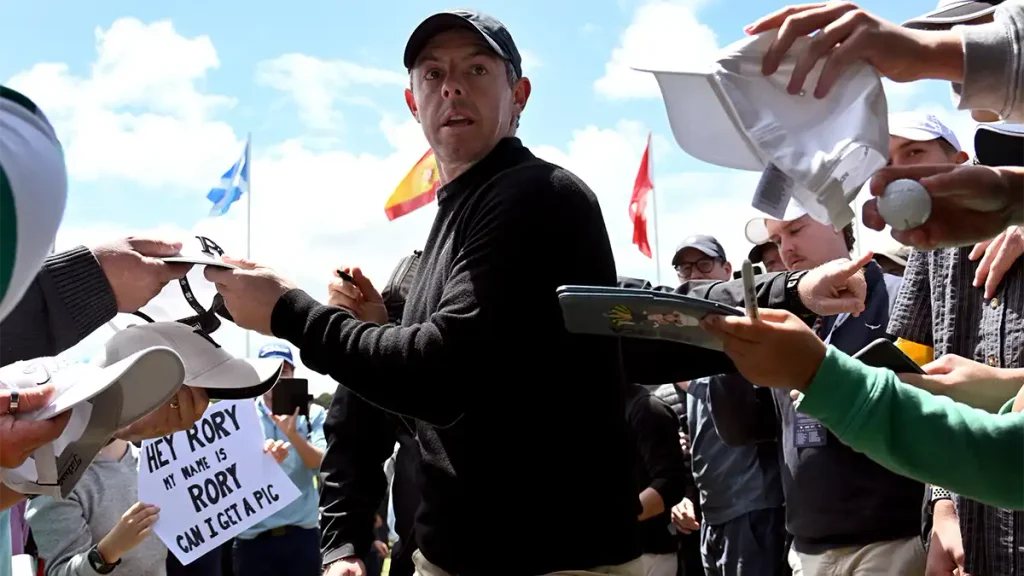
Whether more big-name PGA Tour stars board the 15-hour flight in future years will depend on more than goodwill. The tournament needs a schedule that makes sense, meaningful incentives and, importantly, the PGA Tour to follow through on its promises. It also needs to use the attention McIlroy attracts to build a stronger commercial and sporting foundation for the future. That is where the real return on investment will be measured. Not in the number of photographs taken with McIlroy, nor even in the size of the crowds at Kingston Heath, but in whether the championship becomes a fixture that the world’s best want to play every year.
McIlroy cannot make that happen alone. But he can help make the case. And when he stands on the first tee at Kingston Heath this month, chasing a second Stonehaven Cup, he will have a rare opportunity to do something more than win another tournament. He can help remind the world why the Australian Open really matters.

How Rory stays fresh while travelling
Rory McIlroy’s latest sponsorship deal might be his smartest yet.
The six-time major champion announced a new partnership with DP World recently that comes with an amazing perk that should help optimise – and extend – his playing career. That’s because McIlroy will now have two personalised fitness and recovery trailers with him wherever he plays.
“When you’re competing around the world, consistency really matters,” McIlroy said in a statement. “Having the same environment to train and recover in every week gives me and my team one less thing to think about and lets us focus on preparing and performing.”
Again, he’ll have two of these things at every tournament. No matter where he plays in the entire world. Pretty wild!
It should be noted the personalised fitness trailer isn’t a new thing in golf. In fact, McIlroy, who has long made fitness a top priority, had finally sprung for one at the end of last year after seeing what one had done for Ryder Cup teammate Justin Rose.
“I decided to pull the trigger on it when Justin won in Memphis last year,” McIlroy said. “He’s 45 years old, playing great, contending in major championships, and I was – at that time I was 36 – I was, like, I want to play really well for the next 10 years; I feel like I need to do something like this.”
Suffice to say, the Kingston Heath carpark officials have been put on notice! – Alex Myers
Photographs by getty images/Josh Chadwick, WILLIAM WEST