

Laying out the case for the Players Championship becoming an official fifth major – or not.
The Players Championship looks like a major, sounds like a major and, with a $US25 million ($A36 million) purse, pays like a major. But is it a major? While the short answer is no, there’s no denying the elements that keep the annual debate alive. Frankly, professional golf could do with the boost that creating a fifth major would provide, so here are five reasons for and against the PGA Tour’s annual gathering at TPC Sawgrass gaining major-championship status.
FOR
A major-quality field
Until 2023 – the first edition held without LIV golfers such as Brooks Koepka (now back on the PGA Tour), Patrick Reed (who is aiming to return to the PGA Tour in 2027), Bryson DeChambeau, Cam Smith and others – the Players Championship boasted the strongest field in golf.
How? Well, the field at TPC Sawgrass is filled with the top 125 on the previous PGA Tour season’s FedEx Cup points list, tournament winners between each Players Championship, the top 50 on the Official World Golf Ranking and several other entry categories.
The Players has arguably the strictest entry criteria – the tournament does not allow amateurs or club professionals to compete – and a large field at 144. This is what separates it from the four majors. Amateurs can play in three of the four majors, denied at only the PGA Championship, which instead invites 20 club pros. The two Opens and the PGA have larger fields (156 each) than the Players, but exemptions are more open and wide-ranging.
In fact, in 2018, the stats gurus at Data Golf determined that the bottom 25 percent of the field at TPC Sawgrass was “more than a stroke better per round than the bottom quartile in any of the majors”. That’s an enormous gap in elite pro golf, and a quarter of the field is nothing to shrug at.
History
The Players Championship, created in 1974, is now more than 50 years old. It has enough iconic moments – you might recall Tiger Woods’ “better than most!” putt on the 17th green during the third round of his 2001 victory – to be recognisable in the eyes of even the most casual of golf fans. History is the bedrock of the four majors, but the Players is at the intersection of the oldest tournament with the highest-calibre annual field. In short, it’s old enough to be considered a major.
A new era
In the aftermath of the professional golf divide, adding a fifth major would mark the moment where the game moved on and forged a new identity. It could be argued that a niche sport like golf needs more than four relevant weeks per year that cross over into mainstream media and popular culture. And golf has more in the tank than four championships. Why not use that? This would hinge upon allowing LIV golfers to tee up in the Players Championship, as such a move would make the tournament a neutral venue for professional tours – just like the majors.
Elite course
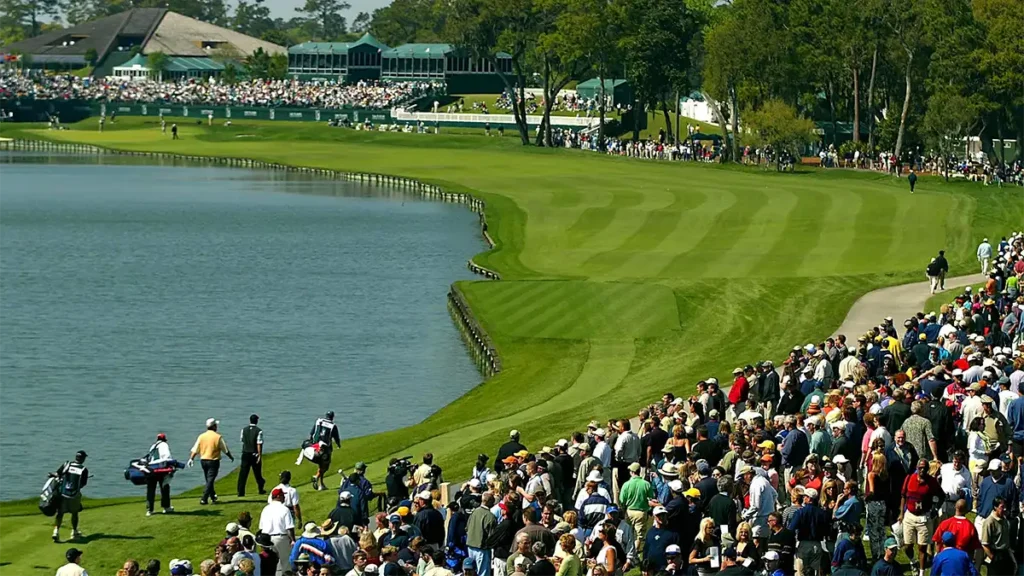
TPC Sawgrass is a wonderful test that torments a percentage of the field while delighting the rest. Only a complete golfer with a well-rounded game can be the last man standing after 72 holes. You can’t fake it or hide parts of your game at Pete Dye’s Stadium course. Visually, too, it looks like a major championship host. Fans lucky enough to attend the Players will remember the first time they rounded the dogleg on the par-5 16th hole and looked across the pond to the island green at the par-3 17th. That feeling is not unlike seeing an iconic major venue for the first time.
Another opportunity for Aussies
In the past 30 years (for which Steve Elkington’s 1995 PGA Championship victory falls just outside), Australian men have won four majors: Geoff Ogilvy (2006 US Open), Adam Scott (2013 Masters), Jason Day (2015 PGA) and Cameron Smith (2022 Open Championship).
In other words, they are bloody hard to win. It may sound biased, but it’s appealing to have another men’s major that Australians could win. There have been six Players wins between five different Australians (Elkington won twice), so we’ve got good form at TPC Sawgrass. The most recent Australian was Smith (2022) while Min Woo Lee shared the lead during the final round in 2024.

AGAINST
A global major
The following point against the Players is basically a dealbreaker for most golf fans, and rightly so. If the game was to add a fifth major, it would be neglecting the rest of the world if it were held in the United States. With the United Kingdom (Open Championship) and US (Masters, PGA and US Open) covered, there are regions of the world more deserving of a fifth major. There’s an argument to be made that European Union countries (Ireland and continental Europe) have contributed so much to the professional game, through great players, courses and Ryder Cup history, that they are worthy of an official ‘Euro major’. So, too, are countries like Australia (the Australian Open could seamlessly evolve into a major) and South Africa, as well as continents like Asia and South America.
Majors need LIV golfers
In the three Players Championships since LIV Golf’s debut, suspending defectors from entering has perhaps been the second-strongest argument against the event gaining major status. Per PGA Tour rules, golfers who compete in LIV events are subject to disciplinary action and not immediately eligible for events, including the Players. But at the height of the PGA Tour’s divide with LIV (June 2022 to June 2023), the four majors took no part in such suspensions. Major championships should sit above and separate from any one tour, for they are opportunities to welcome the best golfers from around the world to tee up in the oldest and most prestigious tournaments.
On their own islands
Major championships being run by one independent organisation each provides a wonderful autonomy (Masters by Augusta National, PGA by the PGA of America, US Open by the USGA and Open Championship by the R&A). Should the PGA Tour, which runs the Players Championship, be permitted to manage a major and a tour? Should any tour be able to also manage a major? The majors’ collective independence affords them an immunity from pro golf’s week-to-week issues.
Symmetry of four
There is something romantic about an even number when it comes to the career – and calendar – Grand Slam. When a rare player is special enough to win the first two majors of the year (most recently Jordan Spieth claimed the 2015 Masters and US Open), it creates a buzz that he’s “halfway”. A golfer stuck at three-quarters of the way is also compelling. It’s what made Rory McIlroy’s journey to a Masters win, and therefore the career Grand Slam, so captivating.
The retroactive puzzle
A fifth major would create a lack of clarity around two pools of golfers: past winners of the career Grand Slam, and of the Players Championship. The Players has always had an elite field, so how would becoming a major affect past winners? Would they have a major added to their tally (many would become multiple major champions because of that), or would golf create multiple eras like tennis? Both are confusing outcomes, although not insurmountable.
Photographs by Getty Images/Richard Heathcote, Mike Ehrmann, jamie squire, Ryan Young, Logan Bowles, Chris Condon, PGA Tour Archive, Tracy Wilcox