
In a way that leaves me even more convinced that golf is the greatest game of all, I’ve always found it tremendous fun to play 18 holes with Jerry Tarde.
I can hear the howls that opener just set off. “Isn’t that guy your boss? Even if it wasn’t fun, what else are you going to say?”
Yes, this is a house job, but I go forth confidently because however conflicted and compromised the assignment might seem, the case supporting the premise is overwhelming.
First, this is the concluding installment in a series celebrating Golf Digest’s 75th anniversary, and no one has been more responsible for the publication’s success in becoming the standard of golf journalism than Tarde. Second, nothing provides a more cogent representation of his philosophy, leadership and identity as a guardian of the game than the way he goes about a round of golf.
Of course, Tarde would never make this big a deal about it. His style is understated but substantive, careful never to let what’s most enjoyable fall victim to overanalysis. Outwardly, all he does is “play happy” in the best Bob Rotella-approved meaning of the term. He likes to revel in watching the ball fly over an artful landscape (Pine Valley, if you’re lucky) and in between shots retell slightly embellished tales usually involving now-absent Golf Digest figures, both for the hilarity of the punchline and as fond tribute.
But inwardly Tarde is a golf romantic who knows the game possesses the power to make people better. It’s evident in the joy he exudes when generously sharing what he’s always found so fulfilling. The more I’ve been privileged to be part of some of these rounds, the more I see Tarde as a deceptively passive but passionate evangelist.
By temperament, Tarde is a natural listener who is comfortable with thoughtful silence. Walking up a fairway together, I used to awkwardly struggle to fill the perceived void. Now I better understand to relax and remember that words can get in the way of those ineffable moments of immersion in the game. I’m convinced that this disposition was steadying for Nick Taylor when he won the 2020 AT&T Pebble Beach Pro-Am while partnered with Tarde, who was unflappable as ever with CBS cameras trained on his every shot.
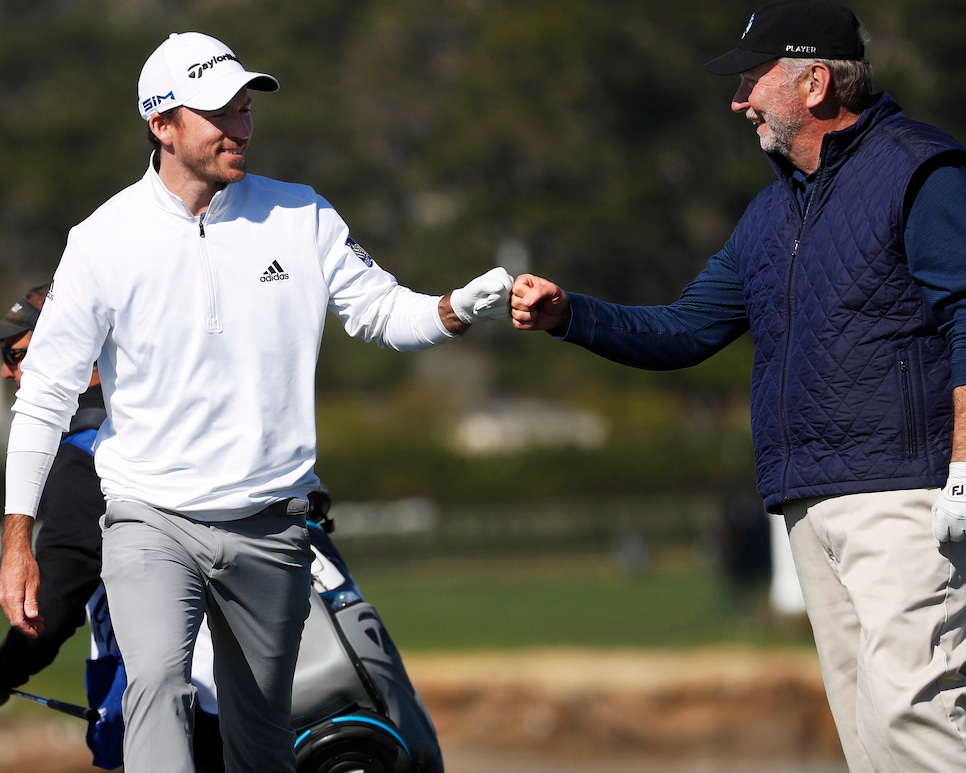
A GOOD PARTNER: Nick Taylor won the 2020 AT&T Pebble Beach Pro-Am with Tarde.
MediaNews Group/The Mercury News via Getty Images
Poise under pressure serves Tarde’s game in a way that is inspiring, which is saying something for a guy with mid-80s mph driver clubhead speed who rarely cracks 200 yards even with a perfectly flighted draw. While genetics ensured that he would never be a long hitter, it’s instructive that back in his early 30s, Tarde got down to a 1-handicap by practicing his wedge game every morning for a summer at Winged Foot. The first time I played with him, in 1987 at Spanish Bay, he shot 74. Now at age 69, he’s a hard-to-beat 12 index who squeezes everything he can out of hitting every fairway (once on a buddies trip in Scotland, he played 10 rounds with the same ball) and blends a useful short game and an especially cold-blooded knack for making eight footers for 4-net-3s with an original 3-ball putter he’s been using since Dave Pelz invented it in 1985. He keeps big mistakes to a minimum, letting that pattern insidiously insinuate itself until the opponent beats himself, bringing forth from Tarde a sympathetic word or nod but no hint of surprise.
“He’s the sweetest, kindest, most vicious competitor I’ve played with,” says Thomas Friedman, the three-time Pulitzer Prize-winning foreign affairs columnist for the New York Times who is Tarde’s closest golfing friend despite having lost the majority of their $20 closeouts over the last 30 years. “Jerry has this deceptive way of seeming to not really be competing, but then you’re 2 down after nine, and, of course, he has been REALLY competing all along. It’s maddening, but it’s raised my respect and admiration for him. When I do manage to win, I feel like I’ve really done something.”
When Tarde breaks away from conversation to briskly go to his ball, especially late in matches, he’ll lock in with a palpable inner strength that—call me crazy—reminds me how the late Sandy Tatum described what was most memorable about his rounds with Ben Hogan.
“When it was Hogan’s turn to play, it was on the basis that he had been accorded the privilege of playing that particular golf shot,” Tatum said, “and that privilege carried with it a responsibility, and that responsibility was to give that shot all the thought and effort that he could, and to make it as effective as he could. It was a very distinct characteristic.”
Put it all together, and it’s what makes Tarde, while certainly not a great golfer, a nearly ideal one. The same qualities that make him a favorite partner on the course are also brought to the boardroom. For all his skill as a writer and editor and as a recruiter of talent and wellspring of original ideas, it is his gift for networking and relationships that is most responsible for his astounding 41 years leading Golf Digest. It’s a tenure exceeded in the history of American magazine publishing by only Jann Wenner (50 years at Rolling Stone) and Hugh Hefner (57 at Playboy).
Tarde has countless friendships in the golf world, among the closest with departed elders like Pete Dye, Herb Kohler, Frank Hannigan and Peter Dobereiner. His many alliances with industry leaders have mostly survived friction caused by moments of unfavorable coverage from the magazine and sometimes Tarde’s own column. “Jerry’s integrity has always been unimpeachable,” says former USGA executive director David Fay. “All the respect he’s earned over the years has cushioned the rough spots. Of course, a round of golf can be the softest cushion of all.”
“Relationships are made on the golf course, and deals are built on relationships,” Tarde says. “In my experience, playing golf together does something to make those relationships less transactional than in other fields. It’s give and take, sure, but golf makes you more inclined to be a giver and less of a taker.”
By reimbursing club memberships and green fees for much of the staff, Tarde has always encouraged making the golf course an extension of the workplace to spur creativity and foster alliances in and out of the office. Golf Digest has long self-identified as a destination for “How to play, what to play, where to play,” but thanks to Tarde, it’s also explored that most rewarding territory of “why to play.”
Tarde found his why in the game’s camaraderie. In his nearly finished memoir, which focuses on more than 100 golf people both prominent and obscure that he has known over the years, Tarde recounts how he began playing the game around age 13 at Juniata Golf Course, a threadbare par-63 muny a couple of blocks from his family’s 1,100-square foot, two-story rowhouse in the Kensington-and-Allegheny section of northeast Philadelphia. The all-day rate for juniors was 50 cents. “There was no range, so we never hit balls or practiced or studied swings, except to copy the best player, a scratch golfer named Ed (The Bear) Billus who we envied for his ability to hit nothing but low hooks,” Tarde remembers. “We just went round and round and round until dinner, then came back to play skins until dark.
“I fell in love with the Dickensian cast of characters who hustled $5 matches during the day and went to the racetrack or Atlantic City at night—so foreign to my world at the time,” he says. They were known by names like Moon Man, Chollie Binoculars, Stiff Arms, Tombstone and Wawa. Even as Tarde developed his gritty game, he says, “For me it was definitely the people first, the competition second. I don’t know that I’ve ever had as much fun as playing two-man nine-hole matches against 15 other pairs over that hardpan muny with sunflower stalks topped by beer cans for flagsticks.”
Tarde would accumulate a tidy sum each summer, bolstered by shifts working behind the counter selling balls and cleaning golf carts, which got him dubbed Pro Shop Jerry. After getting a fake library card with the name “Jack Nicklaus” for the city’s public library, he vividly remembers when his relationship to golf irrevocably deepened—watching on television as Nicklaus on the final day of the 1972 U.S. Open at Pebble Beach hit the flagstick with a 1-iron on the 17th hole. A few days later, he was hooked permanently reading Dan Jenkins’ account of Nicklaus’ victory in Sports Illustrated. This quickly morphed into a singularly focused ambition to become the editor of Golf Digest.
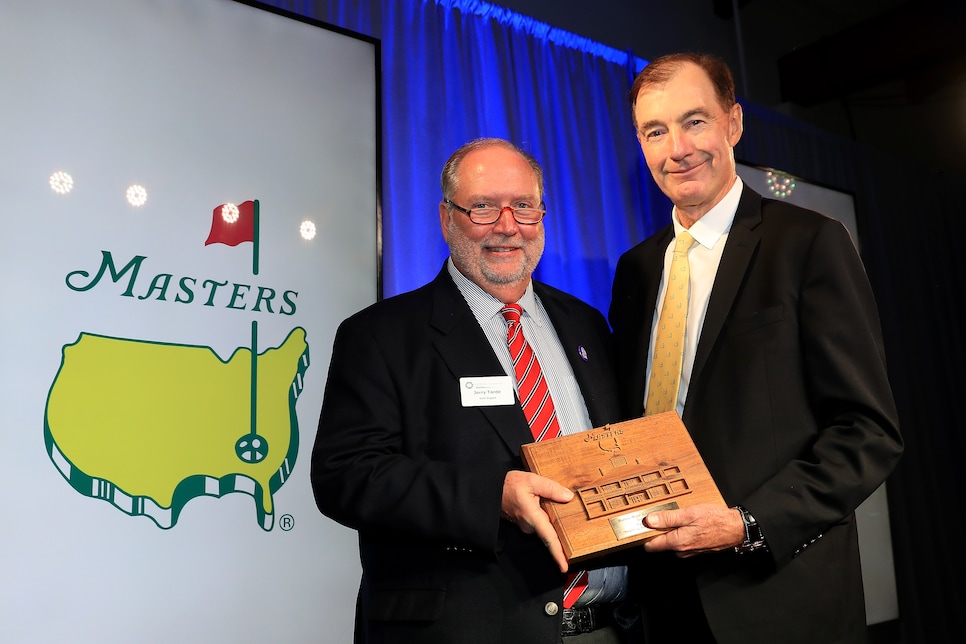
A major player: In 2019, Tarde received the Masters Major Achievement Award from Craig Heatley for 40 years of covering the major
David Cannon
The same qualities that make him a favorite partner on the course are also brought to the boardroom.
An outstanding student, Tarde quit his championship high school debate team to become the editor of the school newspaper. He also gave up a path to the seminary, which had started with being an altar boy and congregation bingo caller, to study journalism at Northwestern. When he left for college, the motley crew of pirates at Juniata took up a collection—he still has the list of 42 contributors who staked him $68.
In Chicago, Tarde met his important mentor, World Golf Hall of Fame entrepreneur Herb Graffis, then in his mid-70s, who encouraged him along his chosen path. Accordingly, in 1977, to pad his résumé for his future job, he joined the PGA of America as an assistant pro at Juniata (he got his amateur status back in 1980). It helped, as he came to Golf Digest as an intern at age 21.
He was hired as a full-time writer and editor for Golf Digest the next year. In 1984, when he was just 28, his vision came true. In an interview for the head job, Tarde told the magazine’s co-founder, Bill Davis, his simple plan: “I’m not looking to change anything. I just intend to make everything better.”
That he did. Right away he hired Jenkins, who had just left Sports Illustrated in a huff and was eager to show off his new fastball. Then, in quick succession, he hired his “Murderer’s Row” of writers including Dobereiner, Tom Callahan, Peter Andrews, Dave Kindred, Dave Anderson and David Owen. Tarde also got cultural icons like John Updike, George Plimpton, Alistair Cooke and Friedman to write for the magazine. Ongoing features like “America’s 100 Greatest Courses,” “The Search for America’s Worst Avid Golfer,” “The Hot List,” “My Shot” and others became popular staples.
When recently asked to choose the best he ever did, Tarde thought about it for a couple of days. With a choice that is consistent with his deep belief that golf can improve lives and that the opportunity to become a golfer should never be unfairly denied, Tarde decided that assigning Marcia Chambers of the New York Times to investigate golf’s long history of discrimination against women and people of color led to the most important journalism that Golf Digest ever published under his watch. The two-part series appeared in May and June of 1990 and raised the issue that caused Hall Thompson, the president of Shoal Creek where the PGA Championship was about to be held, to fatefully say, “We don’t discriminate in any other area except the Blacks.” The American Bar Association awarded Chambers and Tarde its Silver Gavel Award in 1991 for “outstanding contribution to the public understanding” of law and justice, marking the first time that a sports magazine had been so honored.
“Marcia’s stories provided more good for the game where it needed it most,” Tarde says. “It didn’t do enough, and the battle continues, but it was a significant step that led to a major change of direction in the game’s culture. As I tell my golf friends, it’s our job to be evangelists, and on that story we were.”
That is what Tarde has been and continues to be, even when it’s just playing golf.
More From the best i ever did  Golf Digest Logo ‘The Best I Ever Did’: Architect Tom Doak on why the pen is as mighty as the shovel
  The Best I Ever Did The Best I Ever Did: How writer Guy Yocom mastered the golf interview
  Golf Digest Logo The Best I Ever Did: Bob Toski
This article was originally published on golfdigest.com