The LPGA Tour’s all-time winningest player can help you score.
When discussing the greatest players in women’s golf history, names such as Annika Sörenstam, Nancy Lopez and Mickey Wright typically come to mind, but none of them had as many tournament victories as the late Kathy Whitworth.
Whitworth, who died in 2022 aged 83, won an amazing 88 LPGA Tour events between 1962 and 1985, including six major championships. Amazingly, she didn’t start playing golf until age 14, but that didn’t stop her from being a dominant force in the women’s game for decades. In 1990, she wrote a book called Golf for Women with Rhonda Glenn and Golf Digest excerpted her thoughts on chipping and pitching. Here’s what she said:
“I learned to play many different short shots when I was 16 or 17. The little putting green at New Mexico Country Club had a cement block wall around it, about a foot high, with an iron railing above the concrete. I could either pitch over the railing or under it, so I’d practise different shots, going over then going through the opening. This gave me a feel for which club to hit and how hard to hit it.”
Basics of chipping
“Make sure your stance is narrow, with your feet no more than five or six inches apart. The stance should be narrow enough to take weight shift out of the shot. The ball is usually played in the centre of the stance or slightly back of centre.
“Many times people get very wristy and top it, blade it or chunk it. You don’t have to help the ball up. Let the loft of the club do that. Your hands should be at least even with or slightly ahead of the ball at impact, but no further ahead than the left thigh. This hand position will enable you to come into the ball with a more sharply descending blow, which will give you a crisp and controlled shot.”
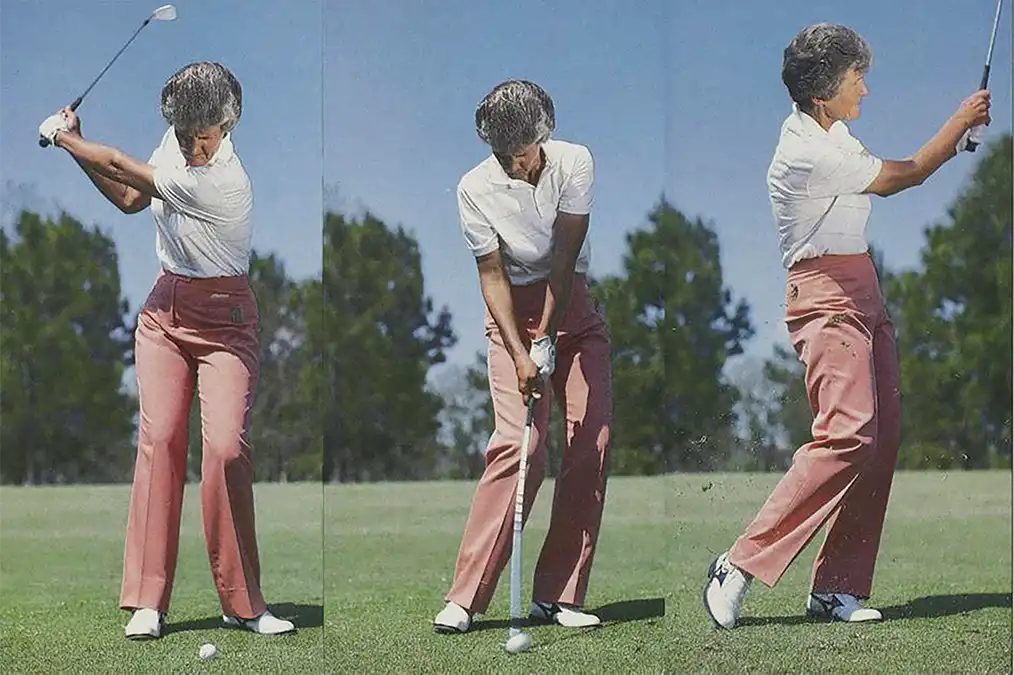
Basics of pitching
“You must still use a narrow stance, but the longer the shot, the wider the stance because you are trying to hit the shot with a little more force. I use a slightly open stance with the wedge. This helps me keep the bottom of the blade going right towards the target, rather than allowing the wrists to roll over, as on the follow-through in a full swing. Your wrists should not be stiff,
just firm.
“To get a good feel for the shot, the length of your backswing and follow-through must be equal. Stay firm through the hitting area. Be consistent.”
Photographs by Stephen Szurlej