
[Photo: Golf Digest]
Here’s a guarantee: The Ryder Cup at Bethpage Black will produce memorable shots that will create collectible items—balls, clubs, flags, who knows what else. Some of those items might be worth real money one day; others might become the centrepiece of a room in someone’s home.
OTHER NEWS: Ryder Cup 2025: Will Bethpage be a breaking point for fan behaviour?
But if you weren’t there, if you didn’t bring it home yourself, how would you know if that thing is, well, the real thing? It’s not an easy answer. In fine art circles, collectors fret about an item’s provenance—the line of ownership that establishes that a piece is authentic. In golf circles, it also gets complicated.
Think back to the Ryder Cup played at The Country Club in 1999—the ugly shirts, the Justin Leonard putt on the 17th hole, the improbable comeback victory by Team USA. There’s lots of good collectible stuff from that weekend for sure. We know Leonard probably still has the shirt because at the start of the pandemic, he put it on to watch a replay of the Ryder Cup. That same year, one of those shirts signed by team captain Ben Crenshaw sold for $3,600 (A$5,490).
As for Leonard’s game-worn shirt, if he were to sell it today, it would easily fetch $200,000 (A$305,000) or more, says Ryan Carey, founder and president of Golden Age Auctions which specialises in golf collectibles.
But what about the cup that caught Leonard’s ball? Or the flagstick? Or his tan cap? Items like these can be hard to authenticate 25 years later. But if someone had done so at the time, that cup would be worth at least $10,000 (A$15,250) today, Carey says.
That lack of clear provenance is something the PGA of America is looking to rectify at this year’s Ryder Cup. It will authenticate items from the event just as professional baseball and football have done for years.
To do this, the PGA of America has partnered with The Realest, a company that will photograph, tag and store pretty much anything from a sporting event. (No item is too big or too small. You can buy confetti from the Philadelphia Eagles’ recent Super Bowl victory for $60 (A$92) on The Realest website.) The PGA of America has two goals for this program. First is to raise money through the sale of items for PGA HOPE, which supports programs for active duty and veteran service members. The second is to bring some sustainability to an event that will feature scores of site-specific signs and large items that can’t be reused.
“When we have these big events, we’re building a small city and afterwards, there’s a lot of stuff that gets thrown away,” says Kris Hart, senior director of growth ventures at the PGA of America. “We’re trying to do something with temporary signage or the giant bleacher flags. Instead of throwing them away or giving them away or having them stolen, why not give fans the opportunity to buy items and support a good cause?”
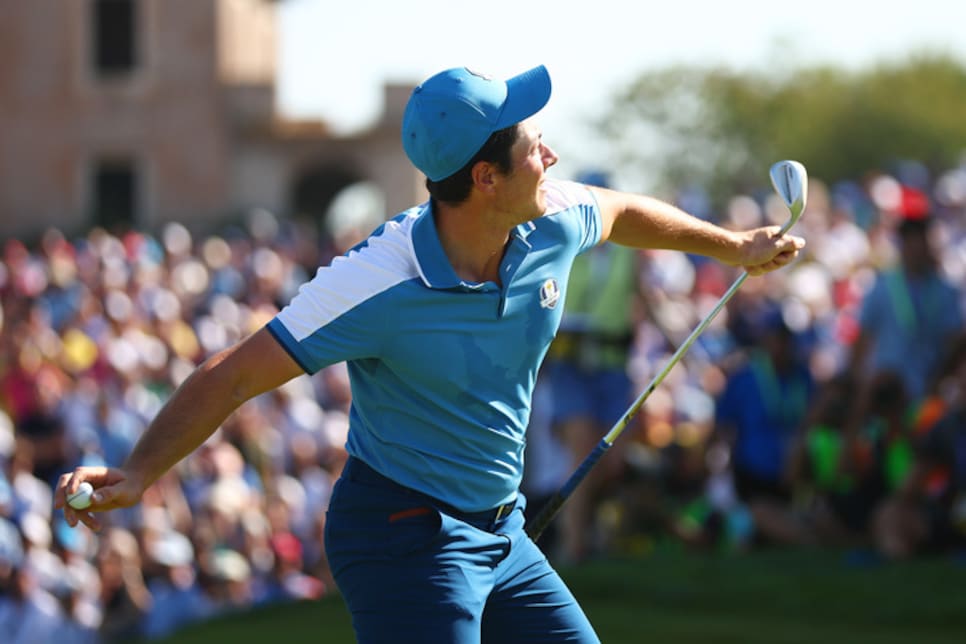
Viktor Hovland throws a ball to the crowd at the 2023 Ryder Cup. Can whoever caught it prove the authenticity?
The PGA first tested out this idea at this year’s PGA Championship at Quail Hollow. On the Friday, leading by four shots, Jhonattan Vegas sprayed his tee shot to the right and the ball hit a bunker rake on the par-3 17th hole. The ball careened off the rake across the green and cosied up to the cup.
“That was a pivotal moment,” Hart says. “We went and got the rake and took it out of play. What if he wins?”
Vegas finished fifth, and the rake sold for $440 (A$670). “But it was important to have people there to authenticate it and eyewitness it, even if it was just preserving history,” Hart says. The PGA Championship also featured two significant holes-in-one. Eric Cole had his first on tour and Si Woo Kim had the longest in major championship history at 252 yards (230m). The PGA of America authenticated the flags and cups from these moments and took them out of play after they happened, then gifted the flags to each player.
OTHER NEWS: The most nerve-wracking thing Charley Hull encountered when invited to Windsor Castle
While there could certainly be rakes—or grandstands or fans—that get hit by errant shots at Bethpage Black, most of what gets authenticated will fall into the category of memorabilia, not a collectible that could potentially increase in value.
https://twitter.com/GolfChannel/status/1923449465362379109
Hart says Major League Baseball is the model for what the PGA of America is trying to start. Brandon Steiner, founder of Steiner Collectibles, built a collectibles empire on authenticating everything that could be authenticated. In 2009, he contracted with the New York Yankees to sell off as much of the old Yankees Stadium as possible, from seats and signage to the dirt and grass from the field. Some things had value; other things were mementos. Everything was authenticated.
The gambit also raises a bigger question for golf enthusiasts: What is the state of the golf collectible market today?
“The market is the best it’s ever been but it skews much older,” Carey says. “The collectors are older and they’re collecting the greats of the game. It’s not yet been done much for the next generation.”
Carey can list many reasons why golf has lagged other major sports in authenticating collectibles. Golfers are independent contractors who use their own clubs and take them home when they’re done. Each tour event is run by a different organisation at a different location. Although the PGA Tour is the governing body, it is not the “central voice or authority when it comes to collecting,” Carey says.
Carey sees what the PGA is doing as integral to making today’s fans into tomorrow’s collectors. The boys and girls who covet a signed flag or hat are the ones who might one day look to buy the club that plays an outsized role in this year’s Ryder Cup victory.
There is also the prospect that some of these items could be worth considerable money someday. And that’s where the PGA of America’s authentication project stands to benefit an entire industry far into the future.
“If you’re going to spend $5,000 (A$7,625), $10,000 (A$15,250), $100,000 (A$152,500) on something, to have as many levels of authenticity as you can counts,” said Mark Zablow, founder of Bleeker Trading in New York, which buys and sells sports collectibles. “There really is no insurance and no guarantee that it’s real.”
Simply, the 2025 Ryder Cup is a step toward growing the golf collectibles market. “I’d love to raise hundreds of thousands of dollars for our foundation, but it’s very unpredictable,” Hart says. “We’ll definitely be authenticating hole flags and bleacher flags. But who knows what else might be available?”
Hart says there is a very good chance they will be auctioning at least one of the vice captain’s carts. One thing is for certain. Any item closely associated with whichever side wins will fetch a premium, and one day collectors will want to make sure it’s the real thing.