One of Australia’s best golfers, Rachel Hetherington’s playing career spanned a remarkable era in the women’s professional game. She gave it everything. Now her life is being lived as she’s choosing.
Rachel Hetherington plays golf now and then. Mostly she plays a few holes with teenage daughter Annie, who is keen on the game. Sometimes she caddies. When she does, she tries to let Annie learn for herself. Hetherington is also a busy lawyer working for a Federal MP and someone who prioritises time to visit her elderly mum, from whom she gets her determination.
It’s a different life now from being one of Australia’s greatest players, with a record that still holds her in high stead. On the list of all-time LPGA wins by Australians, we see in order major winners Karrie Webb (41 times), Jan Stephenson (16), Minjee Lee (10) and Hannah Green (eight). Tied with Green, Rachel Hetherington.
Hetherington’s eight titles on the LPGA came between 1998 and 2003, mostly by close margins ranging from playoff to either one or two strokes. In only one event – her last win, the 2003 Wegmans Rochester LPGA – did she win more comfortably, defeating Lorena Ochoa by four shots.
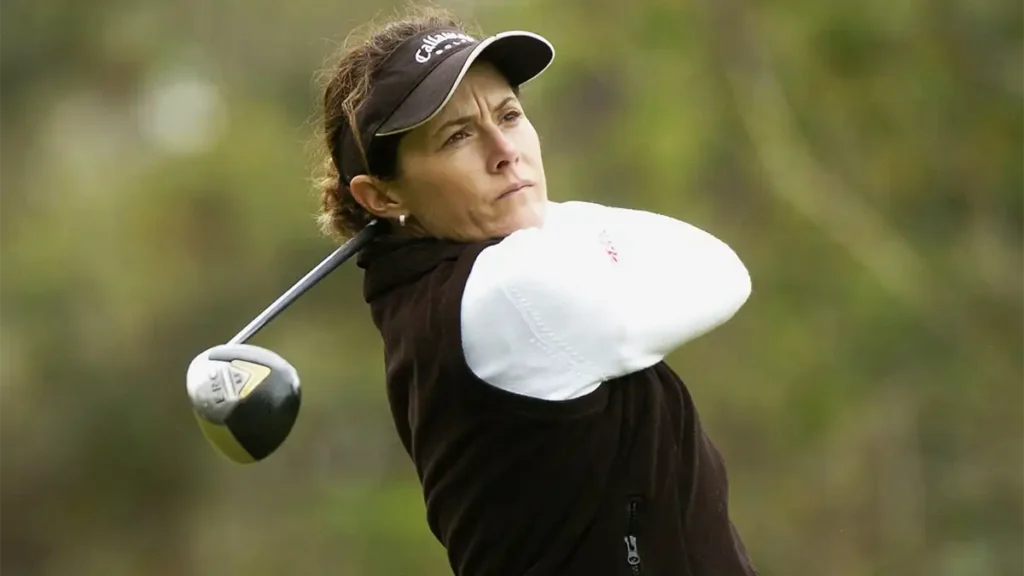
There’s a school of thought that greatness is defined not just by how many times you win but by who defeats you or whom you defeat. Ochoa, for example, would go on to be a World Golf Hall of Famer after a career that included a record consecutive 158 weeks as world No.1. Then there’s this: Hetherington’s first win, the First Union Betsy King Classic in 1998, was a playoff against Annika Sorenstam, the Swede’s first playoff loss.
Hetherington’s fifth win, another playoff, saw her best Sorenstam again. As did her seventh. So, yes, you read that right. Our Rach defeated one of the game’s finest ever in Annika Sorenstam in playoffs. Three times. And one of them on the third extra hole.
Sorenstam herself is a World Golf Hall Of Fame member and was officially world No.1 between 2006 (when official ranking finally began) and 2007. She was unofficially the world’s best for some time before that.
Hetherington hit No.6 on the unofficial world ranking in July 2003. Not bad, huh, to be that high on a rating that included not just Sorenstam but Webb, Se Ri Pak and Laura Davies. How does she see herself among those wonderful players?
“It was great to be in the hunt and to play in that era with those players,” Hetherington says with the quiet modesty for which she is renowned.
It wasn’t just grit in playoffs that sums up her career. Consistency and mental strength were also assets.
“I think my mental game was something that helped me win so many times against Annika in the playoffs.”
Hetherington’s record in majors is outstanding. Between 2002 and 2006 inclusive, she did not miss a cut in majors. Notably, she tied for second twice (the 2001 Kraft Nabisco Championship and the 2004 Women’s British Open). She also shared third at the 2003 LPGA Championship and tied for eighth at the 2006 US Women’s Open.
Of course there’s more, much more. Winning back-to-back twice (in 1999 and 2003). Three wins in Europe, one of them the 2001 Evian Masters (later promoted to major status itself). And her three seconds in the Women’s Australian Open – to Sorenstam in 1994 (Sorenstam’s first pro win), to Webb in 2000 (Webb’s first Australian Open) and to Davies in 2004 (also Davies’ first Australian Open).
“I’m definitely disappointed I didn’t win one of those,” Hetherington says. “You’re there to win, so to not win is a disappointment. But again, in that era of players you had to have all guns blazing to be able to win.”
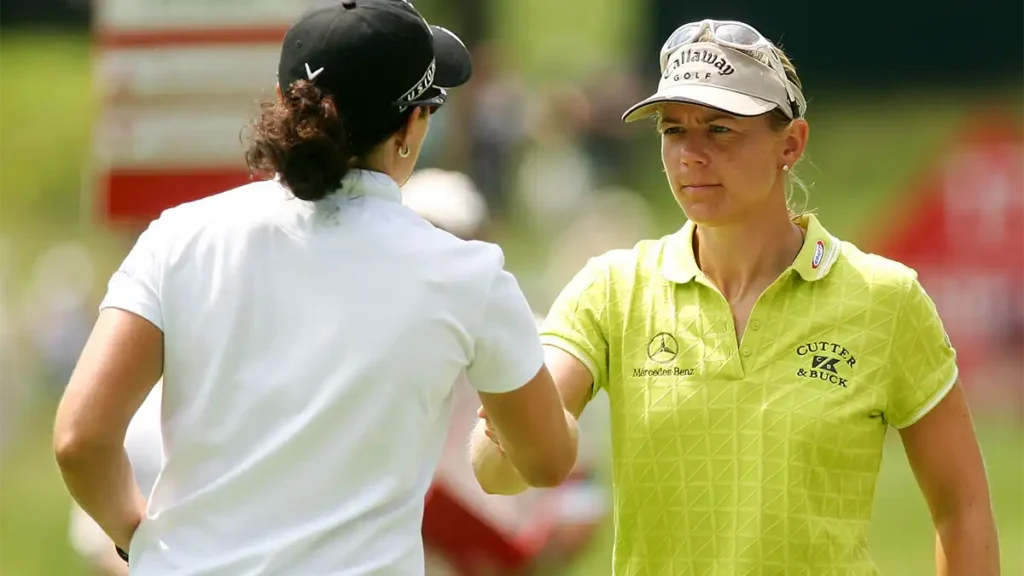
No more was that evident than in the 2000 Australian Open at Yarra Yarra. In the final round, overnight leader Webb and Hetherington went head-to-head over the back nine, Hetherington shooting 29 and Webb 30. Seven birdies for Hetherington, including six in a row from holes 13-18 (several of them 10-metre putts or longer), were matched on that nine by five birdies from Webb and a brilliant eagle chip-in from a swale behind the 16th green to win by three.
Speaking of it later, Webb said: “Rach and I grew up playing together and we’re good friends, but we both wanted to win as badly as each other, so I wasn’t taking my foot off the pedal because we were mates and she wasn’t either. One of my great memories of the Opens is that duel with her.”
Hetherington’s own recollection: “It wasn’t until we signed the scorecard that I realised how good it was. It was brilliant. That’s why you want to play, to be in the battle, in the heat and pulling off shots that we did.”
Later that year she and Webb combined to win the inaugural Women’s World Cup of Golf, coming from six shots behind at the third hole of the final day to win by three from… Annika and Charlotta Sorenstam.
“That was great,” Hetherington says. “Both Karrie and I were very happy to beat them. They’re both very competitive, Annika in particular.”
THE NEXT PHASE
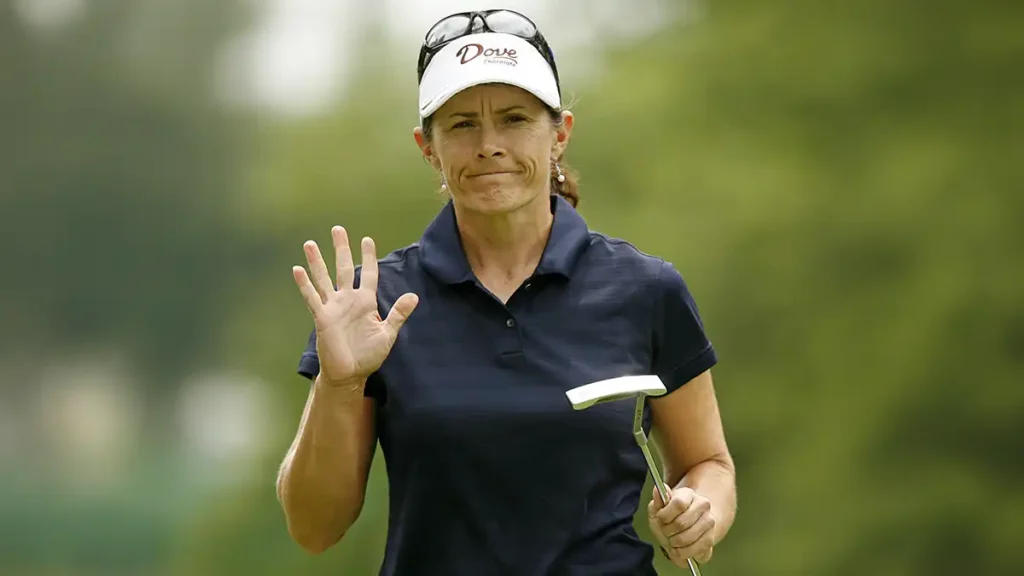
It all came to an end in 2010 after a severe ankle injury put Hetherington on the sidelines.
“While I was rehabbing, I realised I wasn’t really missing tour life,” she says. “So I made the decision that I wasn’t prepared to give it 110 percent anymore and that I would step away from playing full-time.”
Retiring does not come easily for many athletes. In recent years there has been more emphasis on athlete wellbeing, but in 2010 there wasn’t yet much understanding, let alone support.
“As an athlete you never know when you’ll retire and most of us are not sure what we’ll do when we do. It’s never an easy decision,” Hetherington says.
“I felt it was really important to build some skills outside golf. My experience through junior, amateur and professional golf and then retirement is that you are seen as a ‘golfer’ and the golf industry continues to label you as a golfer with golf skills. What isn’t celebrated is the range of skills that golf helps you accrue. So, for me, it was learning additional skills.”
She also wanted to give back in some way. But first, the arrival of Annie and the joy of motherhood.
After that, Hetherington opened a driving range with husband and former Test cricketer Greg Ritchie, with an emphasis on passing her skills not just of playing but of time and course management to new golfers, both juniors and adults and especially women.
“I felt there were messages and teaching I could convey and I loved sharing the wonderful attributes of golf with people,” she says.
During this time Hetherington barely hit a ball. But she did serve on the board of the ALPG (now WPGA Tour of Australasia) for a time and returned to tournament play briefly in 2015 and 2016, playing a handful of domestic events before retirement loomed again. “It was always going to be temporary,” she says.

The recognition that she needed additional skills led her to law; firstly working for a law firm and then to completing a law degree in early 2024.
“I wanted to learn more about Australian sport, how it’s administered and why. My best subjects were constitutional law, corporations law and philosophy, which tie back into the management of sport here and generally.”
To that end, she directed one assessment paper to the Essendon Football Club drug saga and considerations of justice, injustice and the agency of young athletes in decision making that affects them.
“I felt it was very difficult for individual athletes because there were a lot of power plays above them that were out of their control. It’s a hard dynamic. When you’re young, all you’re focused on is doing your best for team, state or country.”
Hetherington’s interest in national organisations around sport is fuelled by a general interest in federal politics evolving over time since retirement. Her current role reflects that interest and also her sense of connecting and giving back.
“It’s interacting with charities, sporting organisations and the like,” she says. “I get to hear from the locals about what’s affecting them and work out avenues to support them. It’s community support – and sporting organisations are part of that community.”
Golf is still in her life, just not as before.
“I keep an eye out. Annie’s very interested in it. We followed a few holes on the last couple of days of the WPGA Championship. It was great to see Hannah play so well and dominate the Aussie events.”
Hetherington was happy to see the return in March of the standalone Women’s Australian Open.
“I’m a strong believer that men’s and women’s golf should be seen as their own independent sport,” she says. “There’s a clear difference in strength and the way we play. I think we’re doing a disservice to women’s golf to compare… Why be equal when we might get to a point where we’re better than the men!”
Hetherington has attempted and accomplished a lot of things in her life so far. Asked how she sees her life, she nominates “broad and varied”. She’s not wrong. From professional sport to family to law to… whatever’s next. It’s all underpinned by her ‘have a go’ life mantra. Take her first foray into the world of tour golf, for example. Structured pathways were not the order of the day back then. If you thought you had talent, you backed yourself and had a go.
“I wasn’t sure whether I was good enough to turn pro, or to go to Europe or the States. But each time, I just made a leap of faith.”
That first leap took place in 1994 when Hetherington turned pro. With support from a small group of members at her home club of Ipswich Golf Club, she then headed to her first LET event, the inaugural Evian Masters.
“I flew to Paris but didn’t speak French,” she recalls. “Changed money into francs, I’d never used francs before and stayed in a tiny hotel. I checked out the next day and they tried to charge for mini-bar and telephone when there was no mini-bar or phone in the room. Jumped on the Ring Road, never having driven on the other side of the road, couldn’t work out the maps or where to go… I eventually got there but it was all just having a go.”

That determination and resilience also served her well throughout her LPGA career, starting from the get-go.
“I remember my very first LPGA event. I played with a couple of experienced LPGA girls and they gave me a hard time for the first couple of holes, but I dug my heels in and thought, Well, I’ll show you.”
That she did. In that first season, 1997, she made 25 of 28 cuts (ranked fifth in that stat category) and was ranked top-10 in driving, ball-striking and rounds played, earning her the princely sum of $US138,175.
In a career littered with highlights, the standouts as Hetherington sees them are clear: “The Evian Masters I won. I actually went into that with a rib injury and didn’t know if I was going to play. I could only hit half shots during warm-up. So it was a good lesson in playing within yourself.
“The first event LPGA I won, that playoff against Annika, that’s very special. And one of my favourite events, the JC Penney (a mixed event of both the PGA and LPGA Tours). In 1998, it was the LPGA’s turn to invite the PGA players and I didn’t know any…”
After striking out with one, her sponsor Callaway suggested Rocco Mediate, also a Callaway player and a talented, charismatic one at that, later runner-up in an epic US Open playoff against Tiger Woods in 2008.
“He was brilliant. I cold-called him and he said, ‘What’s your name again?’ and that he’d ring me back, which he did. He was smoking cigars around the course. He hit the most magnificent 1-iron I’ve ever seen out of a bunker and he was just a fabulous, fabulous person to play with.”
They ultimately came second, holding the 54-hole lead before a record score by Meg Mallon and Steve Pate got the better of them.
What a ride. What a player. And yet, by some, underestimated. Should she be? No. Might it have been different if one or two of those close calls in majors or Aussie Opens had gone her way? Probably.
Hetherington herself says: “I never really felt people had underestimated me, I just felt fortunate to be part of that era. I can’t really complain.”
So here she is now. From divots to pivots. And still having a go. Unhappy feet, troubled with arthritis, are another reason for only playing nine holes.
“I rely on acupuncture and some chiropractic exercises a lot and lately it’s actually feeling a lot better. The past few days have been promising. It’s good not to have the pain. I’m starting to think I’d like to get back to 18 holes and maybe try to prepare for some senior events.”
Who wouldn’t like to see that? Of course, if she does, it would be just for the enjoyment and the thrill of being out there again. As her record shows, Rachel Hetherington was a quality competitor – as tenacious as they come – and winning mattered.
But that was then and this is now.
Photographs by getty images/jonathan ferrey, scott halleran, Al Messerschmidt, david cannon, hunter martin, andrew redington • courtesy of rachel hetherington