To avoid the word loyalist, I’ll just call myself a PGA Tour institutionalist. For decades, I’ve been genuinely enthused by the launch of the Tour Championship, the FedEx Cup, World Golf Championships, ShotLink and others, all substantive improvements to the tour’s competitive platform in their time.
MORE: 5 key questions that still need to be answered about PGA Tour changes
But in these last few dyspeptic years, filled with their various panic purses in response to the LIV threat, my attitude towards future tour changes became “whatever.” My interest in how the world’s premier tour would be built back up waned because I’d never gotten over how close it came to being torn down.
Of course, my job is to bring a clear-eyed energy to any subject of commentary. And I did care, which I couldn’t deny as the tour prepared to announce its new competitive framework—by far the most extensive in its history—in June at the Travelers Championship.
At first, I settled into an honestly felt but emotionally distant stance that drastic change was not needed. I would argue that LIV had not exposed a major weakness in the tour, it simply had what appeared to be unlimited money. The best measure of how the tour was doing pre-LIV was the chorus of players repeatedly thanking Tiger Woods for raising purses so much for 20 years. That view gained some deserved legs when, at last month’s U.S. Open, Rory McIlroy, referring to how the re-imaginers of the new proposal needed more time replace some of the tried and true, said: “I think, as they’ve done all this work, you start to realize that the way the tour was before LIV came along was actually pretty good.”
However, I had some deeper feelings that had been triggered by LIV’s attempted hostile takeover attempt beginning in 2022. I’m a romantic about pro golf. The history and the traditions and the courses, and especially the cavalcade of great players who’ve excelled at the challenge of controlling a little ball with a long stick over a vast expanse with randomness and caprice part of every outcome. Which has given golf its best calling card – the sport most like life.
A little sappy, I know, but I’ve come by my nostalgia honestly. My first contact with what would become the PGA Tour was as an 8-year-old at the 1962 Lucky International Open at Harding Park in San Francisco, where Arnold Palmer reached down through the foggy air with a bronzed forearm to hand me my first autograph. A few months later, on third-grade “career day,” I carried in my dad’s putter and wore an alpaca (probably mostly Orlon) cardigan with the sleeves pushed up like Arnold. Hedging that bet, I also put on my grandfather’s fedora with “Press” written on a card sticking out of the band.
I started to play, getting a sense of the competitive game following my dad during his friendly but hard-fought dollar nassaus at Harding, and on weekends watched the pros on TV. From broadcasts that showed only the final four holes at places like Doral, Westchester and Firestone, I could feel the game’s lonely challenge through the screen. I came to feel and still hold that a winning golfer – between the demands of self-control and artistry – is asked to show more grace under pressure than any other athlete.
To me, the PGA Tour represents its sport with as much stature and authority as the NFL, MLB and NBA represented theirs. The best against the best, everyone measured on a respected historical continuum – the most compelling part of big-time sports.
Unspoken in all this was an acceptance, epitomised at key moments by Palmer, that undermining the health of tour’s collective membership or its prominent stature in the game for selfish gain would violate a code. When LIV tempted so many to cross that line, the players had the choice to stand on loyalty and history and form a unified front that could have stopped the rebel tour cold. Instead, too many gave in to greed, either jumping to LIV or leveraging a stunned tour that was straining to hang on for more. Which would be standard behaviour in business. Admittedly naively, I hadn’t thought it would be in pro golf.
Bottom line, it seemed wrong to me that through outsized prizemoney and bonus programs, there had been so much reward as a result of so much betrayal. Pro golf lost some of its allure through the ordeal, whether temporarily or permanently is yet to be determined. For the first time, it left me disappointed and disillusioned by the tour’s players and for a time dulled my interest in what I was watching or what would happen to it.
Even as LIV’s threat lessened and basically disappeared when the Saudi Public Investment Fund announced it would pull its financial support after this year, traces of those feelings remained as I listened to PGA Tour CEO Brian Rolapp begin his presentation on the new proposals for 2028 at the Travelers. Very quickly, the 22-year-veteran of the NFL, credited as the chief architect and negotiator of the media rights deal that pays The League $US10 billion a year, went big, breaking down the proposed changes into distinct and well explained components. Rolapp was clear, steady, authoritative and organised.
The partial litany: a harder-edged meritocracy featuring a top layer of the best players in the game – the Championship Series – featuring 120-man fields with a cut for $US20 million purses under a more understandable point system to determine, empirically, the player of the year. The unknown there is how cooperative the top players will be in at least 18 of the 21 or 22 tournaments in the season so that sponsors and fans have confidence the fields are as elite as possible.
Below that, in the Challenger Series, another layer of proven players coldly shut out of the big show but with their own series of 144-man fields for $US4 million purse through which there is a pathway to the top tier. To be determined is how Challengers will resent the dramatic wealth gap.
Also, a return to more big markets, like Chicago, that haven’t had a presence in recent years. The buzziest proposal is a match play finale on a storied, sumptuous stage. And no sponsor exemptions on the top tier. About the only merciful respite from the most regimented meritocracy in the tour’s history is a “last chance” late fall series that will allow a final opportunity to earn back a spot on the elite Championship Series.
After 50 minutes on the stage, during which Rolapp answered 31 questions from the assembled media thoroughly and amiably, it occurred that if such a rollout had been executed in announcing the tour’s Framework Agreement with the PIF on June 6, 2023, instead rushing to a CNBC studio for a disjointed and awkward interview with Jay Monahan and Yassir Al-Rumayyan, how different recent golf history might be.
And during that time, I could sense my enthusiasm for the tour and pro game return. That the thing that had been nearly torn down was not only being put back together, but finally off to a genuinely renewed start. It was a just a press conference, but after such a long period of malaise and uncertainty, it felt like a moment.
If it proves to be, much credit must go to the Future Competition Committee, a group formed last August in one of Rolapp’s first acts. The model is the NFL’s Competition Committee, which has been making timely game-changing and product-improving rules changes to professional football since 1968.
It’s what golf has traditionally done very deliberately in the best of times, and too slowly as technological advancements in equipment have changed the elite competitive game at an ever-quickening pace. The most obvious example is the so far eight-year process without a result that has marked the USGA and R&A’s attempt to reign in distance in elite competition.
The nine-member committee was charged by Rolapp to take a “holistic relook” at the tour’s competitive structure and seek “significant and aggressive” rather than incremental change.
Five of the members are active players – Adam Scott, Patrick Cantlay, Keith Mitchell, Camilo Villegas and Maverick McNeally – giving their proposals a more grassroots perspective by taking advantage of years of collective ideas accumulated from informal bull player sessions in the locker room, practice rounds, et al. Unleashed in their wheelhouse, the players blue-skied and best-cased their way through more than 30 meetings on Zoom or in person.
The committee chairman is Woods, whose Darwinian ethos and “just play better” mantra imbue the main theme of the proposed changes. Important for Rolapp, who’s not of the golf world, is to have the ultimate golf guy. Whatever off-course issues Woods is going through, his golf cred is unimpeachable.
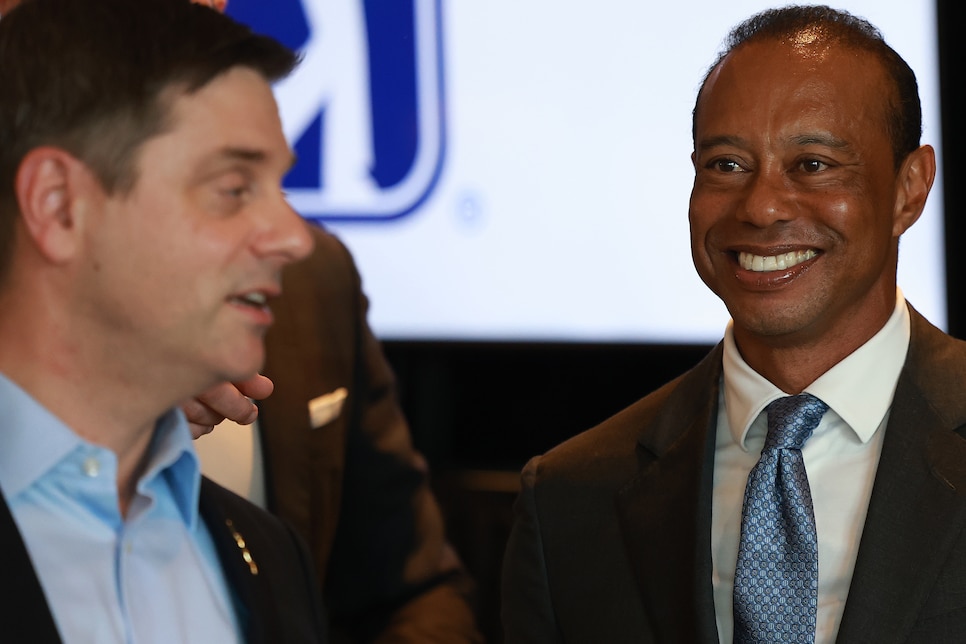
Tiger Woods appeared with PGA Tour CEO Brian Rolapp at the tour press conference on June 23. [Andrew Redington]
That Woods embraced the role was evidenced by his willingness to cold-start the Travelers press conference by dramatically walking to the podium, his first public appearance since he was arrested for DUI in March and underwent rehab in Switzerland. Woods spoke briefly, describing the committee’s work as a process of “honest, hard conversations, and thinking boldly about what is best for the game.” He then gave way to Rolapp, the atmosphere duly energised with a powerful and creative bit of stagecraft.
Joining the players were prominent businessmen Joe Gorder and John Henry in advisor roles, and perhaps the most intriguing member Theo Epstein, the innovative front office world champion with both Boston Red Sox and Chicago Cubs, Epstein was the author and public face of baseball’s transformative pitch clock. Golf eagerly awaits his outside-the- box ideas on pace of play.
All of the above comes with the caveat “to be determined.” There will be more changes, many details to attend to. The reality is that the next 18 months will be part holding pattern and part work in progress. Rolapp will present the next update from the FCC at the Tour Championship in August.
But in his biggest moment of leadership so far, Rolaap succeeded in making a convincing case that the tour has dedicated an intensified level of rigour to deconstruct every aspect of its competitive model and install a new one built to last.
One intended, without a doubt, to produce a product that will draw more fans, more dollars from media contracts, and more profits for the tour’s private equity part owners, Strategic Sports Group. It’s the world Rolapp knows best, but he has long emphasised that making the most money is dependent on putting the product first. As Rolapp told Fortune Magazine when he was negotiating media contracts for the NFL in 2015, “All the stuff we do is completely irrelevant if the game’s not good and pure.”
It’s a condition the tour is closer to now than when it was embattled with LIV. That was a crisis, one whose aftermath hasn’t completely passed. At this very moment, is the pro game as good as it used to be? No.
But is the PGA Tour on a path to be better in 2028 than it’s ever been? A very good case was made.