
There’s a sense of adventure when playing links courses than can’t be replicated elsewhere.
I was lucky. I played the game’s ultimate links, the Old Course at St Andrews, when I was only 16 years old. I arrived there having already read books about the Home of Golf. I so wanted to love the place and I didn’t leave disappointed. I shot 74 and was as happy as a teenage golf-nerd could be, despite the double-bogey I made at the 16th hole.
As ever, it depends on your point of view, but first in my imagination – and now in my memory – links golf has always been great. It is, after all, where it all began and evolved. Golf as we know it would maybe never have been invented if it hadn’t started where it did. Everything that is wonderful about the game is amplified on a links. The ball bounces and rolls after it lands, so there is variety in those extra dimensions. And it looks like God designed the turf for the sole purpose of hitting golf shots. It is perfect.
Modern golf has come a long way from its origins, of course. But one thing remains true: the game is still at its best when the ball is doing as much on the ground as it is in the air. And the randomness that follows when a shot meets the grass is golf at its very best. It is a great sadness to me that the same unpredictability is lost to those who play all their golf on a soft, parkland course. A lack of uncertainty makes the game less interesting, both to watch and play.

To me, there is a great joy to links golf that doesn’t always transfer to others, even those you are playing alongside. More senses are aroused on a links. Let’s say you hit what feels like a solid shot from an awkward lie. The ball lands where you wanted it to, say, 40 paces short of the green. The bounce takes it off a slope, from where the ball rolls through a narrow gap onto the putting surface. The innate satisfaction you get from such a scenario doesn’t quite transfer to your mates, even if they are impressed by the result. Only you know what really went on. It’s ‘user joy’ rather than ‘viewer joy’.
It’s a simple truth that links golf asks the most questions of golfers. Which takes us closer to why we all play the game in the first place. All of the great things about golf are highlighted by the seaside. It’s like playing snooker on a full-sized table versus playing pool in the pub. Equally, if parkland golf is listening to music on a CD, links golf is attending a Led Zeppelin concert. All are fun. But snooker asks you to learn so many more aspects of the game. And nothing beats great live music. Links golf is all of the above.
There are no rules about golf on a links. Every seaside course you visit is different. There is nothing wrong with a 230-yard par 4. Or a 240-yard par 3. Or total blind shots. Or deep bunkers. Or tiny bunkers. Variety and whatever works best with the terrain and prevailing conditions is the rule of thumb. Which takes us all back to when we were kids, hitting balls just for the fun of it. Links golf has that same sense of adventure.
Recreating the inherent challenges of links golf away from the seaside is possible, though. You can ask the same questions. Royal Melbourne does that. So does the National Golf Links of America on New York’s Long Island. And there are others. But recreating the total experience is impossible. Again, it’s the grass. Everyone who has ever felt like they have hit a perfect shot from links turf will know exactly what I mean. It is a unique sensation, one that not even Royal Melbourne can recreate.
Looking back, I have been enormously fortunate in that I have experienced so much links golf in the UK during my career, especially as an amateur. Before I turned professional, I played competitively at Royal St George’s, Muirfield, Turnberry and Lundin Links. It almost goes without saying that the top-end courses, those on the Open Championship rota, are all amazing. But all are inevitably a little bit sanitised, because the clubs have so much money to maintain their courses.
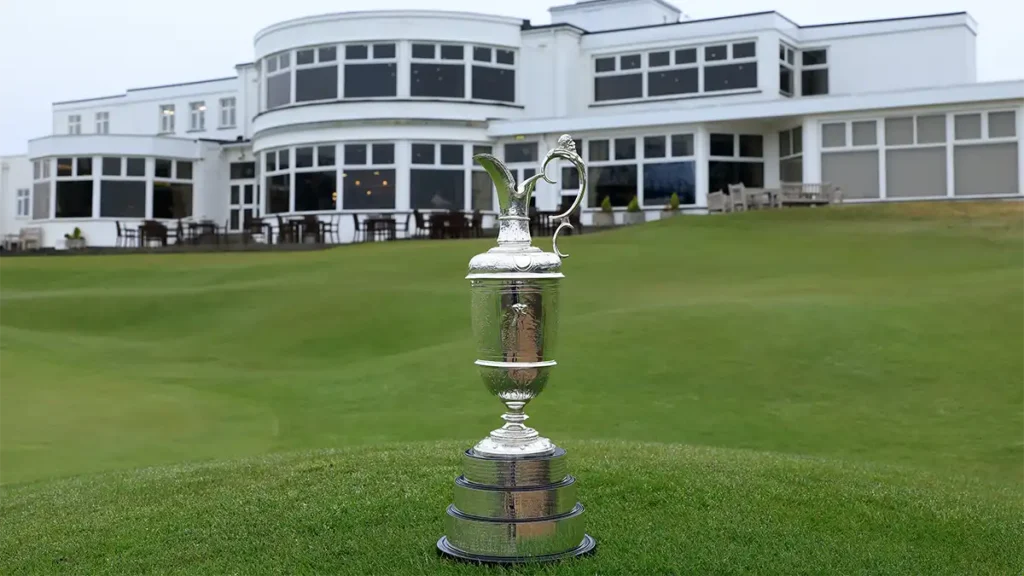
So it is that the courses one step down from the most famous venues can often be even more fun. They are a bit off the beaten path. The starter sends you off and you barely see another soul all day. They have maybe two greenkeepers. The local pub is walking distance from the 18th green.
There is so much quirk to be found at those places – and courses like Prestwick, North Berwick and Elie. Golf there is a bit outside the norm, a little bit weird. At Elie there is a periscope on the first tee so that you can see when it is time to hit. At North Berwick, the 13th green has a wall running alongside. And the last four holes at Prestwick are like nothing you will experience elsewhere on the planet.
On the fairways at a typical links there are green patches on the low bits and brown patches on the high bits. I’ve even seen clover out there. It’s a journey, an adventure that adds up to a succession of odd questions to which you have to find answers. You don’t even need to carry 14 clubs; half-a-dozen is typically enough. Because yardages are merely starting points. You will inevitably encounter shots where you could legitimately use any one of five or six clubs. So you naturally engage with your feel and imagination. You just have to figure it all out.
Then there is putting. Another great thing about links golf is the balance that exists in the relationship between the long game and short game. Yes, hitting almost-unique shots is perhaps the best part of playing by the shore, but the same principles often apply to putting. Imagination is such a big part of the equation. If golf on the pro tours is too often a long-driving and putting contest, links golf neutralises that relatively one-dimensional approach. It is in all the other parts of the game where you will find most of your fun.
Which brings me to my last point: if you don’t enjoy any or all of the above after just a few rounds on links courses, then I’m sorry – you don’t really like golf.
Photographs by Getty Images/daVid cannon