WHAT YOU NEED TO KNOW: Odyssey’s biggest hits have tended to check the same boxes: alignment that resonates, groundbreaking inserts, a price in the heart of the current putter market and tour usage that sends amateurs into shops asking for it by name.
The Rossie had Nick Faldo’s 1996 Masters win. The 2-Ball became the default mallet for a generation of weekend players. The No.7 and Jailbird still account for the bulk of the company’s tour count.
RELATED: Odyssey 1/2 Ball: A bold new alignment putter for 2026
The TRTL (say it “turtle”) is Odyssey’s bid to crack that list, and the company isn’t being modest about it. “We feel like there’s room for a fifth head on Mount Rushmore,” said Luke Williams, Odyssey’s senior director of product and brand management. That’s a lot to hang on a mid-mallet that started as a sketch from a product designer in Japan.
The early numbers, however, make it harder to wave off as launch-day bravado.
Since Odyssey got meaningful quantities into tour vans the first week of August, the TRTL has been the company’s most-played model on tour, ahead of every Rossie, 2-Ball, Jailbird and No.7 variant still floating around at the highest level of professional golf.

Given how many generations of those shapes remain in play, that’s no small feat for a putter that isn’t even at retail yet. Min Woo Lee and recent LPGA Tour winner Yuna Nishimura are among those who’ve put it in play, along with a handful of players who aren’t on Odyssey’s staff.
“If you think of how many generations there are of each of those models that are still out there in play, getting a new model to get this hot this early is really a testament to what we think is an exciting future for this product,” Williams said.
The commercial side has moved just as fast abroad. Japan got a head start on the launch in August, and after three days of sales the four TRTL models were the four best-selling putters in the country. Seven weeks later they’re still going strong, pushing Odyssey’s market share there back over 50 percent.
PRICE/AVAILABILITY: The range will be available at retail from Friday, October 30, across four models: Slant Neck (S), Double Bend (DB), Crank Hosel (CH) and Max S2S. The TRTL Crank Hosel (CH), Double Bend (DB) and Slant Neck (S) models will retail for $549.99 and $649.99 NZD. The TRTL Max Square 2 Square and TRTL Max Cruiser Double Bend (DB) models will be priced at $649.99 and $749.99 NZD.
3 Cool Things

1. Mass in the corners, not the middle. The concept came from a sketch by Ashino, a product designer on Odyssey’s Japan team, and the logic behind it was straightforward. “It takes weight out of the middle, puts it out on the four corners, which maximises MOI,” said Eric Steuben, Odyssey’s head of R&D. The MOI (moment of inertia, or the head’s resistance to twisting on off-centre strikes) is the number nearly every club category chases, and putters are no exception.
Getting from sketch to production took about 18 months. Steuben said the first rendering was far more angular and borrowed its face profile from the No.7. The crown shell also sat pulled back from the face, so the team moved it forward to let the sight line run all the way to the leading edge. They softened the edges, a nod to where mallet design is trending, and relocated the weight from the outside of the head to underneath it.
The materials do the rest. The body is steel finished in black PVD, the green shell is lightweight ABS and the sole is aerospace-grade aluminium. Lighter mass in the middle means more mass available for the perimeter.
Alignment also received its own development track. Odyssey cycled through so many versions that Williams called the alignment work “almost a whole separate project.” The finished Twin Track system runs long, unbroken lines across the green crown, aimed at golfers who prefer a continuous line over a dot or short sight line. The reworked rake and camber on the sole are designed to let the head settle flat and square the moment it’s set behind the ball.
The TRTL Max is about 6 percent bigger than the standard TRTL with roughly 20 percent more MOI. It’s also the only Square 2 Square (zero-torque) model in the lineup, and the reasoning is simple: The zero-torque putters that have caught on so far have been oversized, max-MOI designs, so Odyssey built it big on purpose.
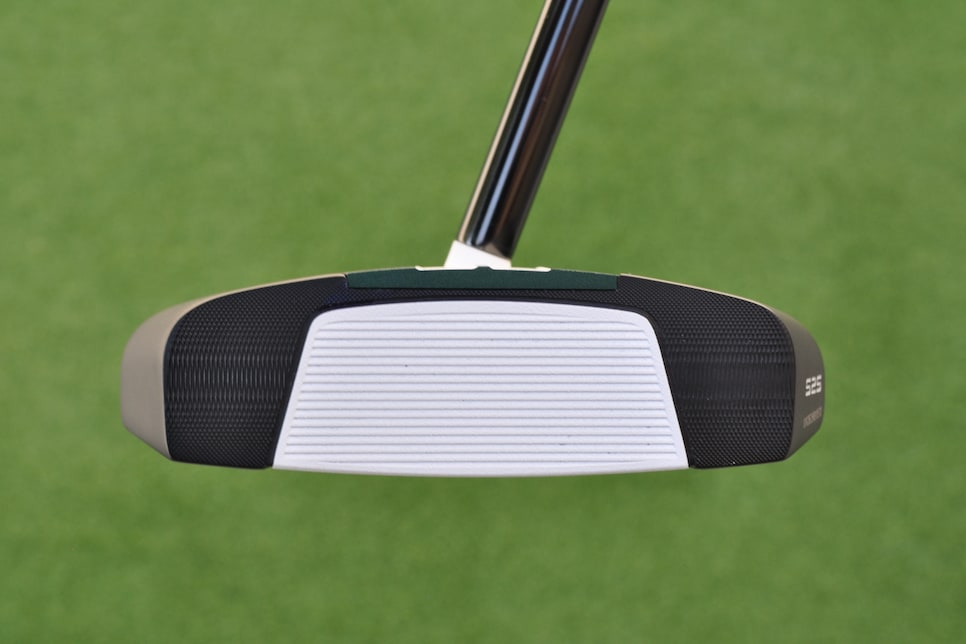
2. Walking back last year’s softness. Every putter insert is a trade-off between speed and spin. “There’s only so much energy you can put in a golf ball,” Steuben said, “and it’s either going to translate [to] speed, or it’s going to rotate.”
With last year’s Ai-Dual, Odyssey leaned towards forward roll and gave up some speed off the face to get it. The roll improved, but the early feedback, according to Steuben, was that the insert felt “a little bit too soft.”
Ai-Star swings back the other way. It’s a dual-layer build similar to the original Ai-One, with an aluminium backer behind a firmer urethane striking surface, and it’s thinner in the heel and toe to prop up ball speed on mishits. Odyssey defines its sweet spot as any point on the face that produces ball speed within 1 percent of a centre strike, and Steuben said the second pass at the Ai-One recipe performed noticeably better than the first.
Why chase speed over roll? Odyssey’s research, which combined robot and player testing across multiple putters and distances, pinned roughly 87 percent of a putt’s total distance on initial ball speed. Roll accounted for about 7 to 8 percent, with launch angle covering the rest. Put another way, if your speed varies across the face, topspin can only do so much to save your lag putting.
“We really want to get back to what we believe in and what we do best,” Steuben said, “and that’s emphasising speed and speed consistency, just to give some more forgiveness on mishits.”
The new insert is also quicker off the face on centre strikes, pushing its impact ratio (ball speed divided by putter-head speed, essentially smash factor for putters) back up near Ai-One territory. A deeper, more aggressive forward roll design groove pattern with a 19-degree slope is there to keep the roll from disappearing entirely.
Min Woo Lee, the first tour player to game the TRTL, put the trade-off in player terms.
“It’s a bit harder than the Microhinge insert that I used to use,” Lee said. “My tendency is to miss a little bit short, so I thought [I’d] have a bit more pop.”
For a putter named after a turtle, it’s a surprisingly quick ride off the face.
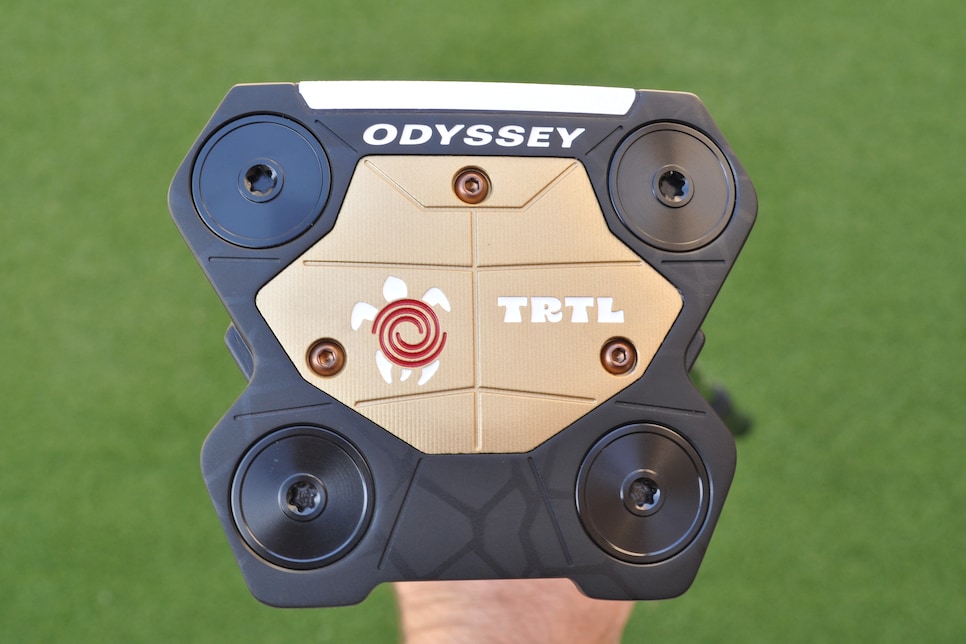
3. Four weights instead of two. Adjustable weighting is nothing new in premium putters, but nearly every model uses two ports (heel and toe). The TRTL has four, one in each corner, which lets a fitter shift the CG front to back as well as heel to toe and tune how much toe hang the head has. Williams calls it “the fine dial,” the last adjustment after hosel, length, loft, lie and grip are sorted. Weight kits are sold separately for golfers who want to go further.
Lee is the case study. He liked how the TRTL looked and felt from the start, but after some fitting time with Quintic data, he landed in a double-bend version with the weights moved towards the heel. Paul Hurrion, the inventor of Quintic and now on Odyssey’s staff, has been working with the four-port setup on the DP World Tour, where Williams said it gives fitters “another little lever to pull” when dialing in a player.
The results have held up. Lee debuted the putter at Pebble Beach and, by his own recollection, ranked second in the field in putting that week. “I think it might have been one or two [weeks] in my career of how good I putted,” Lee said. He followed with a strong showing at Bay Hill. More telling, for a player with a reputation as a serial putter switcher, the TRTL has stayed in the bag all season.
What Odyssey doesn’t have yet is a playbook. Steuben acknowledged the company is still working to “develop a point of view on what these weights do as rules of thumb,” which makes the four ports a fitter’s tool more than a self-serve one.
If you’re planning to dial it in at home with a wrench and a hunch, a putter fitting will get you there a lot faster.